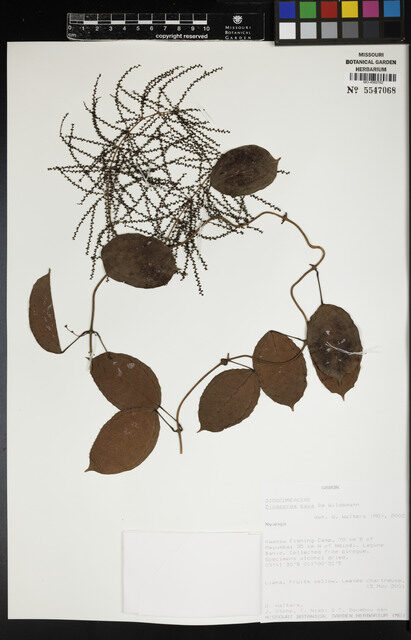
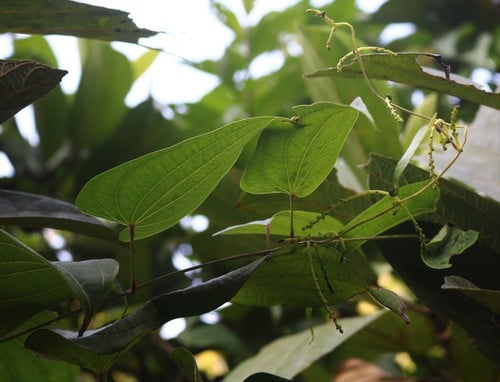
Dioscorea mangenotiana
J. Miege
gbif· cc-by-sa
Saint Fédriche NDZAI
gbif· cc-by-sa
Saint Fédriche NDZAI
gbif· cc-by-sa
Saint Fédriche NDZAI
Description
A yam. A vine with a very long vine. There are short spines on the stems. The tuber keeps developing from year to year. They develop new lobes around the sides. The vines can be 30 m long. They twine right-handed. The tubers are very large.
Edible Uses
The recent growth of the tuber is cooked and eaten; the old main tuber is too woody for consumption.
Traditional Uses
It is the recent growth that is eaten. The old main tuber is too woody. The tuber is cooked and eaten.
This uses section is brief — help expand it
Known Hazards
Plants will not grow easily from smaller sections of the tuber.
Distribution
It is a tropical plant. It grows in forest and woodland.
Where It Grows
Africa, Cameroon, Central Africa, Central African Republic, CAR, Congo DR, Congo R, Côte d'Ivoire, Guinea, Guinée, Guinea-Bissau, Ivory Coast, Liberia, Nigeria, West Africa,
Cultivation
Plants will not grow easily from smaller sections of the tuber.
Propagation
Seed - The tuber is not amenable to multiplication and replanting for the plant will grow only from the whole or most of the tuber.
Production
A tuber can weigh 60 kg.
Also Known As
Ba, Ba'a, Egeu, Esusu, Inhame, Suiduo, Toba, Tumba
References (11)
- Billong Fils, P. E., et al, 2020, Ethnobotanical survey of wild edible plants used by Baka people in southeastern Cameroon. Journal or Ethnobiology and Ethnomedicine. 16:64 p 7
- Bongers, F. et al (Eds), Forest Climbing Plants of West Africa: Diversity, Ecology and Management. CABI
- Burkill, H. M., 1985, The useful plants of west tropical Africa, Vol. 1. Kew. http://www.aluka.org/
- Fern, K., 2012, Tropical Species Database http://theferns.info/tropical/
- Guil-Guerrero, J. L., et al, Edible Wild Plants. in Recent Progress in Medicinal Plants Vol. 8 Sci. Tech publishing, Texas
Show all 11 references Hide references
- INFOODSUpdatedFGU-list.xls
- Terashima, H., & Ichikawa, M., 2003, A comparative ethnobotany of the Mbuti and Efe hunter-gatherers in the Ituri Forest, Democratic Republic of Congo. African Study Monographs, 24 (1, 2): 1-168, March 2003
- Nkeoua, G. & Boundzanga, G. C., 1999, Donnees sur les produits forestieres non ligneux en Republique du Congo. FAO. p 25
- Sato, H., 2001, The potential of edible wild yams and yam-like plants as a staple food resource in the African Tropical Rain Forest. African Study Monographs Suppl. 26:123-134
- Yasuoka, H., 2006, Long-Term Foraging Expeditions (Molongo) among the Baka Hunter-Gatherers in the Northwestern Congo Basin, with Special Reference to the "Wild Yam Question". Human Ecology, Vol. 34, No. 2, April 2006, pp 275 ff
- Yasuoka, H., 2009, Concentrated Distribution of Wild Yam Patches: Historical Ecology and the Subsistence of African Rainforest Hunter-Gatherers. Human Ecology 37:577-587