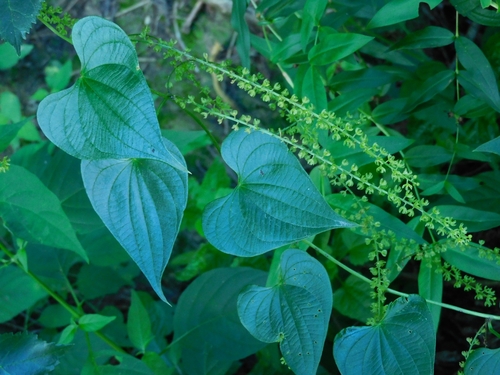
Dioscorea melanophyma
Prain and Burkill
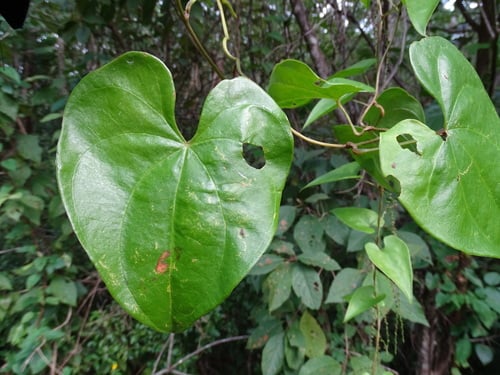
iNaturalist· cc-by-nc-sa
(c) mazus_jan, some rights reserved (CC BY-NC-SA), uploaded by mazus_jan
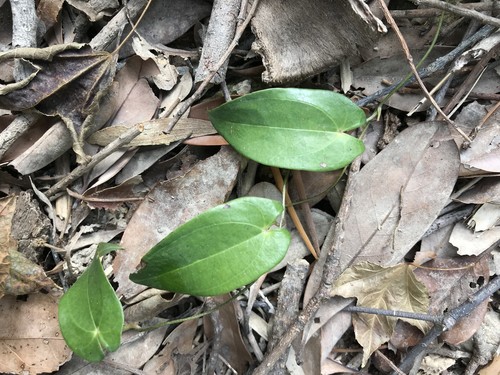
iNaturalist· cc-by-nc-sa
(c) mazus_jan, some rights reserved (CC BY-NC-SA), uploaded by mazus_jan
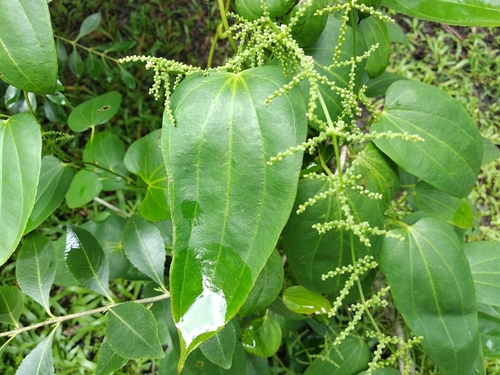
iNaturalist· cc-by-nc
(c) Aniruddha Singhamahapatra, some rights reserved (CC BY-NC), uploaded by Aniruddha Singhamahapatra
Description
A yam. It is a climbing plant. The stems twine clockwise. It has a fleshy round tuber. The tuber has roots. The leaves are alternate and have 3-5 leaflets. The leaflets are 4-14 cm long by 1-2.5 cm wide. They are narrowly sword shaped. It has black bulbils along the stem. The fruit is a capsule 1.5 cm long by 0.5 cm wide.
Edible Uses
The tuberous roots are thoroughly washed and boiled, then cooked as a vegetable in stir fries or as a boiled dish.
Traditional Uses
The tuberous roots are thoroughly washed, boiled and cooked as a vegetable. They are boiled or used in stir fries.
This uses section is brief — help expand it
Distribution
It is a subtropical plant. It grows in Uttar Pradesh in India between 1200-3000 m altitude. In southern China it grows on the edges of forests between 1,300-2,500 m above sea level.
Where It Grows
Asia, China, Himalayas, India, Nepal, Northeastern India, Pakistan, Sikkim, Tibet,
Notes
There are about 650 species of Dioscorea.
Synonyms
Also Known As
Ban-geithi, Ban gethi, Bon-zon-za-lu, Gethu, Hash, Huangshayue, Mag, y-Manghaii
References (9)
- Flora of Pakistan www.eFloras.org
- Jha, P. K., et al, 1996, Plant genetic resources of Nepal: A guide for plant breeders of agricultural, horticultural and forestry crops. Euphytica 87:189-210
- Ju, Y., et al, 2013, Eating from the wild: diversity of wild edible plants used by Tibetans in Shangri-la region, Yunnan, China, Journal of Ethnobiology and Ethno medicine 9:28
- Li, S., et al, 2020, Monpa, memory, and change: an ethnobotanical study of plant use in Mêdog County, South-east Tibet, China. Journal of Ethnobiology and Ethnomedicine. (2020) 16:5 p 17
- Murtem, G. & Chaudhrey, P., 2016, An ethnobotanical note on wild edible plants of Upper Eastern Himalaya, India. Brazilian Journal of Biological Sciences, 2016, v. 3, no. 5, p. 63-81 (As melanophylla)
Show all 9 references Hide references
- Negi, K.S., 1988, Some little known wild edible plants of U.P. Hills. J. Econ. Tax. Bot. Vol. 12 No. 2 pp 345-360
- Pandey, K. C. & Pande, N., 2016, Ethnobotanical Documentation of Wild Edible Plants used by Gujjar Community of Tarai West Forest Division Ramnagar, Nainital, India, Current World Environment. Vol. 11(3), 808-818
- Radha, B., et al, 2013, Wild Edible Plant Resources of the Lohba Range of Kedarnath Forestt Division (KFD), Garhwal Himalaya, India. Int. Res J. Biological Sci. Vol. 2 (11), 65-73
- Wild edible plants of Himachal Pradesh