Syzygium jambos
(L.) Alston
Rose apple, Jambos
iNaturalist· cc-by-nc
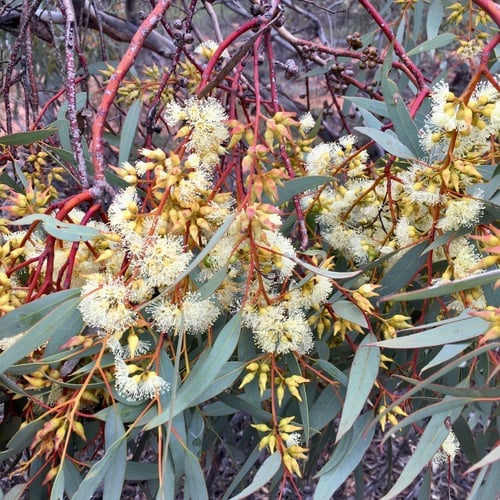
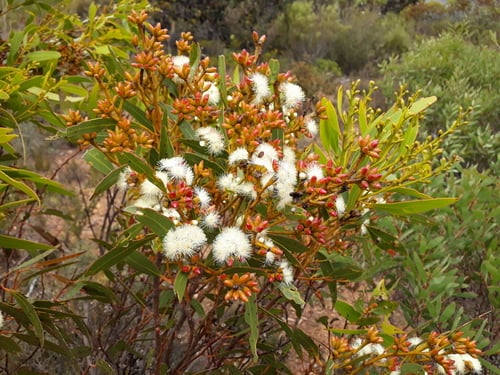
(c) 謝忠良, some rights reserved (CC BY-NC), uploaded by 謝忠良
iNaturalist· cc-by-nc
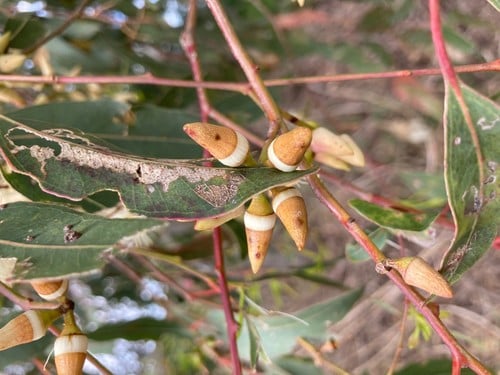
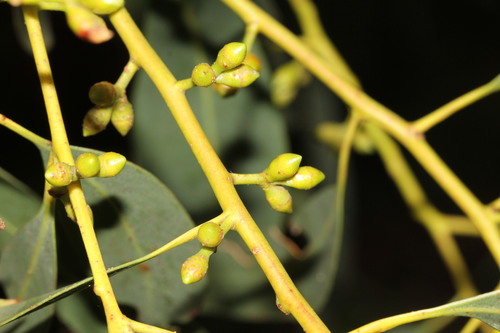
(c) Nate Martineau, some rights reserved (CC BY-NC), uploaded by Nate Martineau
iNaturalist· cc-by
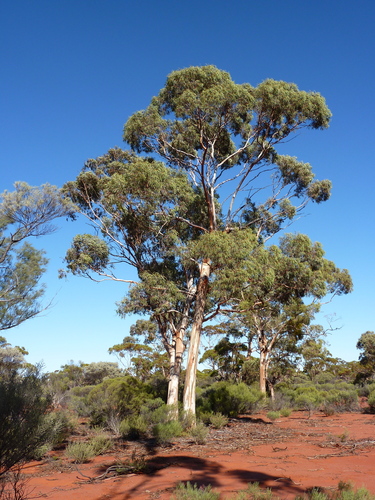
(c) mauroguanandi, some rights reserved (CC BY)
Summary
Source: WikipediaSyzygium jambos is a species of rose apple originating in Southeast Asia and occurring widely elsewhere, having been introduced as an ornamental and fruit tree.
Description
An evergreen tree. It grows up to 7.5-15 m tall and with a spread of 4 m. It can be a small shrub. The stem is erect and 20-40 cm across. The branches hang downwards. The bark is greyish-green. The young twigs are either flattened of somewhat square in cross section. The leaves are simple, thick and shiny. The leaves are narrow and pointed (10-20 cm long and 3-4 cm wide). They taper towards both ends. Young leaves are brownish red coloured. The leaves have 16-18 pairs of side veins which join near the edge of the leaf. The leaf stalk is 1 cm long. The flowers are large (4-5 cm) and greenish-white and fluffy. They occur in clusters at the ends of branches. The fruit is rose scented and apple like. They are dull yellow and tinged pink. Fruit are 4 cm across. The fruit have a distinct crown at the end. They contain 1 or 2 large seeds. The seeds are pale brown. The fruit is edible.
Edible Uses
The fruit is usually eaten raw but can also be stewed or made into jams, jellies and confections. It has a sweet flavour with a crisp, crunchy texture, is somewhat to very juicy, and carries a delicate rose-water fragrance. When cooked with custards or puddings it imparts a rose-like flavour. The large hollow seed cavity can be used to stuff the fruit before baking. The fruit, which measures up to 4cm x 6cm, bruises easily after harvest and must be handled carefully to preserve its crispness. Around the tropics it is mostly eaten fresh, particularly by children, and is seldom marketed commercially. At home it is sometimes stewed with sugar and served as dessert. The fruit can be distilled to produce a rosewater said to equal the best obtained from rose petals. The flowers can be eaten candied.
Traditional Uses
The fruit are eaten raw. They are poor as a dessert fruit but because of the sweet rose smell are often crystallised and used in sweets. They can be used for jams and jellies. (It is good to mix with other fruits as rose apple helps the jam to set.) The flowers are candied.
Medicinal Uses
Several parts of the tree serve as a tonic or diuretic. In India, the fruit is regarded as a tonic for the brain and liver, and an infusion of the fruit acts as a diuretic. A sweetened preparation of the flowers is believed to reduce fever. The seeds are used against diarrhoea, dysentery and catarrh. In Nicaragua, an infusion of roasted, powdered seeds is claimed to benefit diabetics. In Colombia, the seeds are said to have anaesthetic properties. A leaf decoction is applied to sore eyes and also serves as a diuretic, expectorant and treatment for rheumatism. The juice of macerated leaves is taken as a febrifuge. Powdered leaves have been applied to the bodies of smallpox patients for their cooling effect. The bark contains 7–12.4% tannin and is astringent, emetic and cathartic; a decoction is used to relieve asthma, bronchitis and hoarseness. In Cuba, the root is regarded as an effective remedy for epilepsy.
Known Hazards
The seeds are said to be poisonous. An unknown amount of hydrocyanic acid has been reported in the roots, stems and leaves. An alkaloid, jambosine, has been found in the bark of the tree and of the roots, and the roots are considered poisonous.
Distribution
A tropical plant. It needs adequate moisture and suits the warm moist tropics. It can't stand waterlogging. It prefers a rich well composted soil but will do well on poorer soils. It does best in an open sunny position. It is drought and frost tender. It is often along stream banks. It does well near the sea shore. Young plants need shade and moisture but established trees can tolerate harder conditions. It probably grows up to about 1200 metres above sea level in equatorial regions but near the altitudinal and latitudinal limits it produces no fruit. Trees can grow on a variety of soils. A pH between 5.5 and 7 is recommended. In Nepal it grows between 600-1400 m altitude. It suits hardiness zones 10-12. In Sichuan and Yunnan.
Where It Grows
Africa, Andamans, Angola, Asia, Australia, Bangladesh, Belize, Bolivia, Brazil, Cambodia, Cameroon, Cape Verde, Central Africa, Central African Republic, CAR, Central America, China, Colombia, Congo DR, Cook Islands, Costa Rica, Cuba, Dominican Republic, East Africa, East Timor, Easter island, Ecuador, El Salvador, Fiji, FSM, Ghana, Guatemala, Guiana, Guianas, Guinea, Guinea-Bissau, Guyana, Haiti, Hawaii, Himalayas, Honduras, India, Indochina, Indonesia, Jamaica, Japan, Laos, Madagascar, Malawi, Malaysia, Maldives, Marquesas, Mexico, Micronesia, Mozambique, Myanmar, Nepal, New Caledonia, Nicaragua, North America, Northeastern India, Jamaica, Kenya, Pacific, Pakistan, Panama, Papua New Guinea, PNG, Peru, Philippines, Pohnpei, Puerto Rico, Reunion, Rotuma, Samoa, Sao Tome and Principe, SE Asia*, Sierra Leone, Solomon Islands, Somalia, South Africa, Southern Africa, South America, Sri Lanka, St Helena, Suriname, Taiwan, Tanzania, Thailand, Timor-Leste, Tonga, Trinidad-Tobago, Uganda, USA, Vanuatu, Venezuela, Vietnam, Virgin Islands, West Africa, West Indies, Zimbabwe,
Cultivation
Plants can be grown from seed. Seeds germinate well and have no dormancy. Seeds often give rise to more than one seedling. These can be carefully separated when young. As fruit quality varies it is best to preserve better kinds of trees using vegetative propagation methods. Plants can be grafted or budded if needed. Cuttings root fairly easily in sand. Tip cuttings are suitable. Trees need to be 6-8 metres apart. It can be grown as a hedge.
Propagation
Seeds have very short viability and no dormancy, generally germinating well within 10–120 days if sown fresh. Surface sow in a shady position, firming gently into the soil, and water carefully to avoid washing the seed away. A single seed often gives rise to 3–8 seedlings, most of which are true to type. Young plants transplant poorly, so should be potted into individual containers as soon as they are large enough to handle and before the roots have developed significantly. Young plants require some shade. Air layering is also a suitable propagation method.
Other Uses
Distillation of the leaves yields a yellow essential oil important in the perfume industry, containing among other compounds 26.84% dl-a-pinene and 23.84% l-limonene. The bark contains 7% tannin on a dry weight basis and is used locally for tanning and dyeing; it also yields a brown dye. The flexible branches split easily and are valued for making wattle, hoops for large sugar casks and woven baskets. The heartwood is dark red or brown and the sapwood white; the wood is straight and close-grained, medium-heavy to heavy and strong. It is not durable in the ground and is prone to attack by dry wood termites. Though usually too small for many purposes, it is used for fence posts, plant stakes and similar applications; larger pieces are made into furniture, wheel spokes, chair arms, boat knees, construction beams, frames for musical instruments such as violins and guitars, and packing cases. It is also popular for general turnery and makes an excellent fuel and charcoal. If severely pruned when young, plants become very dense and form an effective windbreak hedge. The dense root system is useful for stabilising soils on riverbanks, though the dense canopy can prevent understorey plant growth and lead to sheet erosion unless the crown is thinned. Bees produce a heavy, consistent flow of amber honey from the flowers.
Production
Trees grow slowly. They start bearing when 4-5 years old. Fruiting is normally seasonal but over a long season. In the northern hemisphere it flowers from April to May and fruit ripen July to August. A tree can produce 400 fruit is a season.
Other Information
Not widely grown or used in Papua New Guinea. In Asia it is cultivated for its edible fruit. Thailand produces about 70,000 tons each year.
Notes
It has anticancer properties.
Nutrition
| Part | Moisture | kJ | kcal | Protein | Vit A | Vit C | Iron | Zinc |
|---|---|---|---|---|---|---|---|---|
| Fruit | 80.4 | 105 | 25 | 0.6 | 34 | 27 | 0.1 | 0.1 |
Synonyms
Also Known As
Apeltik, Apolsikisik, Chieng, Chom pu nam, Chom pu, Chomphu-namdokmai, Chumpu sa, Farang nam, Gioi, Golabjamli, Golap jam, Golapi jamu, Gulaab jaam, Gulab jamun, Gulabjamb, Gulap jam, Hnin-thi-pin, Jambavam, Jambo-branco, Jambu bulu, Jambu desrana, Jambu kelampok, Jambi kraton, Jambu mawar, Jambuneereedu, Jamrul, Jamudolo, Jamun, Kavika ni vavalagi, Malabar-plum, Malakkachampa, Manomhom, Manzana rosa, Mirto del rio, Mjambosa, Mjamini, Pannerale, Pannirkoyya, Perunaval, Pomarrosa, Pommeroos, Rose-apple, Sambunaval, Seeni jambu, Tampoy, Thabu-thabye, Varotra, Veli jambu, Yambo, Yamu-panawa, Zama, Zamborozana
References (107)
- Abbiw, D.K., 1990, Useful Plants of Ghana. West African uses of wild and cultivated plants. Intermediate Technology Publications and the Royal Botanic Gardens, Kew. p 46
- Ali, R. M., et al, (Eds.), 2010, ASEAN Herbal and Medicinal Plants. Forestry research Institute Malaysia. p 67
- Ambasta, S.P. (Ed.), 2000, The Useful Plants of India. CSIR India. p 614
- Argent, G et al, nd, Manual of the Larger and More important non Dipterocarp Trees of Central Kalimantan Indonesia. Volume 2 Forest Research Institute, Samarinda, Indonesia. p 471
- Arora, R. K., 2014, Diversity in Underutilized Plant Species - An Asia-Pacific Perspective. Bioversity International. p 88
Show all 107 references Hide references
- Ashton, M. S., et al 1997, A Field Guide to the Common Trees and Shrubs of Sri Lanka. WHT Publications Ltd. pdf p 299
- Baishya, S. Kr., et al, 2013, Survey of Wild Edible Fruits of Dhubri District, Assam, India. Plant Archives Vol 13 (1): 155-158
- Barwick, M., 2004, Tropical and Subtropical Trees. A Worldwide Encyclopedic Guide. Thames and Hudson p 392
- Bianchini, F., Corbetta, F., and Pistoia, M., 1975, Fruits of the Earth. Cassell. p 168 (As Eugenia jambos)
- Blench, R., 2004, Fruits and Arboriculture in the Indo-Pacific Region. Indo-Pacific Prehistory Association Bulletin 24. (Taipei Papers Volume 2) p 40
- Bodkin, F., 1991, Encyclopedia Botanica. Cornstalk publishing, p 964
- Bonney, N., 2012, Edible Wild Native Plants for Southern Australia. p 110
- Borrell, O.W., 1989, An Annotated Checklist of the Flora of Kairiru Island, New Guinea. Marcellin College, Victoria Australia. p 114
- Brahma, S., et al, 2013, Wild edible fruits of Kokrajhar district of Assam, North-East India, Asian Journal of Plant Science and Research 3(6):95-100
- Bremness, L., 1994, Herbs. Collins Eyewitness Handbooks. Harper Collins. p 84
- Burkill, H. M., 1985, The useful plants of west tropical Africa, Vol. 4. Kew.
- Burkill, I.H., 1966, A Dictionary of the Economic Products of the Malay Peninsula. Ministry of Agriculture and Cooperatives, Kuala Lumpur, Malaysia. Vol 1 (A-H) p 985
- Chakraborty, S. & Chaturbedi, H. P., 2014, Some Wild Edible Fruits of Tripura- A Survey. Indian Journal of Applied research. (4) 9
- Chatterjee, A. S., 1997, Fruit Trees in Cambodian Home Gardens. Trainers' training manual. Home garden series No.3 p 35
- Chin, H.F., & Yong, H.S., 1996, Malaysian Fruits in Colour. Tropical press, Kuala Lumpur p 37
- Coronel, R.E., 1982, Fruit Collections in the Philippines. IBPGR Newsletter p 8
- Cundall, P., (ed.), 2004, Gardening Australia: flora: the gardener's bible. ABC Books. p 1392
- Das, S. and De, B., 2013, Evaluation of Angiotension I-Converting Enzyme (ACE) inhibitory potential of some underutilized indigenous fruits of West Bengal using an in vitro model. Fruits, Vol. 68:499-506
- Das, T. & Das, A. K., 2005, Inventorying plant biodiversity in homegardens: A case study in Barak Valley, Assam, North East India. CURRENT SCIENCE, VOL. 89, NO. 1, 10 JULY 2005
- Davis, S.D., Heywood, V.H., & Hamilton, A.C. (eds), 1994, Centres of plant Diversity. WWF. Vol 1 or 2. p 117
- Dharani, N., 2002, Field Guide to common Trees & Shrubs of East Africa. Struik. p 103 (As Eugenia jambos)
- Dobriyal, M. J. R. & Dobriyal, R., 2014, Non Wood Forest Produce an Option for Ethnic Food and Nutritional Security in India. Int. J. of Usuf. Mngt. 15(1):17-37
- Duarte, M. C., et al, 2022, Diversity of Useful Plants in Cabo Verde Islands: A Biogeographic and Conservation Perspective. Plants 2022, 11, 1313 p 14
- Facciola, S., 1998, Cornucopia 2: a Source Book of Edible Plants. Kampong Publications, p 160
- Flora Somalia Vol. 1, 1993, http://plants.jstor.org
- Forest Inventory and Planning Institute, 1996, Vietnam Forest Trees. Agriculture Publishing House p 573
- Franklin, J., Keppel, G., & Whistler, W., 2008, The vegetation and flora of Lakeba, Nayau and Aiwa Islands, Central Lau Group, Fiji. Micronesica 40(1/2): 169–225, 2008
- French, B.R., 1986, Food Plants of Papua New Guinea, A Compendium. Asia Pacific Science Foundation p 241
- Friday, J. B., 2005, Forestry and Agroforestry Trees of East Timor. http://www.ctahr.hawaii.edu/forestry/data/Timor/Timor trees.html
- Gardner, S., et al, 2000, A Field Guide to Forest Trees of Northern Thailand, Kobfai Publishing Project. p 196
- Garner, R.J., and Chaudhri, S.A., (Ed.) 1976, The Propagation of Tropical fruit Trees. FAO/CAB. p 345
- Gautam, R. S., et al, 2020, Wild Edible Fruits of Nepal. Int. J. Appl. Sci. Biotechnol. Vol 8(3): 289-304
- Hazarika, B. et al. (2020). An overview of the unexplored underutilized fruit crops of Assam, India. Journal of Applied and Natural Science, 12(3): 442 - 453.
- Hearne, D.A., & Rance, S.J., 1975, Trees for Darwin and Northern Australia. AGPS, Canberra p 65
- Hedrick, U.P., 1919, (Ed.), Sturtevant's edible plants of the world. p 298 (As Eugenia jambos)
- Hibbert, M., 2002, The Aussie Plant Finder 2002, Florilegium. p 296
- http://www.fao.org/forestry/25323-096344a3de335832e8f363c3ac5184a66.pdf (As Jambosa jambos)
- Hu, Shiu-ying, 2005, Food Plants of China. The Chinese University Press. p 580
- INFOODS:FAO/INFOODS Databases
- Jardin, C., 1970, List of Foods Used In Africa, FAO Nutrition Information Document Series No 2.p 164
- John, L., & Stevenson, V., 1979, The Complete Book of Fruit. Angus & Robertson p 161
- JSTOR Global Plants edible
- Kahlon, L. K. & Singh, R., 2019, Traditional knowledge & Dynamics of edible plants of primitive tribal group ‘Paudi Bhuyan’ with changing demography migration patterns in Northern Odisha. Indian Journal of Traditional Knowledge Vol 18(1), pp 7-15
- Kew Plants of the World Online
- Khan, D. & Shaukat, S.S., 2006, The Fruits of Pakistan: Diversity, Distribution, Trends of Production and Use. Int. J. Biol. Biotech., 3(3):463-499
- Khoo, H. E., et al, 2008, Carotenoid Content of Underutilized Tropical Fruits. Plant Foods for Human Nutrition 63:170-175
- Kintzios, S. E., 2006, Terrestrial Plant-Derived Anticancer Agents and Plant Species Used in Anticancer research. Critical Reviews in Plant Sciences. 25: pp 79-113 (As Eugenia jambos)
- Kiple, K.F. & Ornelas, K.C., (eds), 2000, The Cambridge World History of Food. CUP p 1844
- Latham, P., 2004, Useful Plants of Bas-Congo province. Salvation Army & DFID p 272
- Lautenschläger, T., et al, 2018, First large-scale ethnobotanical survey in the province of Uíge, northern Angola. Journal of Ethnobiology and Ethnomedicine (2018) 14:51
- Leal, M. L. et al, 2018, Knowledge, use, and disuse of unconventional food plants. Journal of Ethnobiology and Ethnomedicine (2018) 14:6
- Llamas, K.A., 2003, Tropical Flowering Plants. Timber Press. p 290
- Lorenzi, H., Bacher, L., Lacerda, M. & Sartori, S., 2006, Brazilian Fruits & Cultivated Exotics. Sao Paulo, Instituto Plantarum de Estuados da Flora Ltda. p 461
- Macmillan, H.F. (Revised Barlow, H.S., et al) 1991, Tropical Planting and Gardening. Sixth edition. Malayan Nature Society. Kuala Lumpur. p 309
- Majumdar, K and Datta, N., 2009, Traditional wild edible fruits for the forest dwellers of Tripura, India. Pleione 3(2) 167-178
- Manandhar, N.P., 2002, Plants and People of Nepal. Timber Press. Portland, Oregon. p 447
- Miguel, E., et al, 1989, A checklist of the cultivated plants of Cuba. Kulturpflanze 37. 1989, 211-357
- Omawale, 1973, Guyana's edible plants. Guyana University, Georgetown p 36
- Palgrave, K.C., 1996, Trees of Southern Africa. Struik Publishers. p 692
- Parham, B. E. V., 1972, Plants of Samoa. New Zealand Department of Scientific and Industrial Research. Information Series. No. 85 p 109
- Pascual-Mendoza, S. et al, 2021, Traditional knowledge of edible plants in an indigenous community in the Sierra Norte of Oaxaca, Mexico. Plant Biosystems - An International Journal Dealing with all Aspects of Plant Biology
- Pasha, M. K. & Uddin, S. B., 2019, Minor Edible Fruits of Bangladesh. Bangladesh J. Plant Taxon. 26(2): 299–313
- Patiri, B. & Borah, A., 2007, Wild Edible Plants of Assam. Geethaki Publishers. p 55
- Paul, A., 2013, Minor and uncultivated fruits of Eastern India, 2nd International Symposium on Minor Fruits and Medicinal Plants
- Phon, P., 2000, Plants used in Cambodia. © Pauline Dy Phon, Phnom Penh, Cambodia. p 578
- Plainsirichai, M., et al, 2010, 1-methylcyclopropene (1-MCP) reduces water loss and extends shelf life of Rose apple (Syzygium jambos Alston). Fruits, Vol. 65, p. 133-140
- Plants of Haiti Smithsonian Institute http://botany.si.edu/antilles/West Indies
- Priyadi, H., et al, Five hundred plant species in Gunung Halimun Salak National Park West Java. A checklist including Sundanese names, distribution and use. CIFOR, FFPRI, SLU p 40
- Purseglove, J.W., 1968, Tropical Crops Dicotyledons, Longmans. p 400
- Rajapaksha, U., 1998, Traditional Food Plants in Sri Lanka. HARTI, Sri Lanka. p 336
- Ramachandran, V.S., 1987, Further Notes on the Ethnobotany of Cannanore District, Kerala. J. Econ. Tax. Bot. Vol. 11 No. 1 pp 47-
- Roa, J. A. G. & Boada, D. S. G., 2018, Fundación para el Fortalecimiento de la Fruticultura y Plantas Alimenticias no Convencionales en Colombia.
- Ruiters-Welcome, A. K., 2019, Food plants of southern Africa. Ph.D. thesis. Univ. of Johannesburg p 81
- Sam, H. V. et al, 2004, Trees of Laos and Vietnam: A Field Guide to 100 Economically or Ecologically Important Species. BLUMEA 49: 201-349
- Schatz, G.E., 2001, Generic Tree Flora of Madagascar. Royal Botanical Gardens, Kew and Missouri Botanical Garden. p 2898
- Segura, S., et al, 2018, The edible fruit species in Mexico. Genet Resour Crop Evol (2018) 65:1767–1793
- Selvam, V., 2007, Trees and shrubs of the Maldives. RAP Publication No. 2007/12 p 15
- Solomon, C., 2001, Encyclopedia of Asian Food. New Holland. p 316
- Staples, G.W. and Herbst, D.R., 2005, A tropical Garden Flora. Bishop Museum Press, Honolulu, Hawaii. p 429
- Styger, E., et al, 1999, Indigenous fruit trees of Madagascar: potential components of agroforestry systems to improve human nutrition and restore biological diversity. Agroforestry Systems 46: 289-310 (As Eugenia jambos)
- Sujanapal, P., & Sankaran, K. V., 2016, Common Plants of Maldives. FAO & Kerala FRI, p 260
- Tabuti, J. R. S., 2012, Important Woody Plant Species, their Management and Conservation Status in Balawoli Sub-country, Uganda. Ethnobotany Research & Applications 10:269-286
- Tankard, G., 1990, Tropical fruit. An Australian Guide to Growing and using exotic fruit. Viking p 115
- Tomar, A., Kumar, A., & Dubey, K., 2002, Underutilized Wild Edible fruits of Nutritional and Medicinal Value. J. Res. Educ. Indian Med., Vol XX1 (As Eugenia)
- Torre, de la, L., et al, 2008, Enciclopedia de las Plantas Útiles del Ecuador. Herbario QCA. Pontificia Universidad Católica del Ecuador. p 470
- Tredgold, M.H., 1986, Food Plants of Zimbabwe. Mambo Press. p 126
- Trimen, Handb. Fl. Ceylon 6:115. 1931
- USDA, ARS, National Genetic Resources Program. Germplasm Resources Information Network - (GRIN). [Online Database] National Germplasm Resources Laboratory, Beltsville, Maryland. Available: www.ars-grin.gov/cgi-bin/npgs/html/econ.pl (10 April 2000)
- van Roosmalen, M.G.M., 1985, Fruits of the Guianan Flora. Utrecht Univ. & Wageningen Univ. p 332
- Van Sam, H. et al, 2004, Trees of Laos and Vietnam: A Field Guide to 100 Economically or Ecologically Important Species. Blumea 29 (2004) 201-349
- Vasquez, R. and Gentry, A. H., 1989, Use and Misuse of Forest-harvested Fruits in the Iquitos Area. Conservation Biology 3(4): 350f
- Wehmeyer, A. S, 1986, Edible Wild Plants of Southern Africa. Data on the Nutrient Contents of over 300 species
- Welcome, A. K. & Van Wyk, B.-E., 2019, An inventory and analysis of the food plants of southern Africa. South African Journal of Botany 122 (2019) 136–179
- Wiersema, J. H. & Leon, B., 2013, World Economic Plants. A Standard Reference CRC Press. 2nd Ed. p 672
- Williams, C.N., Chew, W.Y., and Rajaratnam, J.A., 1989, Tree and Field Crops of the Wetter Regions of the Tropics. Longman, p 135
- Wiriadinata, H., 1995, Ethnobotany of Economic Plants in the Baliem Valley, Jayawijaya, Irian Jaya, Indonesian Institute of Science, Bogor, Indonesia
- World Checklist of Useful Plant Species 2020. Royal Botanic Gardens, Kew
- www.worldagroforestrycentre.org/treedb/
- Yuncker, T.G., 1959, Plants of Tonga, Bernice P. Bishop Museum, Hawaii, Bulletin 220. p 203
- Zawiah, N. & Othaman, H., 2012, 99 Spesies Buah di FRIM. Institut Penyelidikan Perhutanan Malaysia. p 224
- Zeven, A. C. & de West, J. M. J., 1982, Dictionary of cultivated plants and their regions of diversity. Wageningen. p 61 (As Eugenia jambos)
- Zizka, G., 1991, Flowering Plants of Easter Island. Palmarum Hortus Francofurtensis