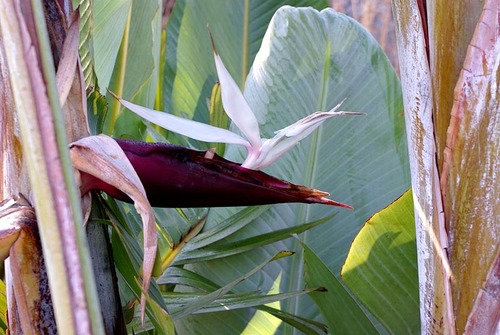
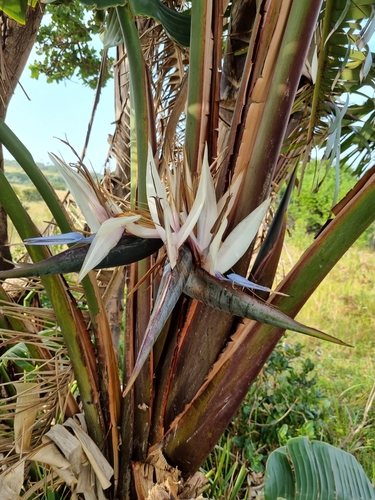
Strelitzia reginae
Banks
Bird's tongue flower, Crane flower, Bird-of-Paradise
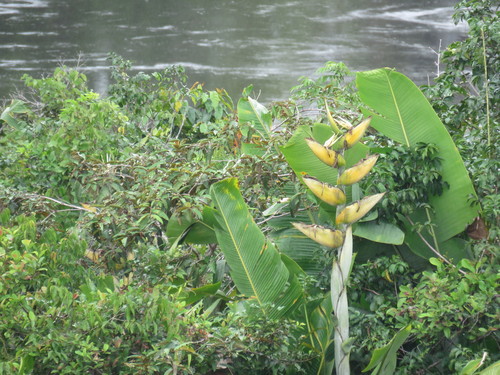
iNaturalist· cc-by-nc
(c) tshire_letso, some rights reserved (CC BY-NC)
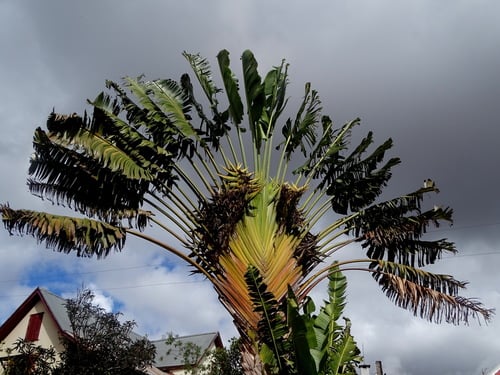
iNaturalist· cc-by-nc
(c) Croc O'Dyle, some rights reserved (CC BY-NC), uploaded by Croc O'Dyle
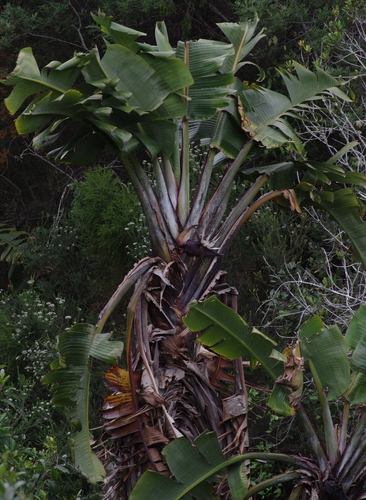
iNaturalist· cc-by-nc
(c) Craig Peter, some rights reserved (CC BY-NC), uploaded by Craig Peter
Summary
Source: WikipediaStrelitzia reginae, commonly known as the crane flower, bird of paradise, or isigude in Nguni, is a species of flowering plant native to the Cape Provinces and KwaZulu-Natal in South Africa. An evergreen perennial, it is widely cultivated for its dramatic flowers. In temperate areas it is a popular houseplant.
Description
A herb which keeps growing from year to year. It can grow to 1.2 m high. It spreads 0.9 m wide. The leaves are 30-75 cm long on stems 1.8 m long. The flowers are orange and blue. Each flower consists of 3 orange coloured sepals and 3 blue petals. Two of the petals are united in an arrowhead-like structure.
Edible Uses
The seeds are cooked and eaten. The tuber, roots, and flowers are also edible.
Traditional Uses
The seeds are cooked and eaten.
This uses section is brief — help expand it
Distribution
A tropical plant. It grows naturally along river banks in South Africa. It suits hardiness zones 10-12. It needs moderate moisture. It needs a fertile, humus-rich, well-drained soil. It needs an acid pH. It needs full sun. Melbourne Botanical Gardens.
Where It Grows
Asia, Australia, Bangladesh, Comoros, Fiji, Guam, Hawaii, Mexico, Micronesia, Myanmar, Nepal, Pacific, Palau, Philippines, SE Asia, Slovenia, South Africa*, Southern Africa, USA,
Notes
It may be in a hot house in Slovenia.
Nutrition
| Part | Moisture | kJ | kcal | Protein | Vit A | Vit C | Iron | Zinc |
|---|---|---|---|---|---|---|---|---|
| Root | 91.9 | 109 | 26 | 0.4 | — | — | 1 | — |
Synonyms
Also Known As
Ave de Paraiso, Kera phul, Kraljevska strelicija, Za-ma-ni-hnget-pan
References (17)
- Benvenuti, S. & Mazzoncini, M., 2021, The Biodiversity of Edible Flowers: Discovering New Tastes and New Health Benefits. Frontiers in Plant Science Article 569499.
- Cundall, P., (ed.), 2004, Gardening Australia: flora: the gardener's bible. ABC Books. p 1375
- Food Composition Tables for use in East Asia FAO http://www.fao.org/infoods/directory No. 413
- Hedrick, U.P., 1919, (Ed.), Sturtevant's edible plants of the world. p 636
- Hibbert, M., 2002, The Aussie Plant Finder 2002, Florilegium. p 295
Show all 17 references Hide references
- Hort. kew. 1:285, t. 2. 1789 [As Aiton]
- http://www.botanic-gardens-ljubljana.com/en/plants
- Kew Plants of the World Online
- Llamas, K.A., 2003, Tropical Flowering Plants. Timber Press. p 355
- Lord, E.E., & Willis, J.H., 1999, Shrubs and Trees for Australian gardens. Lothian. p 265
- Morley, B. & Everard, B., 1970, Wild Flowers of the World. Ebury press. Plate 84
- Recher, P, 2001, Fruit Spirit Botanical Gardens Plant Index. www.nrg.com.au/~recher/ seedlist.html p 7
- Ruiters-Welcome, A. K., 2019, Food plants of southern Africa. Ph.D. thesis. Univ. of Johannesburg p 105
- Smith, A.C., 1979, Flora Vitiensis Nova, Lawaii, Kuai, Hawaii, Volume 1 p 180
- Terra, G.J.A., 1973, Tropical Vegetables. Communication 54e Royal Tropical Institute, Amsterdam, p 77
- Welcome, A. K. & Van Wyk, B.-E., 2019, An inventory and analysis of the food plants of southern Africa. South African Journal of Botany 122 (2019) 136–179
- World Checklist of Useful Plant Species 2020. Royal Botanic Gardens, Kew