Ravenala madagascariensis
Sonn.
Traveller's palm, Traveller's tree
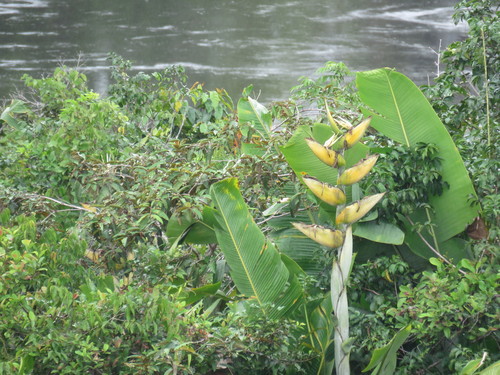
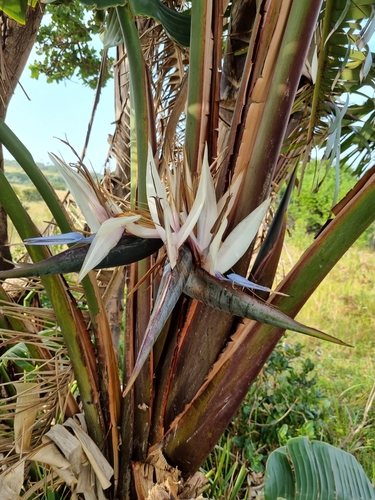
iNaturalist· cc-by-nc
(c) Mica Fraire, some rights reserved (CC BY-NC)
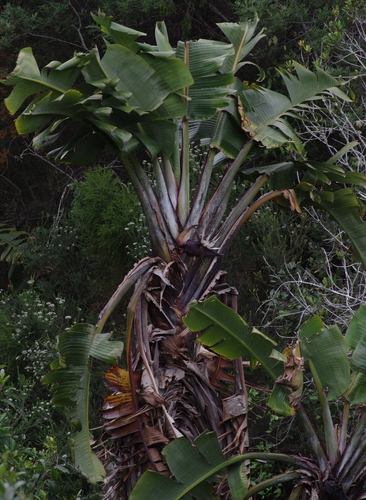
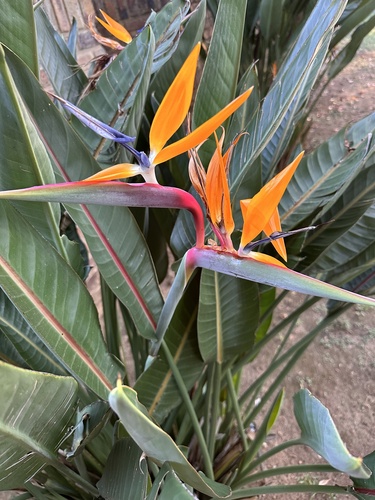
iNaturalist· cc-by-nc
(c) Mica Fraire, some rights reserved (CC BY-NC)
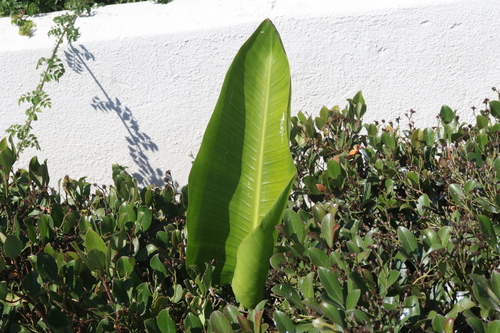
iNaturalist· cc-by-nc
(c) scottjg, some rights reserved (CC BY-NC)
Summary
Source: WikipediaRavenala madagascariensis, commonly known as the traveller's tree, fan palm, traveller's palm or East-West palm, is a species of monocotyledonous flowering plant found in Madagascar. It is not a true palm but a member of the family Strelitziaceae. In tropical and subtropical regions, the plant is widely cultivated for its distinctive habit and foliage.
Description
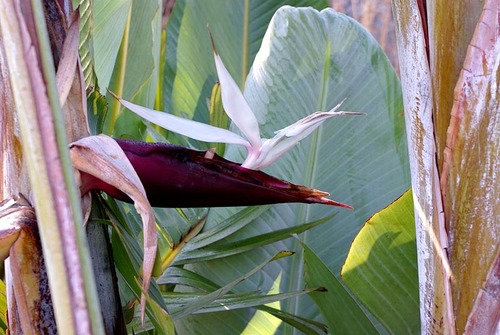
An evergreen shrub. It grows to 10-16 m high and spreads to 3-6 m across. The stem is erect, formed by the bases of the old leaves. It is palm like. The leaves are arranged in 2 opposite rows on long leaf stalks which form sheaths around the stem. They are 5 m long, are closely overlapping and open like fans. They are paddle shaped. The flowers are white and have 3 petals. They occur in long spikes and have boat shaped bracts in the axils. The fruit capsules contain seeds with a bright blue seed covering (aril). The seeds are edible.
Edible Uses
The fat from the fleshy seed layer is used in cooking. Sugary sap is extracted from the trunk. The seeds are eaten whole or ground into flour. The watery sap in enlarged leaf bases is also consumed.
Traditional Uses
The fat found in the fleshy layer around the seeds is used in cooking. Sugary sap is extracted from the trunk. The seeds are eaten. A kind of flour is made from them. There is watery sap in the enlarged leaf bases.
Medicinal Uses
The seed oil is reported to be antiseptic.
Distribution
It is a tropical plant. It does best in rich, moist soil. It needs a protected, sunny, warm position. It is damaged by drought and frost. It grows from sea level to 1,000 m altitude in Madagascar. It needs a temperature above 16-18°C. It suits hardiness zones 10-12. In XTBG Yunnan.
Where It Grows
Africa, Asia, Australia, Burkina Faso, China, Colombia, Dominican Republic, East Africa, Fiji, Ghana, Hawaii, India, Indochina, Indonesia, Laos, Madagascar*, Malawi, Malaysia, Mauritius, Myanmar, Pacific, Papua New Guinea, PNG, Puerto Rico, SE Asia, Sri Lanka, Thailand, USA, Vietnam, West Africa, West Indies,
Cultivation
Plants can be grown from seed or by division of suckers. Seeds grow slowly.
Propagation
Seed - slow to germinate. Seed is best sown in a moist, sandy soil at 20°c. Seedlings of 2 - 6 months old are planted in a rich, deep, loamy soil in full sunlight, incorporating organic matter into the soil at planting time in order to prevent the roots drying out. Division of offshoots. Suckers grow at irregular intervals, close to the parental stem. Rooted suckers can be separated at the beginning of the rainy season, and are planted directly into fertile soil for quick growth.
Other Uses
The leaves are used for roofing and as a packing material. The leaf petioles and midribs are used for making walls. The bark is used for making floors in houses. The stem is used in house construction.
Notes
There is one Ravenala species.
Also Known As
Chuei re quat, Fontsy, Kluay-phat, Ohn-nget-pyaw, Ointsy, Panthopadop, Pisang kipas, Pokok travelers, Ravenala, Ravinala, Ravinamafy
References (29)
- Ambasta S.P. (Ed.), 2000, The Useful Plants of India. CSIR India. p 517
- Bodkin, F., 1991, Encyclopedia Botanica. Cornstalk publishing, p 871
- Borrell, O.W., 1989, An Annotated Checklist of the Flora of Kairiru Island, New Guinea. Marcellin College, Victoria Australia. p 41
- Brickell, C. (Ed.), 1999, The Royal Horticultural Society A-Z Encyclopedia of Garden Plants. Convent Garden Books. p 860
- Burkill, H. M., 1985, The useful plants of west tropical Africa, Vol. 5. Kew.
Show all 29 references Hide references
- Burkill, I.H., 1966, A Dictionary of the Economic Products of the Malay Peninsula. Ministry of Agriculture and Cooperatives, Kuala Lumpur, Malaysia. Vol 2 (I-Z) p 1920
- Cundall, P., (ed.), 2004, Gardening Australia: flora: the gardener's bible. ABC Books. p 1135
- Dharani, N., 2002, Field Guide to common Trees & Shrubs of East Africa. Struik. p 153
- Hearne, D.A., & Rance, S.J., 1975, Trees for Darwin and Northern Australia. AGPS, Canberra p 102, Pl 31
- Hedrick, U.P., 1919, (Ed.), Sturtevant's edible plants of the world. p 554
- Hibbert, M., 2002, The Aussie Plant Finder 2002, Florilegium. p 245
- Jardin, C., 1970, List of Foods Used In Africa, FAO Nutrition Information Document Series No 2.p 47, 97
- Little, E. L., et al, 1974, Trees of Puerto Rico and the Virgin Islands. USDA Handbook 449. Forestry Service. p 70
- Llamas, K.A., 2003, Tropical Flowering Plants. Timber Press. p 354
- Lord, E.E., & Willis, J.H., 1999, Shrubs and Trees for Australian gardens. Lothian. p 99
- Martin, F.W. & Ruberte, R.M., 1979, Edible Leaves of the Tropics. Antillian College Press, Mayaguez, Puerto Rico. p 206
- Menninger, E.A., 1977, Edible Nuts of the World. Horticultural Books. Florida p 121
- Perry, F., and Hay, R., 1982, Guide to Tropical and Subtropical Plants. Sun Books p 36
- Roa, J. A. G. & Boada, D. S. G., 2018, Fundación para el Fortalecimiento de la Fruticultura y Plantas Alimenticias no Convencionales en Colombia.
- Schatz, G.E., 2001, Generic Tree Flora of Madagascar. Royal Botanical Gardens, Kew and Missouri Botanical Garden. p 393
- Schmelzer, G.H., 2002. Ravenala madagascariensis Sonn. [Internet] Record from Protabase. Oyen, L.P.A. & Lemmens, R.H.M.J. (Editors). PROTA (Plant Resources of Tropical Africa), Wageningen, Netherlands. < http://database.prota.org/search.htm>. Accessed 22 October 2009.
- Schuler, S., (Ed.), 1977, Simon & Schuster's Guide to Trees. Simon & Schuster. No. 158
- Smith, A.C., 1979, Flora Vitiensis Nova, Lawaii, Kuai, Hawaii, Volume 1 p 180
- Staples, G.W. and Herbst, D.R., 2005, A tropical Garden Flora. Bishop Museum Press, Honolulu, Hawaii. p 752 (Drawing)
- Styger, E., et al, 1999, Indigenous fruit trees of Madagascar: potential components of agroforestry systems to improve human nutrition and restore biological diversity. Agroforestry Systems 46: 289-310
- Sukarya, D. G., (Ed.) 2013, 3,500 Plant Species of the Botanic Gardens of Indonesia. LIPI p 1133
- Swaminathan, M.S., and Kochnar, S.L., 2007, An Atlas of major Flowering Trees in India. Macmillan. p 269
- Voy. Indes orient. 2:223. 1782
- World Checklist of Useful Plant Species 2020. Royal Botanic Gardens, Kew