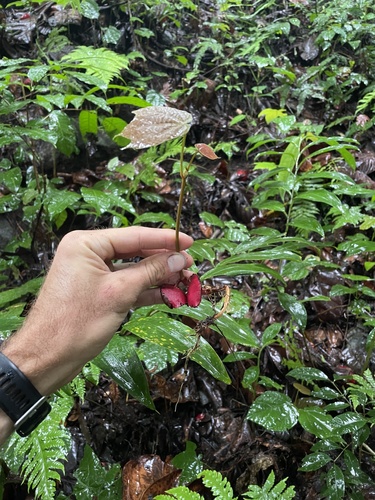
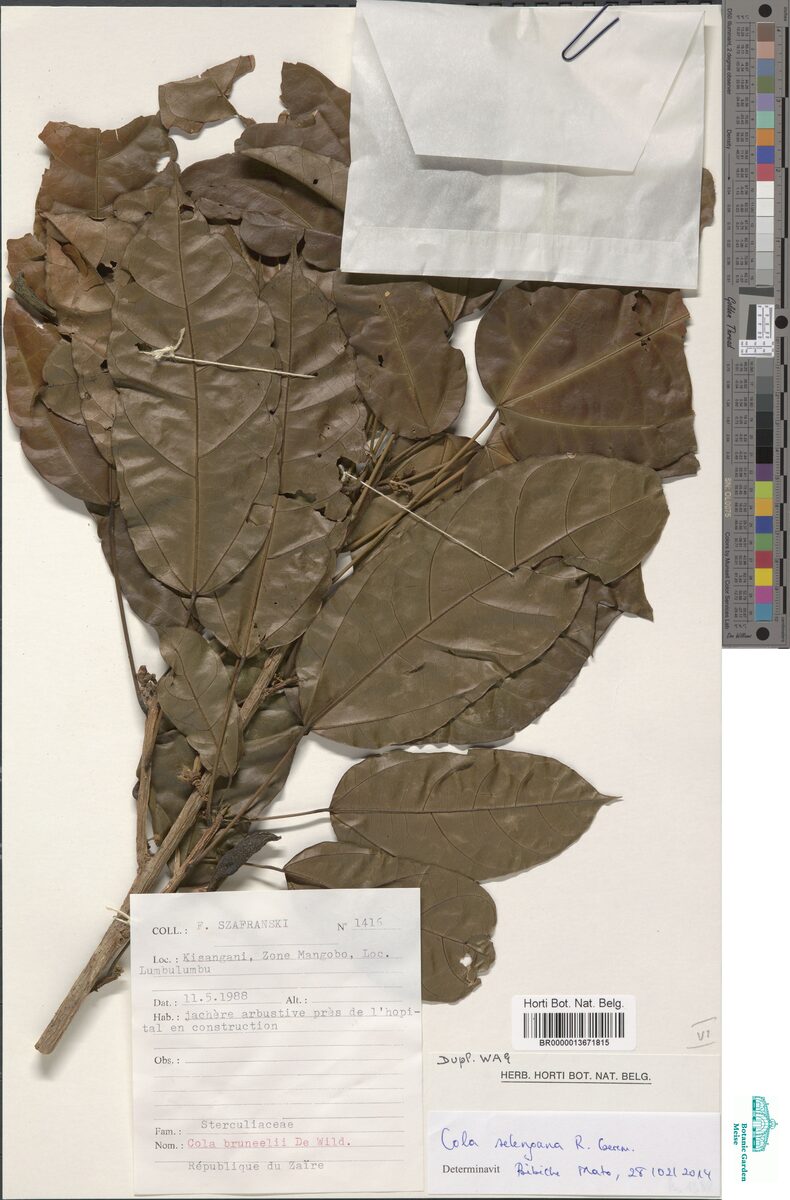
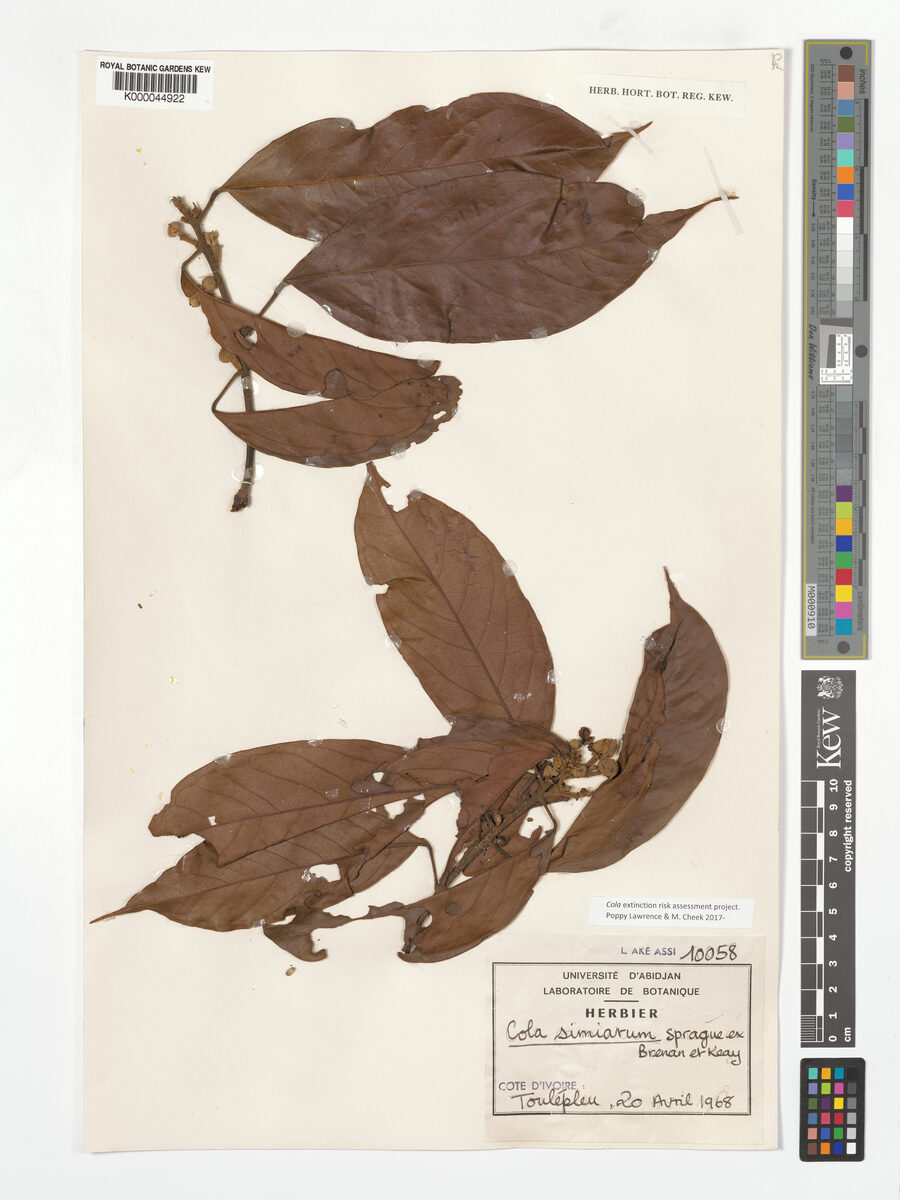
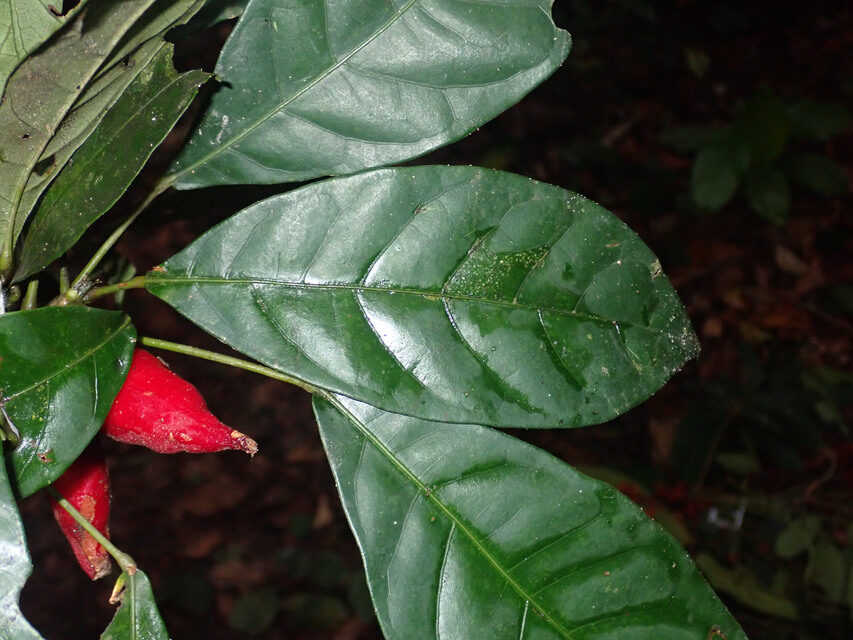
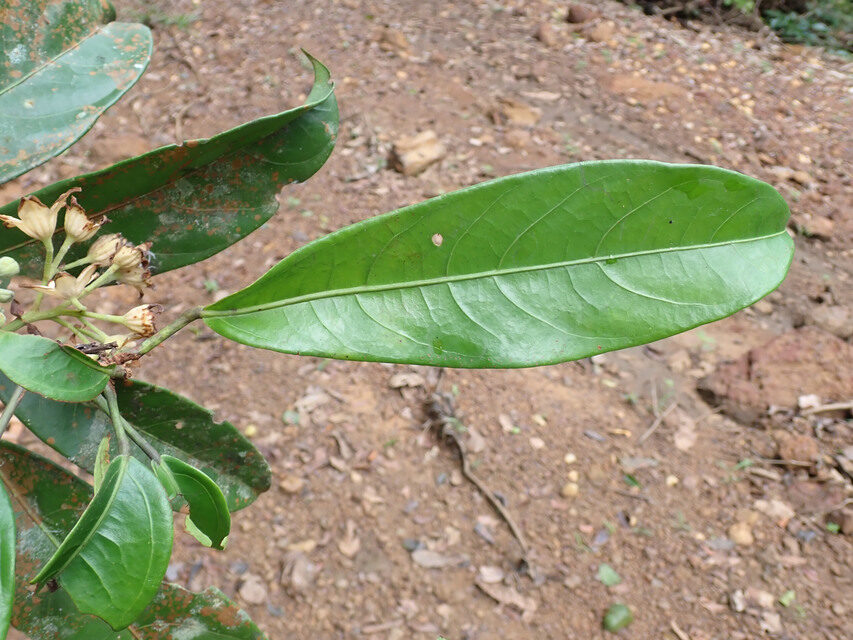
Sterculia quinqueloba
(Garcke) K. Schum.
Large-leaved star-chestnut, Large-leaved sterculia
iNaturalist· cc-by-nc
(c) paullatham36, some rights reserved (CC BY-NC)
iNaturalist· cc-by-sa
(c) Andrew Hankey, some rights reserved (CC BY-SA), uploaded by Andrew Hankey
iNaturalist· cc-by
(c) Mario Bassini, some rights reserved (CC BY)
Description
A tree. It grows 5-12 m high. It can be 25 m high. The bark is cream to pinkish-brown. The bark is smooth and shiny. It sometimes flakes off in large flakes. The leaves are crowded near the ends of branches. They are large and have 5 lobes. They are broadly oval. They are 15-40 cm long by 15-40 cm wide. They are dark yellowish-green above and with woolly hairs underneath. The veins are easy to see. The leaves turn yellow and gold in autumn. The ends of the lobes taper and the base is lobed. The leaf stalk is 27 cm long. The flowers are yellow and 5 mm across. They occur as many flowers in a head at the ends of branches. These are 9-30 cm long. The fruit is made up of 5 separate carpels. Each of these is 6 cm long by 3 cm wide. They are covered with golden hairs. These split along the side and show black seeds.
Edible Uses
Seeds. They can be roasted and eaten whole like peanuts, or roasted, pounded and then cooked with vegetables such as peas or pumpkins.
Traditional Uses
The seeds are roasted and spiced with salt.
This uses section is brief — help expand it
Medicinal Uses
A decoction of the bark from branches is recorded to be given as enema as remedy for diarrhoea, whereas the boiled bark is reportedly used as enema against constipation. A decoction of the leaves and the bark of thin branches is drunk to cure stomach-ache. A decoction of leaves and roots is drunk to cure malaria.
Distribution
A tropical plant. It occurs at medium and low altitudes. It grows in rocky places and on hill sides. It occurs in deciduous forest and dry bush. It grows in Miombo woodland. It grows in hot arid places with a marked dry season. It grows below 680 m above sea level. It can grow in arid places. Mt Cootha Botanical Gardens.
Where It Grows
Africa, Angola, Australia, Burundi, Central Africa, Congo DR, East Africa, Kenya, Malawi, Mozambique, Namibia, South Africa, Southern Africa, Tanzania, Zambia, Zimbabwe,
Cultivation
Plants can be grown from seed. Cuttings and large cuttings can be used. It can be cut back and will re-grow.
Propagation
Seed - dried seed has a moderate storage life of a year or more. Dried seed germinates more freely than fresh or moist seed. Germination typically takes between 2 - 3 weeks under optimal conditions of 25°c. A physical dormancy caused by the hard seed coat of the mature seeds of many species in this genus can be overcome by scarifying the seed. This is carried out by cutting away or abrading some of the seed coat to allow the ingress of water, though great care must be taken not to damage the embryo. The aril surrounding the seed should also be removed - this is easiest when it has been softened through soaking in water. The seeds germinate optimally at temperatures between 20 - 30°c. They can be sown in a nursery seedbed or in containers. A germination rate of about 95%, occurring within about 2 weeks can be expected if the seed has been properly treated.
Other Uses
A clear, hard gum is obtained from the trunk. The trees are tapped for their gum, which is traded as 'gum karaya' together with the gum of other Sterculia spp. and is used as thickener, emulsifier, laxative and denture adhesive. Carefully harvested and graded gum meets the requirements of commercial 'gum karaya' (more commonly derived from the Indian species Sterculia urens). The high tannin content, however, limits its usefulness in foods and pharmaceuticals. The gum possesses solubility and viscosity properties similar to commercial gum arabic from Acacia spp., especially in having a rather low viscosity which is similar in hot and cold water. However, the gum does not meet all specifications required of gum arabic and much higher amounts of the gum are needed to obtain similar results. The bark is used to make floor mats and yields fibres that are used to make ropes, mats and sacks. Larger trees have been described as providing very hard timber for planks and sleepers. However, this may well be a case of mistaken identity as other sources describe the wood as soft and easy to work. The heartwood is pinkish red when freshly cut, darkening to mid-brown on exposure, and distinctly demarcated from the pale yellow, up to 6 cm wide sapwood. The grain is straight, texture medium to coarse. The numerous very broad rays visible on tangential surfaces give a speckled effect. The wood is moderately heavy; the strength rather low; it is moderately durable to durable, being moderately resistant to termites. It saws easily and power demand is low; planing and moulding are easy; it finishes to a good polish; bores and drills fairly well; nailing properties are poor; the wood tends to split and pre-boring is recommended. It is used for furniture, mine props, coffins and light construction. It is also suitable for flooring, interior trim, joinery, turnery, poles, veneer, plywood and pulpwood. The wood is used for fuel and making charcoal.
Notes
The bark and leaves are used in medicine. Also put in the family Sterculiaceae.
Synonyms
Also Known As
Donha, Garoso, Goza, Grootblaarsterkastaiing, Maaguye, Melva, Mgoza, Mhuja, Mkungulanga, Mpelemusi, Mpepe, Msetanyani, Mukosa, Mulendi, Muluze, Nemwajani, Nicoria
References (12)
- CROSS-UPCOTT,
- Drummond, R. B., 1981, Common Trees of the Central Watershed Woodlands of Zimbabwe, National Herbarium Salisbury. p 142
- Fowler, D. G., 2007, Zambian Plants: Their Vernacular Names and Uses. Kew. p 46
- Kew Plants of the World Online
- Mbuya, L.P., Msanga, H.P., Ruffo, C.K., Birnie, A & Tengnas, B., 1994, Useful Trees and Shrubs for Tanzania. Regional Soil Conservation Unit. Technical Handbook No 6. p 450
Show all 12 references Hide references
- Njana, M. A., et al, 2013, Are miombo woodlands vital to livelihoods of rural households? Evidence from Urumwa and surrounding communities, Tabora, Tanzania. Forests, Trees and Livelihoods, 22:2, 124-140
- Palgrave, K.C., 1996, Trees of Southern Africa. Struik Publishers. p 597
- Royal Botanic Gardens, Kew (1999). Survey of Economic Plants for Arid and Semi-Arid Lands (SEPASAL) database. Published on the Internet; http://www.rbgkew.org.uk/ceb/sepasal/internet [Accessed 11th June 2011]
- Ruffo, C. K., Birnie, A. & Tengnas, B., 2002, Edible Wild Plants of Tanzania. RELMA p 630
- van Wyk, B, van Wyk, P, and van Wyk B., 2000, Photographic guide to Trees of Southern Africa. Briza. p 292
- Williamson, J., 2005, Useful Plants of Malawi. 3rd. Edition. Mdadzi Book Trust. p 235
- World Checklist of Useful Plant Species 2020. Royal Botanic Gardens, Kew