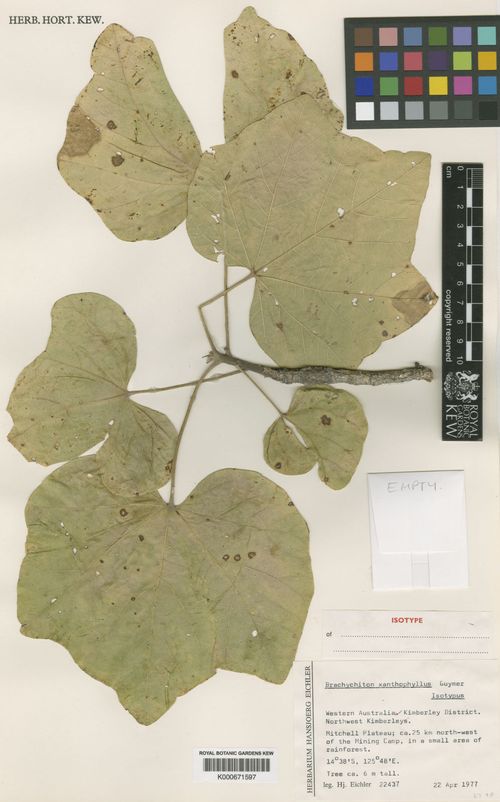
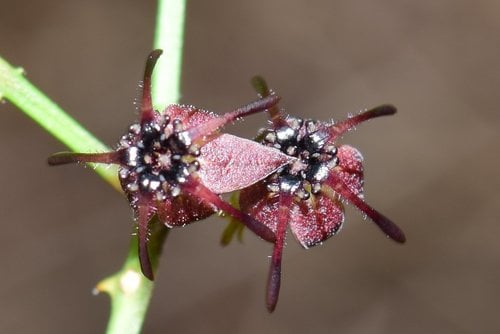
Sterculia quadrifida
R. Br.
Peanut tree, Red-fruited Kurrajong
iNaturalist· cc-by
(c) Steve Kerr, some rights reserved (CC BY), uploaded by Steve Kerr
iNaturalist· cc-by-nc
(c) Jackie Beer, some rights reserved (CC BY-NC), uploaded by Jackie Beer
iNaturalist· cc-by-sa
(c) Greg Tasney, some rights reserved (CC BY-SA), uploaded by Greg Tasney
Summary
Source: WikipediaSterculia quadrifida, also known as the peanut tree, monkey nut or red-fruited kurrajong is a small tree that grows in some forests of New Guinea and Australia.
Description
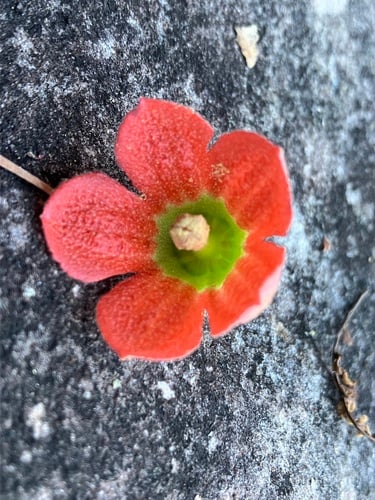
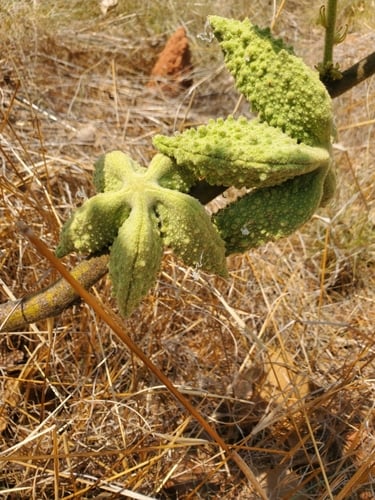
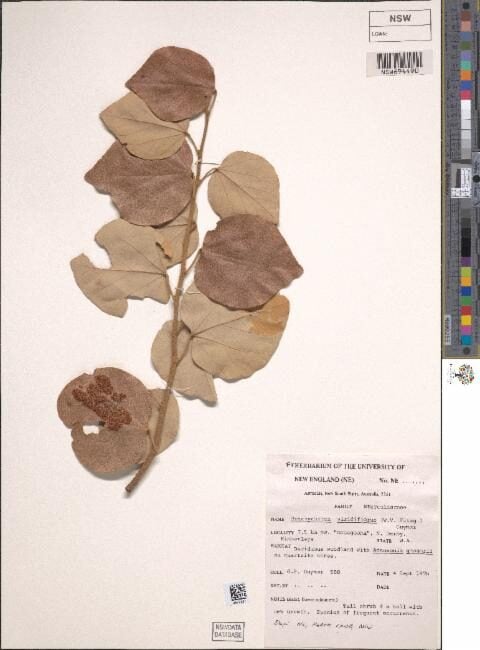
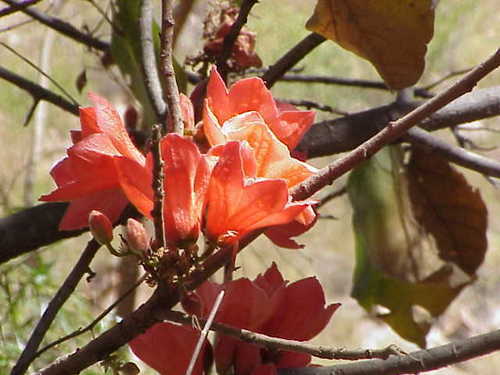
A small to medium sized tree. It grows up to 5-12-20 m tall. It has an open rounded crown. It is a straggly plant and the smaller stems are thick. The bark is smooth and grey. The leaves are long and heart shaped. They are 9-23 cm long by 5.5-17.5 cm wide. They are dark green and rough with prominent veins. They are paler and finely hairy underneath. The leaves fall off during the year. The leaf stalk is 4-10 cm long. The flowers are small, greenish-yellow and not easily noticed. They are produced in flower heads towards the ends of branches. The sepals of the flower remain joined forming a tube which is bell-shaped. They are 0.5-1 cm long by 0.5 cm wide. The outer surface is green and hairy. Several flowers occur together in flower arrangements that are 3-10 cm long. The fruit are groups of leathery pods or capsules carried stiffly on the stems. The fruit are 5-8 cm across by 3-4 cm long. The skin is rough velvety and leathery and turns red when ripe. The ripe pods split to show the light shiny inner surface and black seeds. There are 2-8 shiny seeds. The seeds are 1-2 cm long. The seeds are edible.
Edible Uses
The seeds are edible after removing the bitter black coating. The leaves and bark are used medicinally by indigenous Australians and in Indonesia. The bark is used by indigenous Australians in their traditional weaving techniques to make baskets and other products.
Traditional Uses
The seeds are eaten raw. When peeled they have a pleasant peanut like taste. They are also cooked. They are harvested after the fruit is ripe and fully open.
Medicinal Uses
The leaves are crushed and applied as a poultice to treat wounds, sores, skin complaints and stings. An infusion of the bark, or the juice wrung from the inner bark, is applied directly to the eyes.
Distribution
A tropical plant. It grows naturally in coastal monsoon vine thickets and on sand dunes behind the beach. It can be grown on a wide variety of well-drained soils. It has some tolerance to drought. Melbourne Botanical Gardens. It suits hardiness zones 10-12.
Where It Grows
Asia, Australia*, East Timor, India, Malesia, Pacific, Papua New Guinea, PNG, SE Asia, Timor-Leste, Torres Strait,
Cultivation
Plants are grown from seed. Fresh seed germinate in a few days. Germination can be improved by pouring hot water over the seeds and allowing them to soak for 24 hours.
Propagation
Seed - fresh, moist seed germinates in a few days. A physical dormancy caused by the hard seed coat of the mature seeds of many species in this genus can be overcome by scarifying the seed. This is carried out by cutting away or abrading some of the seed coat to allow the ingress of water, though great care must be taken not to damage the embryo. The aril surrounding the seed should also be removed - this is easiest when it has been softened through soaking in water. The seeds germinate optimally at temperatures between 20 - 30°c. They can be sown in a nursery seedbed or in containers. A germination rate of about 95%, occurring within about 2 weeks can be expected if the seed has been properly treated.
Other Uses
A strong fibre is obtained from the bark. It is used for making twine, nets and fishing lines. The light grey wood is close-grained, soft, spongy and easily worked. It is little used.
Production
Young plants are fast growing. In Australia, flowering occurs from February to November and fruiting from April to December.
Notes
Also put in the family Sterculiaceae.
Nutrition
| Part | Moisture | kJ | kcal | Protein | Vit A | Vit C | Iron | Zinc |
|---|---|---|---|---|---|---|---|---|
| Nuts | 40.7 | 1249 | 299 | 12.3 | — | 2 | 2.6 | 6.5 |
Synonyms
Also Known As
Balk-balk, Balkpalk, Calool, Convavola, Garrmurnamal, Gorarbar, Ko-ral-ba, Ku-man, Malikini, Yarakakur, Wu, Wurranyini, Wurwu
References (49)
- Anon., 2003, Native Plants for the Fitzroy basin. Society for Growing Australian Plants Inc. (Rockhampton Branch) p 76
- Bailey, F. M., 1913, Comprehensive Catalogue of Queensland Plants. Queensland Government.
- J. J. Bennett & R. Brown, Pl. jav. rar. 233. 1844
- Bindon, P., 1996, Useful Bush Plants. Western Australian Museum. p 237
- Bodkin, F., 1991, Encyclopedia Botanica. Cornstalk publishing, p 950
Show all 49 references Hide references
- Brock, J., 1993, Native Plants of Northern Australia, Reed. p 303
- Calvert, G., 2010, The Burdekin Delta Tree Guide. Lower Burdekin Landcare Association., Inc., Ayr p 141
- Cherikoff V. & Isaacs, J., The Bush Food Handbook. How to gather, grow, process and cook Australian Wild Foods. Ti Tree Press, Australia p 58, 201
- Cooper W & Cooper W T, 1994, Fruits of the Rain Forest. RD Press p 262
- Cooper, W. and Cooper, W., 2004, Fruits of the Australian Tropical Rainforest. Nokomis Editions, Victoria, Australia. p 534
- Cowie, I, 2006, A Survey of Flora and vegetation of the proposed Jaco-Tutuala-Lore National Park. Timor-Lests (East Timor) www.territorystories.nt/gov.au p 53
- Cribb, A.B. & J.W., 1976, Wild Food in Australia, Fontana. p 93
- Cundall, P., (ed.), 2004, Gardening Australia: flora: the gardener's bible. ABC Books. p 1372
- Facciola, S., 1998, Cornucopia 2: a Source Book of Edible Plants. Kampong Publications, p 239
- Fell, D.G. & Stanton, D.J., 2015: The vegetation and flora of Mabuyag, Torres Strait, Queensland. Memoirs of the Queensland Museum – Culture 8(1):1-33. Brisbane. ISSN 1440-4788
- Hardwick, G., 2001, Economically Useful Plants for Northern Australia: Master Species List. Crusader eBooks.
- Hearne, D.A., & Rance, S.J., 1975, Trees for Darwin and Northern Australia. AGPS, Canberra p 108, Pl 33
- Hibbert, M., 2002, The Aussie Plant Finder 2002, Florilegium. p 294
- Hiddins, L., 1999, Explore Wild Australia with the Bush Tucker Man. Penguin Books/ABC Books. p 158
- Hill, R. and Baird, A., 2003, Kuku-Yalanji Rainforest Aboriginal People and Carbohydrate Resource Management in the Wet Tropics of Queensland, Australia. Human Ecology, Vol. 31, No. 1. pp 27-52
- Isaacs, J., 1987, Bush Food, Aboriginal Food and Herbal Medicine. Weldons. p 85
- Jackes, B.R., 2001, Plants of the Tropics. Rainforest to Heath. An Identification Guide. James Cook University. p 84
- Jones D, L, 1986, Ornamental Rainforest Plants in Australia, Reed Books, p 246
- Lazarides, M. & Hince, B., 1993, Handbook of Economic Plants of Australia, CSIRO. p 229
- Lord, E.E., & Willis, J.H., 1999, Shrubs and Trees for Australian gardens. Lothian. p 21
- Low, T., 1991, Wild Food Plants of Australia. Australian Nature FieldGuide, Angus & Robertson. p 94
- Low, T., 1992, Bush Tucker. Australia’s Wild Food Harvest. Angus & Robertson. p 92
- Melzer, R. & Plumb, J., 2011, Plants of Capricornia. Belgamba, Rockhampton. p 342
- Menninger, E.A., 1977, Edible Nuts of the World. Horticultural Books. Florida p 43
- Mua Bioversity Profile, 2013, Profile for Management of the Habitats and Related Ecological and Cultural Resources of Mua Island. Torres Strait Regional Authority Land & Sea Management Unit. p 32
- Nicholson, N & H., 1996, Australian Rainforest Plants 2, Terania Rainforest Publishing. NSW. p 56
- Norrington, L., & Campbell, C., 2001, Tropical Food Gardens. Bloomings Books. p 113
- Paczkowska, G . & Chapman, A.R., 2000, The Western Australian Flora. A Descriptive Calatogue. Western Australian Herbarium. p 545
- Recher, P, 2001, Fruit Spirit Botanical Gardens Plant Index. www.nrg.com.au/~recher/ seedlist.html p 3
- Ryan, M. (Ed.), 2003, Wild Plants of Greater Brisbane. Queensland Museum. p 295
- Smith, N and Wightman, G.M., 1990, Ethnobotanical Notes from Belyuen Northern Territory Australia. Northern Territory Botanical Bulletin No 10. Parks and Wildlife Commission of the Northern Territory. p 23, 24.
- Smith, N. M., 1991, Ethnobotanical Field Notes from the Northern Territory, Australia, J. Adelaide Bot. Gard. 14(1): 1-65
- Tiwi Plants and Animals. 2001, Aboriginal flora and fauna knowledge from Bathurst and Melville Islands, northern Australia. Northern Territory Botanical Bulletin; No. 24 p 80
- Townsend, K., 1994, Across the Top. Gardening with Australian Plants in the tropics. Society for Growing Australian Plants, Townsville Branch Inc. p 338
- Townsend, K., 1999, Field Guide to Plants of the Dry Tropics. Society for Growing Australian Plants, Townsville Branch Inc. p 83
- Vigilante, T., et al, 2013, Island country: Aboriginal connections, values and knowledge of the Western Kimberley islands in the context of an island biological survey. Records of the Western Australian Museum Supplement 81: 145-182
- Wheeler, J.R.(ed.), 1992, Flora of the Kimberley Region. CALM, Western Australian Herbarium, p 196, 194
- Wickens, G.E., 1995, Edible Nuts. FAO Non-wood forest products. FAO, Rome. p156
- Wightman, G. & Andrews, M., 1991, Bush Tucker Identikit. Common Native Food Plants of Australia’s top end. Conservation Commission Northern Territory. p 26
- Wightman, G. M. & Andrews, M.R., 1989, Plants of Northern Territory Monsoon Vine Forests (Vol 1). Conservation Commission of Northern Territory. p 9, 78
- Williams, J.B., Harden, G.J., and McDonald, W.J.F., 1984, Trees and shrubs in rainforests of New South Wales and Southern Queensland. Univ. of New England, Armidale. p 55, 96
- World Checklist of Useful Plant Species 2020. Royal Botanic Gardens, Kew
- Yallakool Reserve Plant List July 1, 2009 Off internet
- Yunupinu Banjgul, Laklak Yunupinu-Marika, et al. 1995, Rirratjinu Ethnobotany: Aboriginal Plant Use from Yirrkala, Arnhem Land, Australia. Northern Territory Botanical Bulletin No 21. Parks and Wildlife Commission of the Northern Territory. p 70.