Rhodognaphalon brevicuspe
(Sprague) Roberty
iNaturalist· cc-by-nc
(c) Carel Jongkind, some rights reserved (CC BY-NC), uploaded by Carel Jongkind
iNaturalist· cc-by-nc
(c) Carel Jongkind, some rights reserved (CC BY-NC)
Summary
Source: WikipediaRhodognaphalon brevicuspe is a species of flowering plant in the family Malvaceae. It is found in Cameroon, Republic of the Congo, Democratic Republic of the Congo, Ivory Coast, Gabon, Ghana, Nigeria, and Sierra Leone. It is threatened by habitat loss.
Description
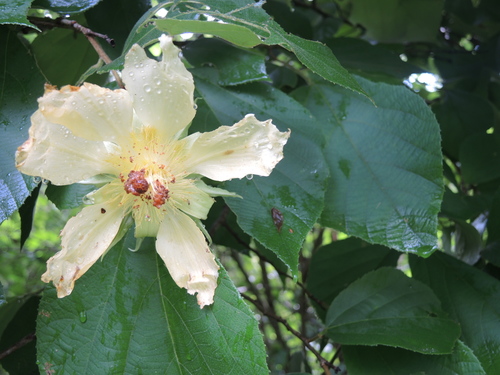
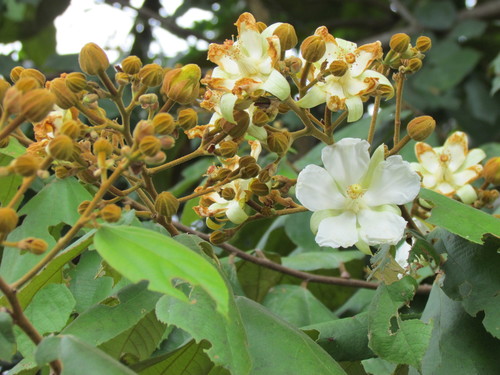
A large tree. It grows to 45 m high. The trunk can be 3 m around. It has small buttresses. The trunk is long and straight. The bark is grey-brown. The leaves are compound and like fingers. There are 4-6 leaflets. They are 3-10 cm long by 1-4 cm wide. They are broad or rounded. They have a blunt tip and taper to the base. The leaf stalk is 1.5-5 cm long. The flowers occur either singly or as a few in a cluster. They are white. Petals are 3.5-5 cm long and 1 cm wide. The fruit are broadly oval and 5-8 cm long by 3-4 cm wide. They split open in their cup. The kapok inside is brown.
Edible Uses
The leaves are eaten.
Medicinal Uses
The bark is emetic, and is also taken to prevent abortion. A decoction of the bark is gargled to treat sore throat, and applied topically to promote wound healing. The bark is also used for the treatment of boils and venereal diseases. A dye-decoction obtained from the bark is applied to sores, causing them to heal rapidly. A liquor prepared from the bark and leaves is used internally to treat venereal diseases and externally in poultices on 'blue boils'. The powdered root, when mixed with water, forms a mucilaginous paste. This is taken internally in the treatment of rheumatism and dysentery. The root is also recorded to be used as an antitumour agent. The powdered root is applied topically to swellings and dislocations.
Known Hazards
The wood, especially the sawdust, may cause dermatitis in workers when it comes into contact with the skin.
Distribution
It is a tropical plant. It grows in the forest.
Where It Grows
Africa, Benin, Cameroon, Central Africa, Central African Republic, CAR, Côte d'Ivoire, Equatorial Guinea, Gabon, Ghana, Ivory Coast, Liberia, Nigeria, Sierra Leone, Togo, West Africa,
Cultivation
Requires a sunny position Initial growth of the tree is very slow. After planting out in the field, the growth was 20 cm/year during the first 2 years. In southern Côte d’Ivoire the average annual diameter increment was 2.4mm in natural evergreen forest and 4.3mm in thinned forest.
Propagation
Seed - sown in light shade in a nursery seedbed. The seed normally sprouts within 5 - 8 days, with a germination rate of 60 - 80%. Seedlings grow slowly. The mean height of nursery-grown plants in Guinea was 13cm at 15 weeks after sowing, 20cm after 43 weeks and 80cm after 2 years, by which time they are ready to plant out.
Other Uses
The bark is used for making hut walls. The bark-slash is bright red becoming brown on exposure. The bark is easily detached from the wood. A red dye is extracted from it by boiling and this is used for dying cloth. It is used to dye funeral cloths, called kuntunkuni, a saffron colour. The dye is said to be fast. A black dye obtained from the root is used for making funeral cloth. The fruit pods, in distinction from Bombax spp. which burst open on the tree, normally fall unopened. They contain a yellowish brown or reddish, crisp floss of inferior quality which is used locally for stuffing pillows, cusions, mattresses etc., and is also used for making sacks. It has been suggested as usable for paper-pulp. No use is recorded of the seeds, but one may expect them to be oil-bearing with an oil content similar to that of Bombax spp. The heartwood is pinkish to red when freshly cut, turning violet brown to brown ochre with darker veins upon drying; it is distinctly demarcated from the up to 10cm wide band of white sapwood, which turns pale brown on exposure. The grain is usually straight, sometimes interlocked; the texture coarse. The wood is very light to light; very soft to soft; moderately brittle; of low to moderate durability with a good resistance to dry wood borers but susceptible to fungi and termites It seasons rapidly, with only a slight risk of distortion but a high risk of checking; once dry it is stable in service, but the dry wood absorbs moisture readily, becoming very heavy, and its use in humid conditions is not recommended. The wood saws and works easily when sharp-edged tools are used, although it is occasionally fibrous; it nails and screws well, but holding properties are poor; it glues well; it does not polish well, but turning and moulding properties are good, and it paints and varnishes satisfactorily. Peeling characteristics are moderate to good. The wood is used for the production of veneer, plywood, interior joinery, packaging material, pallets, boxes, crates, panelling, trim, light furniture and decorative boards. Traditionally, canoes are dug out from the bole, and smaller branches are hollowed out to produce quivers. The wood is also suitable for light construction, light flooring, musical instruments, matches, carvings, toys, novelties, turnery, hardboard and particle board. It is suitable for pulping. Rhodognaphalon brevicuspe is characterized as a light-demanding pioneer species, and should have potential for use in reforestation projects; but natural regeneration is rarely abundant and growth rates are rather slow, so it would be best used as a small element of a mixed planting when restoring native woodland. The tree is a host of Cacao Swollen Shoot Virus (CSSV) which causes swollen shoot disease in cocoa, a disease that has had a devastating effect on cocoa production in Ghana and neighbouring countries. The virus causes chlorosis of the leaves in this species.
Notes
Also put in the family Bombacaceae. In the subfamily Bombacoideae.
Synonyms
Also Known As
Awori, Onyinakoben, Sangoi, Sangulei
References (4)
- Salako, V. K. et al, 2013, Home gardens: an assessment of their biodiversity and potential contribution to conservation of threatened species and crop wild relatives in Benin. Genet Resour Crop Evol
- Savill, P. S. & Fox, J. E. D., Trees of Sierra Leone. p 58
- Vivien, J. & Faure, J.J., 1985, Abres des forets dense d'Afrique Centrale. Agence de Cooperation Culturelle et Technique. Paris. p 46
- World Checklist of Useful Plant Species 2020. Royal Botanic Gardens, Kew