Sterculia apetala
(Jacq.) H. Karst.
Panama nut, Coolie sterculia
iNaturalist· cc-by-nc
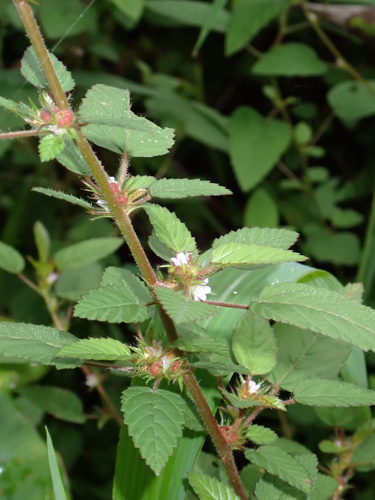
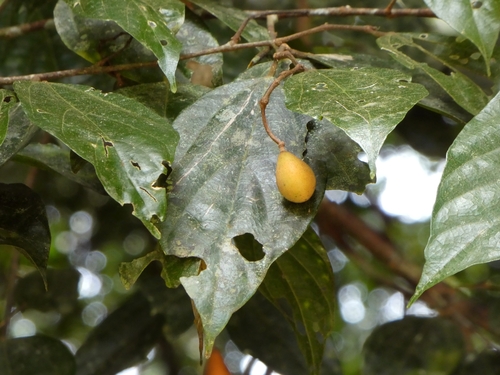
(c) Edith Belén Jiménez Díaz, some rights reserved (CC BY-NC), uploaded by Edith Belén Jiménez Díaz
iNaturalist· cc-by-nc
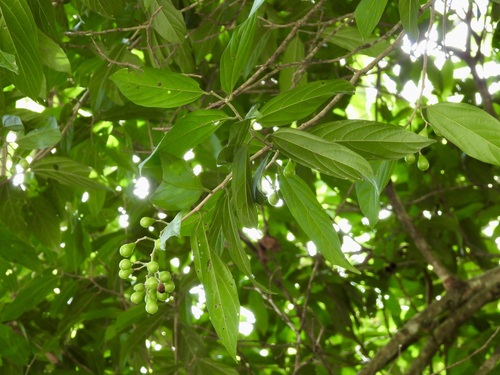
(c) jcelaya, some rights reserved (CC BY-NC)
iNaturalist· cc-by-nc
(c) jcelaya, some rights reserved (CC BY-NC)
Summary
Source: WikipediaSterculia apetala, the Panama tree, is a species of flowering plant in the family Malvaceae. It is found in Florida, southern Mexico, Central America, and northern South America, and has been introduced to the Caribbean islands. Sterculia apetala is recognized as the national tree of the Republic of Panama.
Description
A tree. It grows 15-30 m high. It spreads 9-15 m wide. It is like Sterculia chicha. The trunk is straight and has buttresses. The trunk can be 2 m across. It has an umbrella shaped crown. The leaf stalks are 20-25 cm long. The leaves are divided like fingers on a hand and are 30-35 cm long by 40-45 cm wide. The leaves are heart shaped and have 5 lobes. The lobes can be 15-50 cm long. The edges have irregular teeth. They are densely woolly when young. They are clustered near the ends of branches. The leaves hang down. The flowering stalk is 8-12 cm long. The flowers are 2-3 cm wide. The fruit are woody follicles and are narrow and dark brown. There are 3-4 capsules. These are 10-13 cm long by 8-12 cm wide. There are 7-10 seeds inside. The fruit contain 4-5 seeds. They are 2.5 cm long by 1.5 cm wide and black. These are oval. They are edible.
Edible Uses
Wood from Sterculia apetala is used to produce cases, crates, industrial and domestic woodware, canoes, and tool handles. The tree is often grown for shade, resulting from its large leaves. In some regions, seeds are consumed after being boiled or roasted, used to flavor chocolate, or given to animals as fodder. The flowers are used as antitussive.
Traditional Uses
The almond flavoured seeds are eaten raw or roasted or fried. The roasted and ground seeds are mixed with water to form a drink. The fruit are also eaten. The seeds are also used in place of cola nuts.
Medicinal Uses
An oil extracted from the seeds is used externally to treat skin eruptions. The plant (part not specified) is pectoral. It is used in the treatment of catarrh.
Distribution
A tropical plant. It is native to C and S America. It grows in dry forests and woodlands in the Amazon in Brazil. In Central America it grows from sea level to 1,000 m altitude. It suits hardiness zones 11-12. It grows well alongside rivers. In Townsville palmetum.
Where It Grows
Amazon, Australia, Belize, Bolivia, Brazil*, Caribbean, Central America, Colombia, Costa Rica, Cuba, Dominican Republic, El Salvador, French Guiana, Guatemala, Guyana, Haiti, Hawaii, Honduras, Jamaica, Mexico, Nicaragua, North America, Pacific, Panama, Paraguay, Peru, Puerto Rico, SE Asia, Singapore, South America, USA, Venezuela, West Indies,
Cultivation
Plants are grown from seed. The seed are removed from ripe fruit. Putting the fruit in the sun helps them open. Seeds only remain viable for about 60 days. Fresh seed should be planted. Seeds germinate in 20-30 days. Seedlings can be transplanted into the field in 5 months.
Propagation
Seed - best sown as soon as it is ripe in a partially shaded position in individual containers. A high germination rate can be expected, with the seed sprouting within 20 - 30 days. A physical dormancy caused by the hard seed coat of the mature seeds of many species in this genus can be overcome by scarifying the seed. This is carried out by cutting away or abrading some of the seed coat to allow the ingress of water, though great care must be taken not to damage the embryo. The aril surrounding the seed should also be removed - this is easiest when it has been softened through soaking in water. The seeds germinate optimally at temperatures between 20 - 30°c. They can be sown in a nursery seedbed or in containers. A germination rate of about 95%, occurring within about 2 weeks can be expected if the seed has been properly treated.
Other Uses
An oil obtained from the seeds is used in making paints and for lubricating watches. The heartwood is light brown, reddish brown, or yellowish brown; it is not sharply demarcated from the 4 - 6cm wide band of yellowish sapwood. The texture is medium to coarse; the grain straight to irregular; the lustre medium. The wood is light to moderately heavy; soft; not durable. It seasons at a normal rate, with a high risk of checking and distortion; once dry it is poorly stable in service. It is generally reported to be easy to work with both hand and machine tools, though tools need to be kept very sharp in order to avoid fuzzy surfaces and obtain a good finish; nailing and screwing are good; gluing is correct. The wood is used for making canoes, coffins, boxes and crates, furniture components, interior construction, flooring, general carpentry, plywood, particleboard, millwork etc. The tree is often planted to provide shade.
Production
Plants grow at a moderate to fast rate. They can be 2.5 m high in 2 years.
Other Information
The seeds are not very popular.
Notes
It is the National Tree of Panama. The seeds are rich in starch and fats. Also put in the family Sterculiaceae.
Synonyms
Also Known As
Amendoim-de-bugre, Anacaguita, Araxixa, Bellota, Boia-unha-d'anta, Boia, Cacaito, Camajon, Camaruca, Camoruco, Castanha do Para, Castano, Chica, Chicha, Comoruco, Mandiveiro, Mandovi, Manduvi, Maranhao, O-suborri-s, Panama Tree, Pantanal xixa, Pau-de-boia, Pau-de-cortica, Pepetaca, Pica-pica, Sujo rojo, Sujo, Wu ban ping po, Xixa, Yasisa
References (35)
- Barwick, M., 2004, Tropical and Subtropical Trees. A Worldwide Encyclopedic Guide. Thames and Hudson p 385
- Bendezu, Y. F., 2018, Arboles nativos de lad Region Ucayali. Instituto Nacional de Innovacion Agraria. p 196 (As var. elata)
- Bodkin, F., 1991, Encyclopedia Botanica. Cornstalk publishing, p 949
- Chizmar Fernandez, C., et al, 2009, Plantas comestibles de Centroamerica. Instituto de Biodiversidad, Costa Rica. p 314
- Condit, R., et al, 2011, Trees of Panama and Costa Rica. Princeton Field Guides. p 294
Show all 35 references Hide references
- Cundall, P., (ed.), 2004, Gardening Australia: flora: the gardener's bible. ABC Books. p 1372
- Diss. 6:353. 1788 (As Sterculia cathaginensis)
- Facciola, S., 1998, Cornucopia 2: a Source Book of Edible Plants. Kampong Publications, p 239 (Also as Sterculia chicha)
- FAO, 2012, Forest Genetic Resources Situation in Mexico. Final Report of Project TCP/ 3301 p 289
- Fl. columb. 2:35, t. 118. 1862
- Fl. Bras. merid. 1:278, t. 46. 1828 (As Sterculia chicha)
- Grandtner, M. M., 2008, World Dictionary of Trees. Wood and Forest Science Department. Laval University, Quebec, Qc Canada. (Internet database http://www.wdt.qc.ca)
- Grandtner, M. M. & Chevrette, J., 2013, Dictionary of Trees, Volume 2: South America: Nomenclature, Taxonomy and Ecology. Academic Press p 628
- Hedrick, U.P., 1919, (Ed.), Sturtevant's edible plants of the world. p 634 (As Sterculia cathaginensis) (Also as Sterculia chicha)
- Hellmuth, N. M., 2011, Maya Ethnobotany. Complete Inventory of plants. Associacion FLAAR Mesoamerica. Tenth edition.
- Kermath, B. M., et al, 2014, Food Plants in the Americas: A survey of the domesticated, cultivated and wild plants used for Human food in North, Central and South America and the Caribbean. On line draft. p 837 (Also as Sterculia chicha)
- Lorenzi, H., 2002, Brazilian Trees. A Guide to the Identification and Cultivation of Brazilian Native Trees. Vol. 01 Nova Odessa, SP, Instituto Plantarum p 345 (As Sterculia chicha)
- Lorenzi, H., 2002, Brazilian Trees. A Guide to the Identification and Cultivation of Brazilian Native Trees. Vol. 02 Nova Odessa, SP, Instituto Plantarum p 345
- Lorenzi, H., Bacher, L., Lacerda, M. & Sartori, S., 2006, Brazilian Fruits & Cultivated Exotics. Sao Paulo, Instituto Plantarum de Estuados da Flora Ltda. p 163
- Melander, M., 2007, Endangered plants on the market in Havana City, Cuba. Uppsala University, Sweden p 28
- Menninger, E.A., 1977, Edible Nuts of the World. Horticultural Books. Florida p 42 and p 43 (As Sterculia cathaginensis) (Also as Sterculia chicha)
- Miguel, E., et al, 1989, A checklist of the cultivated plants of Cuba. Kulturpflanze 37. 1989, 211-357
- Oliviera V. B., et al, 2012, Native foods from Brazilian biodiversity as a source of bioactive compounds. Food Research International 48 (2012) 170-179
- Piedra-Malagón, E. M., et al, 2022, Edible native plants of the Gulf of Mexico Province. Biodiversity Data Journal 10: e80565 p 24
- Plants of Haiti Smithsonian Institute http://botany.si.edu/antilles/West Indies
- Reis, S. V. and Lipp, F. L., 1982, New Plant Sources for Drugs and Foods from the New York Botanical Garden herbarium. Harvard. p 180
- Roa, J. A. G. & Boada, D. S. G., 2018, Fundación para el Fortalecimiento de la Fruticultura y Plantas Alimenticias no Convencionales en Colombia.
- Russell, T., Cutler, C., & Walters, M., 2005, The Illustrated Encyclopedia of Trees of the Americas. Lorenz Books. p 201
- Segura, S., et al, 2018, The edible fruit species in Mexico. Genet Resour Crop Evol (2018) 65:1767–1793
- Staples, G.W. and Herbst, D.R., 2005, A tropical Garden Flora. Bishop Museum Press, Honolulu, Hawaii. p 543
- Tanaka, (Also as Sterculia chicha)
- TodaFruta.com.br
- Vasquez, Roberto Ch. & Coimbra, German S., 1996, Frutas Silvestres Comestibles de Santa Cruz. p 245, 235, (Also p 234 As Sterculia chicha)
- Wickens, G.E., 1995, Edible Nuts. FAO Non-wood forest products. FAO, Rome. p155 (Also as Sterculia chicha)
- www.colecionandofrutas.org