Sporobolus fimbriatus
(Trin.) Nees
Dropseed grass, Perennial dropseed
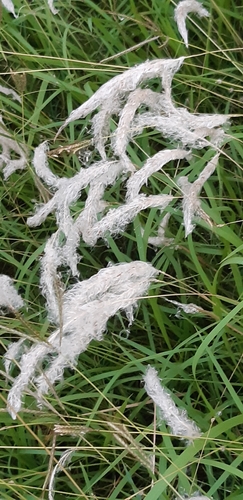
iNaturalist· cc-by-nc
(c) justindutoit, some rights reserved (CC BY-NC)
iNaturalist· cc-by-nc
(c) Johan Bodenstein, some rights reserved (CC BY-NC)
Summary
Source: WikipediaSporobolus fimbriatus is a perennial grass growing to 1.2 m (4ft) tall and 0.1 m (0ft 4in) wide at a fast rate, hardy to UK zone 10. Adapts to light sandy, medium loamy, or heavy clay soils at any pH from mildly acidic to mildly alkaline. Tolerates semi-shade or full sun and thrives in dry, moist, or wet soil conditions.
Description
A herb. It is a grass that forms tussocks. It is erect and keep growing from year to year but loses its leaves. It has underground stems or rhizomes. It can grow 1.7 m high. The leaves can be 30 cm long and 2-4 mm wide.
Edible Uses
The seed is eaten during times of food shortage and may be ground to prepare a porridge.
Traditional Uses
The young flower spikes are made into porridge and eaten in times of scarcity. The seeds are used in porridge and for drinks.
This uses section is brief — help expand it
Medicinal Uses
None known
Known Hazards
The plant may contain hydrocyanic acid, but poisoning is seldom a problem.
Distribution
It is a tropical plant. It grows in hot arid areas. It grows in areas with an annual rainfall between 300-1,100 mm. It grows in deep, well-drained soils. It is often over limestone materials. It grows from sea level to 2,200 m above sea level. It can tolerate shade. It can grow in arid places.
Where It Grows
Africa, Angola, Asia, Botswana, Central Africa, East Africa, India, Kenya, Lesotho, Malawi, Mozambique, Namibia, Somalia, South Africa, Southern Africa, Sudan, Tanzania, Uganda, Zambia, Zimbabwe,
Cultivation
This species photosynthesizes by a more efficient method than most plants. Called the 'C4 carbon-fixation pathway', this process is particularly efficient at high temperatures, in bright sunlight and under dry conditions.
Propagation
Seed.
Other Uses
The plant has been used for soil stabilization.
Other Information
It is a famine food.
Notes
There are about 160 Sporobolus species. They are mainly in the tropics and subtropics.
Synonyms
Also Known As
Matolo-a-maholo, Mussinguizuana, Tedze
References (12)
- Ambasta, S.P. (Ed.), 2000, The Useful Plants of India. CSIR India. p 596
- Fl. Afr. austral. ill. 156. 1841
- Fox, F. W. & Young, M. E. N., 1982, Food from the Veld. Delta Books. p 301
- Gillarmod, J., 1971,
- Jardin, C., 1970, List of Foods Used In Africa, FAO Nutrition Information Document Series No 2.p 8
Show all 12 references Hide references
- National Research Council, 1996, Lost crops of Africa. Volume 1 grains, p 259
- Peters, C. R., O'Brien, E. M., and Drummond, R.B., 1992, Edible Wild plants of Sub-saharan Africa. Kew. p 28
- Royal Botanic Gardens, Kew (1999). Survey of Economic Plants for Arid and Semi-Arid Lands (SEPASAL) database. Published on the Internet; http://www.rbgkew.org.uk/ceb/sepasal/internet [Accessed 4th June 2011]
- Ruiters-Welcome, A. K., 2019, Food plants of southern Africa. Ph.D. thesis. Univ. of Johannesburg p 90
- van Wyk, Be, & Gericke, N., 2007, People's plants. A Guide to Useful Plants of Southern Africa. Briza. p 9
- Welcome, A. K. & Van Wyk, B.-E., 2019, An inventory and analysis of the food plants of southern Africa. South African Journal of Botany 122 (2019) 136–179
- World Checklist of Useful Plant Species 2020. Royal Botanic Gardens, Kew