Sphenostylis schweinfurthii
Harms
Yam bean
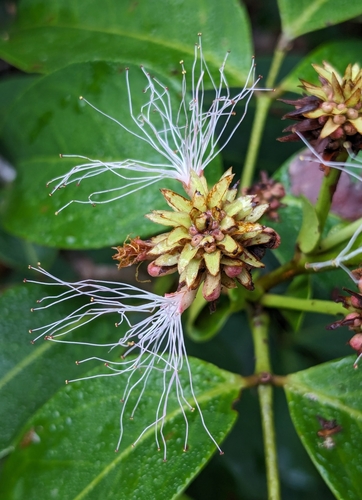
iNaturalist· cc-by-nc
(c) Carel Jongkind, some rights reserved (CC BY-NC), uploaded by Carel Jongkind
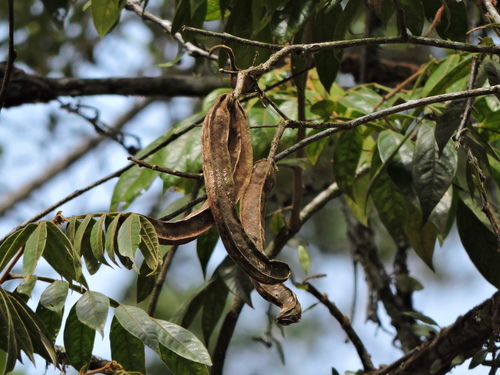
iNaturalist· cc-by-nc
(c) Carel Jongkind, some rights reserved (CC BY-NC), uploaded by Carel Jongkind
iNaturalist· cc-by-nc
(c) Carel Jongkind, some rights reserved (CC BY-NC), uploaded by Carel Jongkind
Description
A herb or shrub. It is erect and grows up to 1.7 m high. The stems and leaflets are hairy. The flowers are large and yellow. There are 2 subspecies.
Edible Uses
The African yam bean is a legume that is rich in protein and starch and an important source of calcium and amino acids. It contains amino acids that are important for the development in early pre-school and school aged children and also those required for adults. The yam bean is a useful source of nutrients for many African communities with a nutritional value comparable to that of the soybean, although the cooking time for the yam bean is much longer (4–6 hours). However, some health problems have been discovered in relation to consumption of these beans including flatulence, stomach cramps, diarrhea and dizziness. These problems result from the way they are usually cooked. Although little research has been devoted to this plant, some important studies have been conducted including one on how to relieve these health problems. Studies show problems are resolved when the yam bean seeds are exposed to pre-cooking treatments such as lactic acid fermented using a low-level technological process. The fermentation method also reduces the amount of time and energy to produce a viable food product from the yam bean. In addition to research on cooking treatments, some research has been conducted on the genetic variability of the plant. The yam bean has a high level of genetic variability, which will be useful during the hybridization of the plant in order to increase food production and sustainability. While the yam bean has been subject to cultivation, there has been little artificial selection on specific traits. If the yam bean could be grown in large quantities, this crop could be the important source of protein needed by the people of sub-Saharan Africa.
Traditional Uses
The flowers are cooked and eaten as an attractive vegetable.
This uses section is brief — help expand it
Distribution
A tropical plant. It grows in open savannah. It can grow in arid places. It has drought resistance.
Where It Grows
Africa, Angola, Benin, Burkina Faso, Burundi, Cameroon, Central Africa, Central African Republic, CAR, Chad, Congo, East Africa, Ethiopia, Ghana, Mali, Nigeria, Sudan, Togo, West Africa,
Cultivation
This species has a symbiotic relationship with certain soil bacteria, these bacteria form nodules on the roots and fix atmospheric nitrogen. Some of this nitrogen is utilized by the growing plant but some can also be used by other plants growing nearby.
Other Uses
A fibre obtained from the stems is used to make a rope.
Other Information
The flowers and seeds are occasionally eaten.
Also Known As
Adjadadjalmia, Mada, Sansongbe
References (15)
- Achigan-Dako, E, et al (Eds), 2009, Catalogue of Traditional Vegetables in Benin. International Foundation for Science.
- Batawila, K., et al, 2007, Diversite et gestion des legumes de cueillete au Togo. African Journal of Food, Agriculture, Nutrition and Development 7( 3& 4): 66
- Bot. Jahrb. Syst. 26:309. 1899
- Burkill, H. M., 1985, The useful plants of west tropical Africa, Vol. 3. Kew.
- Busson, 1965,
Show all 15 references Hide references
- Grivetti, L. E., 1980, Agricultural development: present and potential role of edible wild plants. Part 2: Sub-Saharan Africa, Report to the Department of State Agency for International Development. p 26
- Grubben, G. J. H. and Denton, O. A. (eds), 2004, Plant Resources of Tropical Africa 2. Vegetables. PROTA, Wageningen, Netherlands. p 565
- Jardin, C., 1970, List of Foods Used In Africa, FAO Nutrition Information Document Series No 2.p 20, 29
- Martin, F.W. & Ruberte, R.M., 1979, Edible Leaves of the Tropics. Antillian College Press, Mayaguez, Puerto Rico. p 200
- Menninger, E.A., 1977, Edible Nuts of the World. Horticultural Books. Florida p 100
- Peters, C. R., O'Brien, E. M., and Drummond, R.B., 1992, Edible Wild plants of Sub-saharan Africa. Kew. p 138
- Potter, D., 1992, Economic Botany of Sphenostylis (Leguminosae). Economic Botany. 46(3) pp 262-275
- Royal Botanic Gardens, Kew (1999). Survey of Economic Plants for Arid and Semi-Arid Lands (SEPASAL) database. Published on the Internet; http://www.rbgkew.org.uk/ceb/sepasal/internet [Accessed 29th April 2011]
- Terra, G.J.A., 1973, Tropical Vegetables. Communication 54e Royal Tropical Institute, Amsterdam, p 76
- World Checklist of Useful Plant Species 2020. Royal Botanic Gardens, Kew