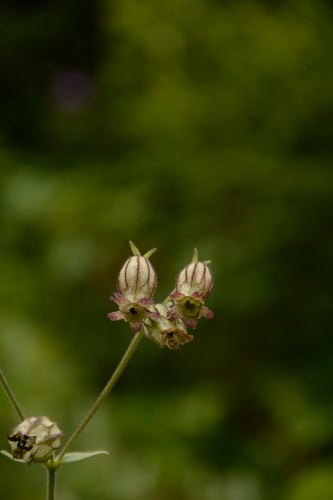
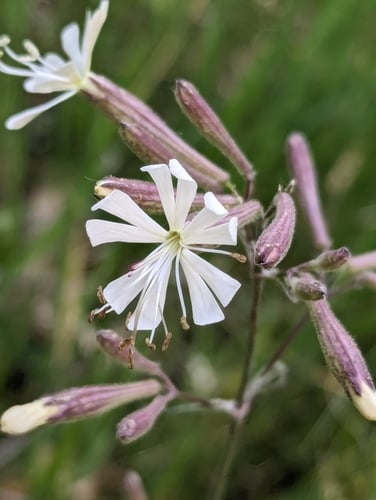
Spergula arvensis
L.
Corn Spurrey
iNaturalist· cc-by-nc
(c) Lauren Glevanik, some rights reserved (CC BY-NC), uploaded by Lauren Glevanik
iNaturalist· cc-by-nc
(c) Adriana W. Van Leeuwen, some rights reserved (CC BY-NC), uploaded by Adriana W. Van Leeuwen
iNaturalist· cc-by-nc
(c) Simon Nicholas, some rights reserved (CC BY-NC), uploaded by Simon Nicholas
Summary
Source: WikipediaSpergula arvensis, the corn spurry, stickwort, starwort or spurrey, is a species of plant in the genus Spergula. It is an annual plant which is native to Europe, Macaronesia, Siberia, northwestern India, northwestern Africa, and the highlands of eastern tropical Africa. It is considered a cosmopolitan agricultural weed, and has been introduced to the Americas, Southern Africa, and parts of Asia.
Description
An annual herb. The plant grows up to 50 cm high. The stems are erect but often bend at the nodes. The leaves are narrow and somewhat fleshy. There is a long furrow on the lower side. This is covered with hairs. The leaves occur in rings. The flowers have fine white petals. The seeds are black and slightly flattened. The seed can stick to the hands when damp.
Edible Uses
Young leaves and plants are edible, though no preparation details are given. The seed can be cooked — dried and ground into a meal, it can be mixed with flour for making bread and similar foods. The seed is rich in oil but contains saponins, so some caution is advised. It is regarded as a famine food, used only when other options are unavailable.
Traditional Uses
The seeds are used for bread flour. The oil is used in margarine and cheese.
This uses section is brief — help expand it
Medicinal Uses
The plant has been used as a diuretic.
Known Hazards
The seed, and probably also the leaves, contain saponins. Although toxic, these substances are very poorly absorbed by the body and so tend to pass through without causing harm. They are also broken down by thorough cooking. Saponins are found in many plants, including several that are often used for food, such as certain beans. It is advisable not to eat large quantities of food that contain saponins. Saponins are much more toxic to some creatures, such as fish, and hunting tribes have traditionally put large quantities of them in streams, lakes etc in order to stupefy or kill the fish.
Distribution
It grows in subtropical and warm temperate places. It often grows on acid soils. In Argentina it grows from sea level to 1,000 m above sea level. Tasmania Herbarium.
Where It Grows
Africa, Argentina, Asia, Australia, Bhutan, Brazil, Britain, Central Asia, Chile, China, East Africa, Europe, Falklands, Finland, Hawaii, Himalayas, India, Ireland, Japan, Kazakhstan, Korea, Luxembourg, Madagascar, Nepal, North Africa, North America, Northeastern India, Norway, Pacific, Pakistan, Paraguay, Philippines, Russia, Scandinavia, SE Asia, Sikkim, South America, SW Asia, Sweden, Tasmania, Uruguay, Zimbabwe,
Cultivation
Prefers a sandy lime-free soil and a sunny position. A calcifuge plant, requiring a neutral to acid soil. The flowers are only open in the morning.
Propagation
Sow seed in spring or autumn in situ. In the wild, some seed germinates in autumn while the remainder germinates in spring.
Other Uses
None known
Other Information
A famine food.
Notes
There are between 20 and 60 Spergularia species. There are 9 in Australia.
Synonyms
Also Known As
Anamoka, Asperge, Da zhua cao, Esparguta, Khandidal, Kharika arxa, Maleza arvense, Muchmuchia, Sand Spurrey, Toadflax
References (21)
- Ambasta, S.P. (Ed.), 2000, The Useful Plants of India. CSIR India. p 591
- Curtis, W.M., 1956, The Students Flora of Tasmania Vol 1 p 70
- Dashorst, G.R.M., and Jessop, J.P., 1998, Plants of the Adelaide Plains & Hills. Botanic Gardens of Adelaide and State Herbarium. p 56
- Hedrick, U.P., 1919, (Ed.), Sturtevant's edible plants of the world. p 629
- Hussey, B.M.J., Keighery, G.J., Cousens, R.D., Dodd, J., Lloyd, S.G., 1997, Western Weeds. A guide to the weeds of Western Australia. Plant Protection Society of Western Australia. p 130
Show all 21 references Hide references
- Hyde-Wyatt, B.H. & Morris D.I., 1975, Tasmanian Weed Handbook. Dept of Ag Tasmania. p 74
- Irving, M., 2009, The Forager Handbook, A Guide to the Edible Plants of Britain. Ebury Press p 246
- Kermath, B. M., et al, 2014, Food Plants in the Americas: A survey of the domesticated, cultivated and wild plants used for Human food in North, Central and South America and the Caribbean. On line draft. p 832
- Lamp, C & Collet F., 1989, Field Guide to Weeds in Australia. Inkata Press. p 284
- Lu Dequan, Wu Zhengyi, Zhou Lihua, Chen Shilong; Michael G. Gilbert, Magnus Lidén, John McNeill, John K. Morton, Bengt Oxelman, Richard K. Rabeler, Mats Thulin, Nicholas J. Turland, Warren L. Wagner, CARYOPHYLLACEAE, Flora of China.
- Marandi, R. R. & Britto, S. J., 2015, Medicinal Properties of Edible Weeds of Crop Fields and Wild plants Eaten by Oraon Tribals of Latehar District, Jharkhand. International Journal of Life Science and Pharma Research. Vo. 5. (2) April 2015
- Menninger, E.A., 1977, Edible Nuts of the World. Horticultural Books. Florida p 121
- Morley, B.D., & Toelken, H.R., (Eds), 1983, Flowering Plants in Australia. Rigby. p 78
- Paczkowska, G. & Chapman, A.R., 2000, The Western Australian Flora. A Descriptive Catalogue. Western Australian Herbarium. p 197
- Plants for a Future database, The Field, Penpol, Lostwithiel, Cornwall, PL22 0NG, UK. http://www.scs.leeds.ac.uk/pfaf/
- Razanameharizaka, J., et al, 2022, Catalogue Legumes Traditionnels de Madagascar. Université d’Antananarivo, Antananarivo (101), Madagascar. Vol. 1. p 31
- SAYCE,
- Sp. pl. 1:440. 1753
- Tasmanian Herbarium Vascular Plants list p 20
- UPHOF,
- World Checklist of Useful Plant Species 2020. Royal Botanic Gardens, Kew