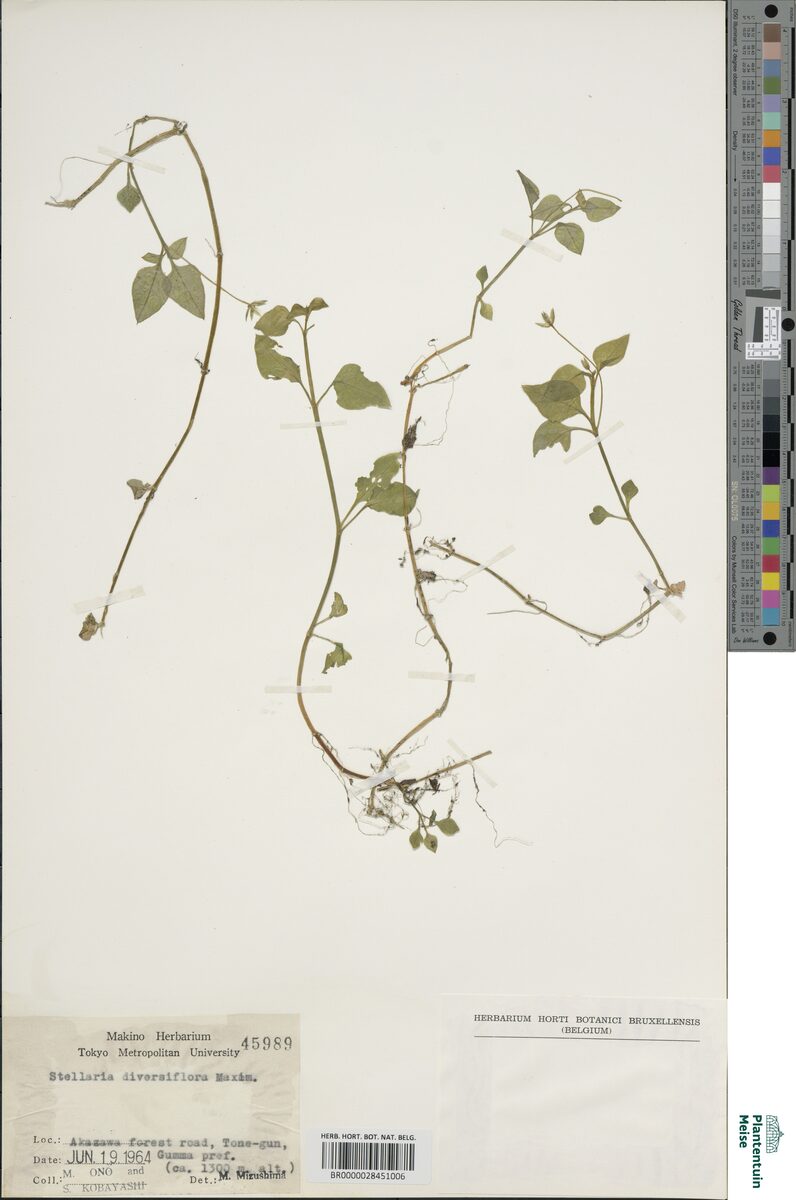
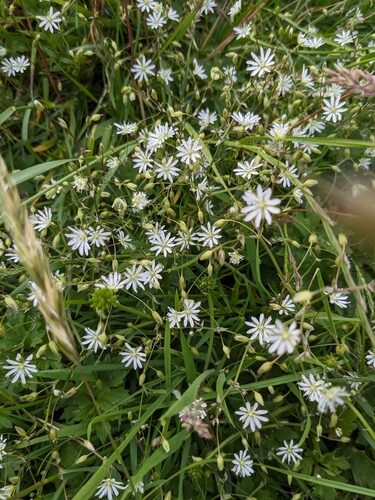
Stellaria alsine
Grimm.
Bog Chickweed, Bog Stitchwort
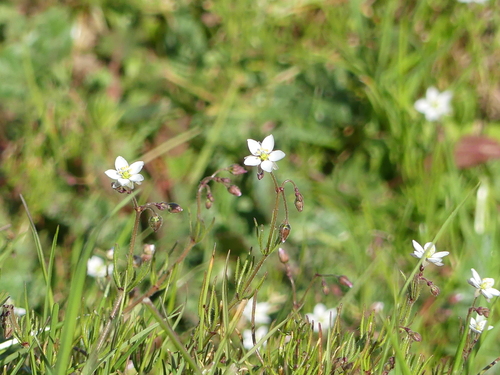
iNaturalist· cc-by-sa
(c) Gilles San Martin, some rights reserved (CC BY-SA), uploaded by Gilles San Martin
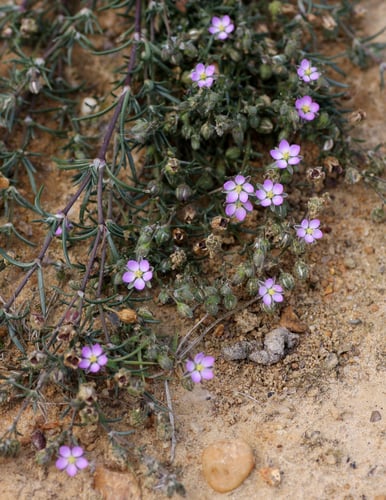
iNaturalist· cc-by-nc
(c) Patricia Butter, some rights reserved (CC BY-NC)
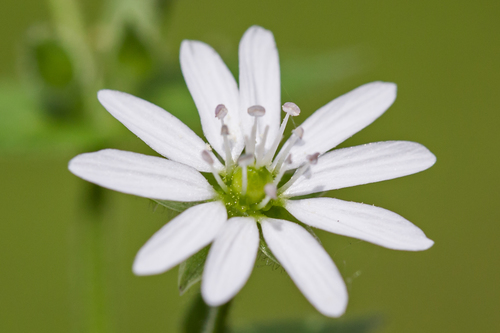
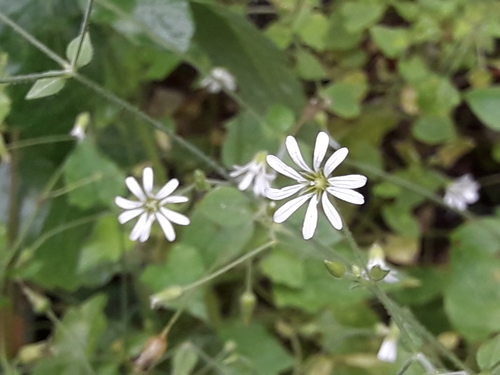
iNaturalist· cc-by-nc
(c) Patricia Butter, some rights reserved (CC BY-NC)
Summary
Source: WikipediaStellaria alsine, the bog stitchwort, is a species of herbaceous perennial flowering plant in the carnation family Caryophyllaceae. It grows in bogs and marshes in Europe and parts of North America.
Description
A herb. It grows each year from seed. The stems are tufted and 15-25 cm tall. The leaves do not have stalks. They are sword shaped and 1-2 cm long by 2-4 mm wide. The base is wedge shaped and partly clasps the stem.
Edible Uses
Young leaves and shoots can be eaten raw or cooked.
Medicinal Uses
The whole plant is carminative, depurative, and galactogogue, and promotes hydrosis. A decoction is used as an antidote against snakebite and in the treatment of colds, traumatic injuries, and pimples. The fresh herb can be crushed and applied externally.
Known Hazards
Although no mention has been seen for this species, the leaves of some members of this genus contain saponins. Although toxic, these substances are very poorly absorbed by the body and so tend to pass through without causing harm. They are also broken down by thorough cooking. Saponins are found in many plants, including several that are often used for food, such as certain beans. It is advisable not to eat large quantities of food that contain saponins. Saponins are much more toxic to some creatures, such as fish, and hunting tribes have traditionally put large quantities of them in streams, lakes etc in order to stupefy or kill the fish.
Distribution
It is a subtropical plant. In China it grows near streams and wetlands between 500-4,000 m above sea level. In Sichuan and Yunnan.
Where It Grows
Asia, Bhutan, Britain, China, Europe, Falklands, Himalayas, India, Indochina, Japan, Kashmir, Korea, Luxembourg, Nepal, Pakistan, SE Asia, Vietnam,
Cultivation
Prefers a moist soil.
Propagation
Sow seed in situ in spring.
Other Uses
None known
Notes
There are about 120-130 Stellaria species. They are mostly in temperate regions.
Synonyms
Also Known As
Que she cao
References (6)
- Ambasta, S.P. (Ed.), 2000, The Useful Plants of India. CSIR India. p 598
- Hwang, HS, et al, 2014, Distribution characteristics of plant in the Ungseokbong Mountain, Gyeongsangnam-do, Korea. Journal of Asia-Pacific Biodiversity. 7(2014) e164-e178
- Lu Dequan, Wu Zhengyi, Zhou Lihua, Chen Shilong; Michael G. Gilbert, Magnus Lidén, John McNeill, John K. Morton, Bengt Oxelman, Richard K. Rabeler, Mats Thulin, Nicholas J. Turland, Warren L. Wagner, CARYOPHYLLACEAE, Flora of China.
- Nova Acta Phys.-Med. Acad. Caes. Leop.-Carol. Nat. Cur. 3, app.:313. 1767
- Plants for a Future database, The Field, Penpol, Lostwithiel, Cornwall, PL22 0NG, UK. http://www.scs.leeds.ac.uk/pfaf/
Show all 6 references Hide references
- Upson, R., & Lewis R., 2014, Updated Vascular Plant Checklist and Atlas for the Falkland Islands. Falklands Conservation and Kew.