Arenaria serpyllifolia
L.
Thyme-leaf sandwort
iNaturalist· cc-by-sa
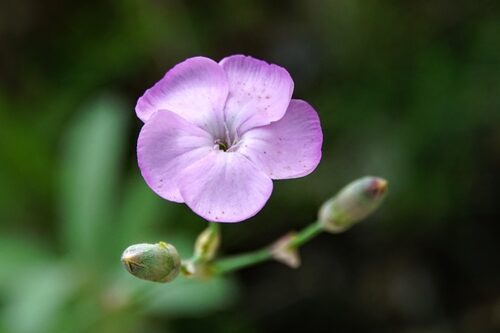
(c) Douglas Goldman, some rights reserved (CC BY-SA), uploaded by Douglas Goldman
iNaturalist· cc-by
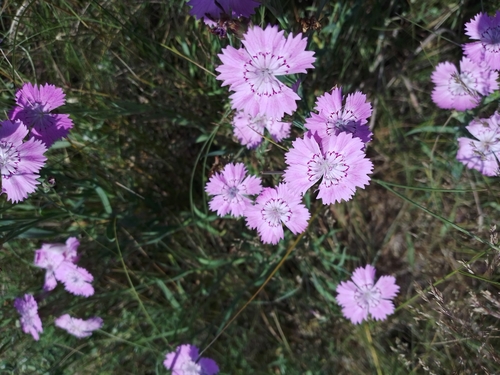
(c) Don Loarie, some rights reserved (CC BY), uploaded by Don Loarie
iNaturalist· cc-by-sa
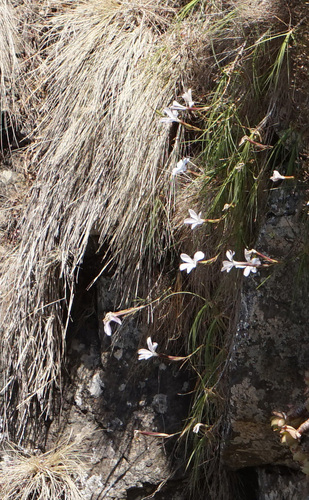
(c) Douglas Goldman, some rights reserved (CC BY-SA), uploaded by Douglas Goldman
Summary
Source: WikipediaArenaria serpyllifolia, commonly known as thyme-leaf sandwort, or thyme-leaved sandwort is an annual or biennial flowering plant in the pink and carnation family Caryophyllaceae that can be found from Nepal to Pakistan. It also have a wide distribution in the United Kingdom and southern Poland. It was introduced to Chile. The species is widespread in China.
Description
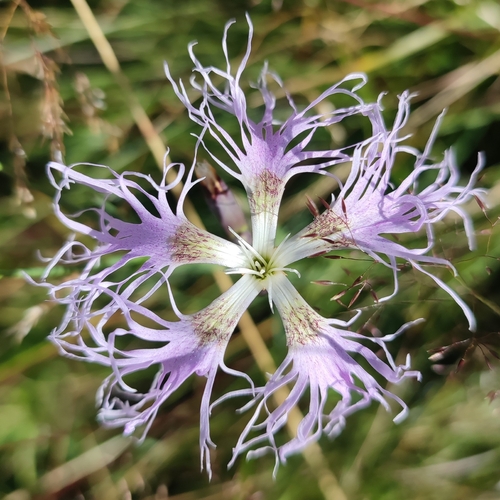
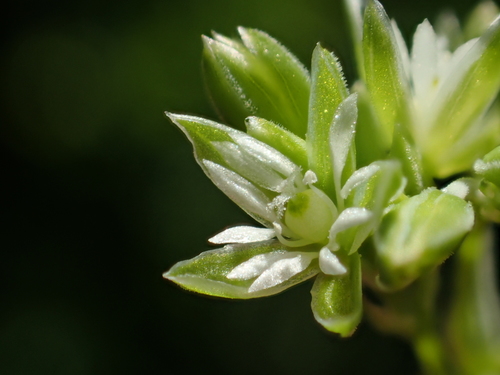
An annual herb. Sometimes it takes 2 years to complete its life cycle. The stems are erect or curve upwards. It is 3-15 cm high. It branches at the base. The lower leaves have short leaf stalks. The upper leaves do not have leaf stalks. The leaf blade is broad and oval. It is 3-6 mm long. It tapers to the tip. There are usually 3-5 veins. There are 5 sepals and 5 petals. They are white. The fruit is a capsule which is flask shaped. It is wider at the base. It splits open with 6 teeth. The seeds are about 0.5 mm across. They are lumpy and dark brown.
Edible Uses
Edible Parts: Leaves Edible Uses: The entire plant is used as a pot-herb.
Traditional Uses
The leaves are used in soup.
This uses section is brief — help expand it
Medicinal Uses
Antitussive Depurative Diuretic Dysentery Febrifuge The plant is antitussive, depurative, diuretic and febrifuge[. A decoction of the leaves is used in the treatment of dysentery. It is also used in the treatment of bladder complaints, calculus troubles and acute and chronic cystitis.
Distribution
A temperate plant. It grows in mountain grassland slopes, sandy or stony barrens, fields, gardens between 600–4000 m altitude in many places in China. It grows in sandy places. Tasmania Herbarium.
Where It Grows
Africa, Albania, Argentina, Asia, Australia, Britain, Canada, Caribbean, Central Asia, Chile, China, Dominican Republic, East Africa, Ethiopia, Europe, Korea, Luxembourg, New Zealand, Norfolk Island, North Africa, North America, Pakistan, South America, Tajikistan, Tasmania, Uruguay, USA, West Indies,
Cultivation
Plants are grown from seeds.
Propagation
Seed - sow spring in situ.
Other Uses
None known Special Uses
Notes
It is used in medicine. There are about 150-160 Arenaria species.
Synonyms
Also Known As
Byeorukijari, Wu xin cai
References (16)
- Bodkin, F., 1991, Encyclopedia Botanica. Cornstalk publishing, p 97
- Flora of Australia Volume 49, Oceanic Islands 1, Australian Government Publishing Service, Canberra. (1994) p 92
- Flora of China @ efloras.org Volume 6
- Hussey, B.M.J., Keighery, G.J., Cousens, R.D., Dodd, J., Lloyd, S.G., 1997, Western Weeds. A guide to the weeds of Western Australia. Plant Protection Society of Western Australia. p 128
- Hwang, H., et al, 2013, A Study on the Flora of 15 Islands in the Western Sea of Jeollanamdo Province, Korea. Journal of Asia-Pacific Biodiversity Vol. 6, No. 2 281-310
Show all 16 references Hide references
- Kang, Y., et al, 2012, Wild food plants and wild edible fungi in two valleys on the Qinling Mountains (Shaanxi, central China) Journal of Ethnobiology and Ethnomedicine; 9:26
- Kim, H. & Song, M., 2013, Ethnobotanical analysis for traditional knowledge of wild edible plants in North Jeolla Province (Korea). Genetic. Resour. Crop Evol. (2013) 60:1571-1585
- Lazarides, M. & Hince, B., 1993, Handbook of Economic Plants of Australia, CSIRO. p 24
- Lu Dequan, Wu Zhengyi, Zhou Lihua, Chen Shilong; Michael G. Gilbert, Magnus Lidén, John McNeill, John K. Morton, Bengt Oxelman, Richard K. Rabeler, Mats Thulin, Nicholas J. Turland, Warren L. Wagner, CARYOPHYLLACEAE, Flora of China.
- Paczkowska, G. & Chapman, A.R., 2000, The Western Australian Flora. A Descriptive Catalogue. Western Australian Herbarium. p 195
- Plants for a Future database, The Field, Penpol, Lostwithiel, Cornwall, PL22 0NG, UK. http://www.scs.leeds.ac.uk/pfaf/
- Sp. pl. 1:423. 1753
- Tasmanian Herbarium Vascular Plants list p 18
- USDA, ARS, National Genetic Resources Program. Germplasm Resources Information Network - (GRIN). [Online Database] National Germplasm Resources Laboratory, Beltsville, Maryland. Available: www.ars-grin.gov/cgi-bin/npgs/html/econ.pl (10 April 2000)
- Wiersema, J. H. & Leon, B., 2013, World Economic Plants. A Standard Reference CRC Press. 2nd Ed. p 66
- World Checklist of Useful Plant Species 2020. Royal Botanic Gardens, Kew