Solanum anguivi
Lam.
Forest bitterberry, Madagascar potato
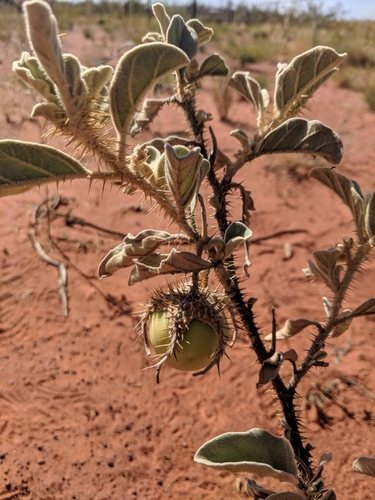
iNaturalist· cc-by-nc
(c) Bart Wursten, some rights reserved (CC BY-NC), uploaded by Bart Wursten
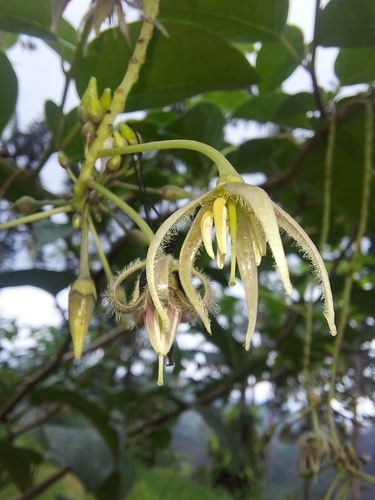
iNaturalist· cc-by-nc
(c) Troos van der Merwe, some rights reserved (CC BY-NC), uploaded by Troos van der Merwe
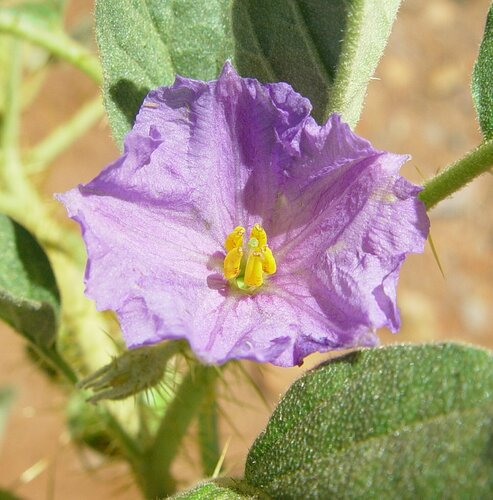
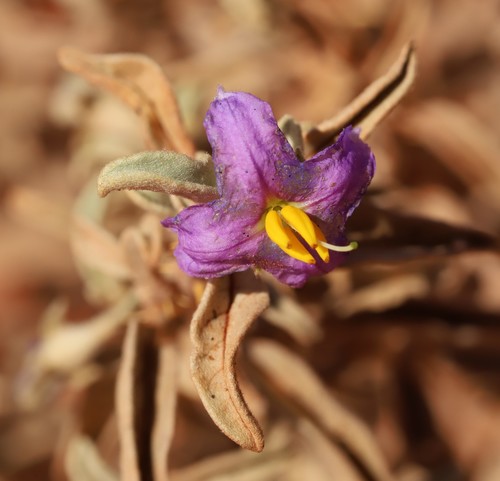
iNaturalist· cc-by-nc
(c) Alison Young, some rights reserved (CC BY-NC), uploaded by Alison Young
Summary
Source: WikipediaSolanum anguivi is a plant indigenous to non-arid parts of Africa, and is commonly known as forest bitterberry or African eggplant, although the latter term is most commonly associated with Solanum aethiopicum. It is a traditional ethnomedicine in India.
Description
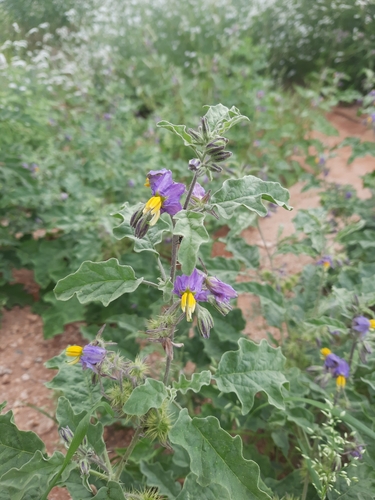
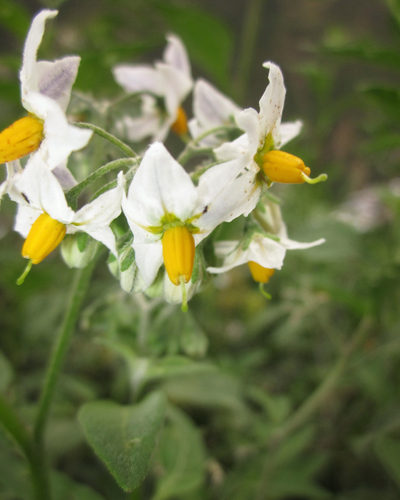
A shrub. It grows 1 m high. It has irregular branches. They are slightly woody. There are short prickles on the stems and leaf veins. The leaves are oval and some deep triangle shaped lobes on each side. The leaves are 15 cm long by 10 cm wide. The flowers are in compact groups of 12 small flowers. They are mauve or white. The fruit are small orange or red berries. They are 1 cm across.
Edible Uses
The fruit are eaten as a vegetable, either unripe or ripe. Unripe fruit can be cooked, sun-dried for storage, and used later in soups, or they can be salted, dried, roasted in oil, and eaten. Ripe fruit can be eaten raw or fried. Leaves are also edible.
Traditional Uses
The fruit are eaten as a vegetable. They can be cooked and sun dried and then stored for later use in soups. They are used unripe. The ripe fruit can be eaten raw. They are also fried. The green fruit are salted, dried, roasted in oil and eaten.
Medicinal Uses
The plant is used for medicine.
Known Hazards
Although providing many well-known foods for people, including the potato, tomato, pepper and aubergine, most species in this genus also contain toxic alkaloids. Whilst these alkaloids can make the plant useful in treaing a range of medical conditions, they can also cause problems such as nausea, vomiting, salivation, drowsiness, abdominal pain, diarrhoea, weakness and respiratory depression. Unless there are specific entries with information on edible uses, it would be unwise to ingest any part of this plant.
Distribution
A tropical plant. It grows in relatively humid locations.
Where It Grows
Africa, Arabia, Asia, Cameroon, Central Africa, Comoros, Congo, Côte d'Ivoire, East Africa, Equatorial Guinea, Eritrea, Eswatini, Ethiopia, Gambia, Ghana, Guinea, Guinée, Guinea-Bissau, Himalayas, India, Indochina, Ivory Coast, Kenya, Laos, Liberia, Madagascar, Malawi, Middle East, Mozambique, Nepal, Nigeria, Northeastern India, Pacific, Pakistan, Philippines, Rwanda, Sao Tome and Principe, SE Asia, Senegal, Seychelles, Sierra Leone, Somalia, South Africa, Southern Africa, Swaziland, Taiwan, Tanzania, Uganda, West Africa, Zambia, Zimbabwe,
Cultivation
Plants are grown from seeds. Seedlings emerge in about a week. A spacing of about 1 m is suitable.
Propagation
Seed - sow in situ. Emergence of the seedlings starts about a week after sowing.
Production
Flowering starts 2-3 months after seed germination. Fruit are ready 2-3 weeks after fruit set. Plants can keep producing for up to one year. Often fruit are collected at the end of the rainy season and early in the dry season.
Other Information
Fruit are sold in local markets.
Notes
It is used for flavouring and medicine. There are about 1400 Solanum species.
Synonyms
Also Known As
Bekuri teeta, Chunda, Duro, Hepi keho, Kattuthudhuvalai, Katukuma, Katunkuma, Kharangeh, Limka, Mothiringani, Mselekete, Njujui, Ntunfululu, Obuhuruhuru, Ranavangi, Ranvangi, Samtawk-te, Songwa, Twak-te-aka
References (32)
- Abbiw, D.K., 1990, Useful Plants of Ghana. West African uses of wild and cultivated plants. Intermediate Technology Publications and the Royal Botanic Gardens, Kew. p 38
- Agea, J. G., et al 2011, Wild and Semi-wild Food Plants of Bunyoro-Kitara Kingdom of Uganda: etc. Environmental Research Journal 5(2) 74-86
- Andabati, B., & Muyonga, J., 2014, Phenolic content and antioxidant activity of selected Ugandian traditional medicinal foods. African Journal of Food Science. 8(8), pp 427-434
- Arinathan, V., et al, 2007, Wild edibles used by Palliyars of the western Ghats, Tamil Nadu. Indian Journal of Traditional Knowledge. 6(1) pp 163-168 (var. multiflora)
- Burkill, H. M., 1985, The useful plants of west tropical Africa, Vol. 5. Kew.
Show all 32 references Hide references
- Ethnobotany of Karbis. Chapter 4 in p 101 (Has Solanum violaceum as synonym)
- Flora of Pakistan. www.eFloras.org
- Godfrey, J. et al, 2013, Harvesting, preparation and preservation of commonly consumed wild and semi-wild food plants in Bunyoro-Kitara Kingdom, Uganda. Int. J. Med. Arom. Plants. Vol.3 No.2 pp 262-282
- Grubben, G. J. H. and Denton, O. A. (eds), 2004, Plant Resources of Tropical Africa 2. Vegetables. PROTA, Wageningen, Netherlands. p 480
- Hedrick, U.P., 1919, (Ed.), Sturtevant's edible plants of the world. p 613
- Jadhav, R., et al, 2015, Forest Foods of Northern Western Ghats: Mode of Consumption, Nutrition and Availability. Asian Agri-History Vol. 19, No. 4: 293-317
- Kar, A., & Borthakur, S. K., 2007, Wild vegetables sold in local markets of Karbi Anglong, Assam. Indian Journal of Traditional Knowledge. 6(1) January 2007, pp 169-172
- Kew Plants of the World onLine
- Khayde, M. S., et al, 2009, Wild Edible Plants Used by the tribes of Akole Tahasil of Ahmednagar District (MS), India. Ethnobotanical Leaflets 13:1328-36
- Manandhar, N.P., 2002, Plants and People of Nepal. Timber Press. Portland, Oregon. p 430
- Msuya, T. S., et al, 2010, Availability, Preference and Consumption of Indigenous Foods in the Eastern Arc Mountains, Tanzania, Ecology of Food and Nutrition, 49:3, 208-227
- Musinguzi, E., et al, 2006, Utilization of Indigenous Food Plants in Uganda: A Case Study of South-Western Uganda. AJFAND Vol. 6(2):
- NYBG Herbarium "edible"
- Pradhan, R., et al, 2020, Potential Wild Edible Plants and its Significance in Livelihood of Indigenous People of Male Mahadeshwara Hills, Karnataka. Economic Affairs Vol. 64, No. 4 pp. 01-14
- Ruffo, C. K., Birnie, A. & Tengnas, B., 2002, Edible Wild Plants of Tanzania. RELMA p 612
- Sangma, A. j. T., 2018, Non-timber forest products (NTFPs) used by Garo tribe of Rongram block in West Garo Hills, Meghalaya. Indian Journal of Traditional Knowledge Vol 18 (1), pp 151-161
- Samuels, J., 2015, Biodiversity of Food Species of the Solanaceae Family: A Preliminary Taxonomic Inventory of Subfamily Solanoideae. Resources 2015, 4. 277-322
- Strangeland, T et al, 2009, Total antioxidant activity in 35 Ugandan fruits and vegetables. Food Chemistry 113: 85-91
- Swaziland's Flora Database http://www.sntc.org.sz/flora
- Tabl. encycl. 2(vol. 3):23. 1794
- Teron, R. & Borthakur, S. K., 2016, Edible Medicines: An Exploration of Medicinal Plants in Dietary Practices of Karbi Tribal Population of Assam, Northeast India. In Mondal, N. & Sen, J.(Ed.) Nutrition and Health among tribal populations of India. p 155
- Tsering, J., et al, 2017, Ethnobotanical appraisal on wild edible plants used by the Monpa community of Arunchal Pradesh. Indian Journal of Traditional Knowledge. Vol 16(4), October 2017, pp 626-637
- USDA, ARS, National Genetic Resources Program. Germplasm Resources Information Network - (GRIN). [Online Database] National Germplasm Resources Laboratory, Beltsville, Maryland. Available: www.ars-grin.gov/cgi-bin/npgs/html/econ.pl (10 April 2000)
- Weinberger, K., Msuya J., 2004, Indigenous Vegetables in Tanzania. Significance and Prospects. Technical Bulletin No. 31 AVRDC, Taiwan/FAO p 4
- Wiersema, J. H. & Leon, B., 2013, World Economic Plants. A Standard Reference CRC Press. 2nd Ed. p 642
- World Checklist of Useful Plant Species 2020. Royal Botanic Gardens, Kew
- Yesodharan, K. & Sujana, K. A., 2007, Wild edible plants traditionally used by the tribes in the Parambokulam Wildlife Sanctuary, Kerala, India. Natural Product Radiance 6(1) pp 74-80