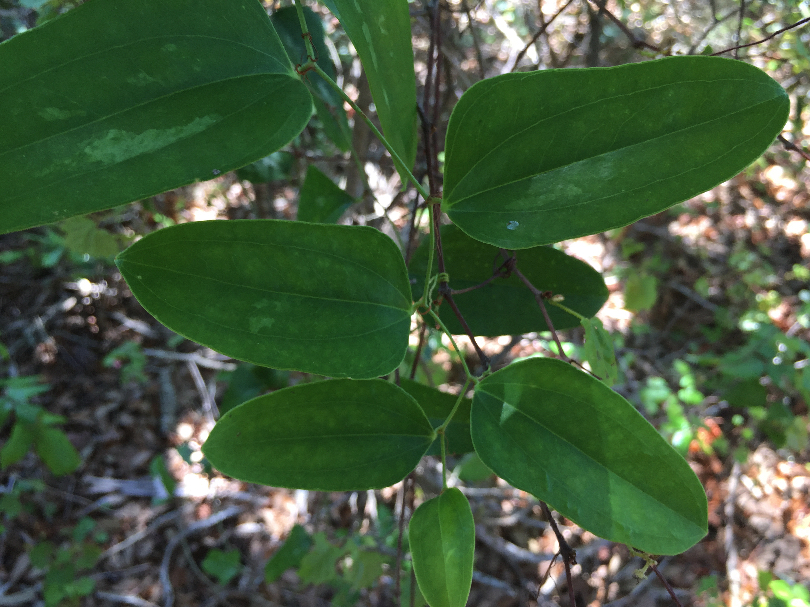
Smilax ovalifolia
(A. DC.) Roxb.
Giant sarsaparilla
iNaturalist· cc-by-nc
(c) Rujuta Vinod, some rights reserved (CC BY-NC), uploaded by Rujuta Vinod
iNaturalist· cc0
no rights reserved
Description
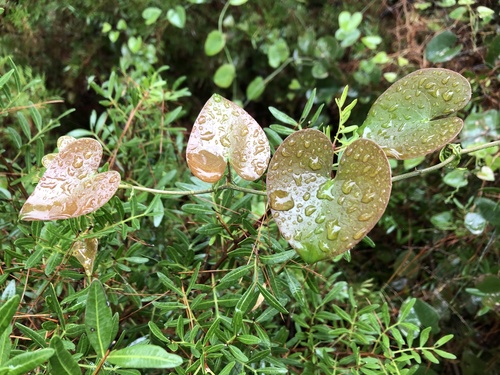
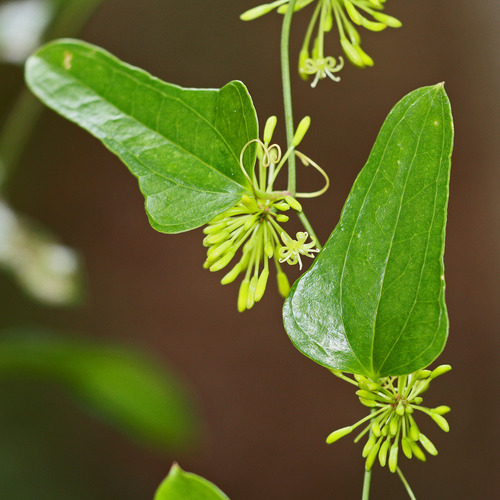
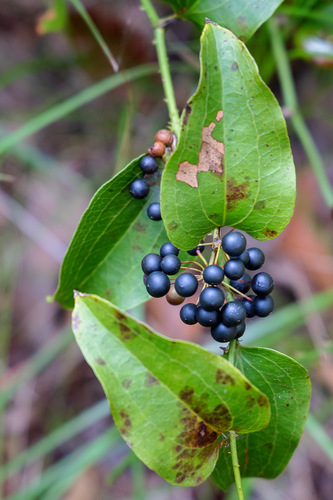
A twining shrub or climbing vine. It is armed with some prickles. The stems are branched. They can be 10 m long and are woody. The leaves are stalked. The stalks are 1.6-3 cm long and they have narrow wings for about half their length. Leaves are 10-20 cm long and 3.5-15 cm wide. They can be larger. They are oval and taper to the tip. There can be 1-3 flowering stalks together. They have 12-40 flowers each. The flowers are yellowish. The fruit is a berry and round. It is dark red and 0.9-1.2 cm across.
Edible Uses
The tender shoots and leaves are cooked as a vegetable, used in curry, and pickled. The ripe fruit are eaten fresh. The root is used as a substitute for sarsaparilla.
Traditional Uses
The tender shoots and leaves are cooked as a vegetable. They are used in curry. They are also pickled. The ripe fruit are eaten fresh. The root is used as a substitute for sarsparilla. It is used in medicine.
Medicinal Uses
The root is used in traditional medicine as a sarsaparilla substitute.
Distribution
It is a tropical plant. In Nepal plants grow to about 1400 m altitude. They grow in moist places in forested areas. In China it grows in forests from near sea level to 1500 m altitude in the south. In India it grows on the Deccan.
Where It Grows
Asia, Cambodia, Himalayas, India, Indochina, Laos, Malaysia, Myanmar, Nepal, Northeastern India, Pacific, Pakistan, Papua New Guinea, PNG, SE Asia, Sri Lanka, Thailand, Vietnam,
Cultivation
Plants are grown from seed.
Notes
There are about 300 Smilax species.
Synonyms
Also Known As
Atkir, Bagh achura lota, Chob-chini, Daini lahara, Fupro, Ghotvel, Guti, Hana, Hok-a-paw, Jangli-aushbah, Kaiha, Kaltamara, Kamakua, Konda tamara, Kukurdaino, Kukurdiano, Kumarika, Kumbhi, Luan ye ba qia, Malaittamarai, Mitri, Nadar, Nirubetta, Pundi marang atikir, Ralbu, Ramdatan, Tamboli, Tao wanyang, Yorit
References (29)
- Acharya K. P. and Acharya, R., 2010, Eating from the Wild: Indigenous knowledge on wild edible plants in Parroha VDC of Rupandehi District, Central Nepal. International Journal of Social Forestry. 3(1):28-48
- Ambasta, S.P. (Ed.), 2000, The Useful Plants of India. CSIR India. p 578
- Aryal, K. P., et al, 2018, Diversity and use of wild and non-cultivated edible plants in the Western Himalaya. Journal of Ethnobiology and Ethnomedicine (2018) 14:10
- Bandyopadhyay, S. et al, 2009, Wild edible plants of Koch Bihar district, West Bengal. Natural Products Radiance 8(1) 64-72
- Borrell, O.W., 1989, An Annotated Checklist of the Flora of Kairiru Island, New Guinea. Marcellin College, Victoria Australia. p 100+3, 168
Show all 29 references Hide references
- Chen Xinqi, Liang Songyun, Xu Jiemei, Tamura M.N., Liliaceae. Flora of China. p 41
- Dangol, D. R., 2002, Economic uses of forest plant resources in western Chitwan, Nepal. Banko Janakari, 12(2): 56-64
- Dangol, D. R. et al, 2017, Wild Edible Plants in Nepal. Proceedings of 2nd National Workshop on CUAOGR, 2017.
- Eiadthong, W., et al, 2010, Management of the Emerald Triangle Protected Forests Complex. Botanical Consultant Technical Report. p 51
- Flora of Pakistan. www.eFloras.org (As Smilax macrophylla)
- GAMMIE, (As Smilax macrophylla)
- Johnson, N., 2002, Environmental Change in northern Thailand: Impact on Wild Edible Plant Availability. Ecology of Food and Nutrition, 41: 5, 373-399
- Joshi, N., et al, 2007, Traditional neglected vegetables of Nepal: Their sustainable utilization for meeting human needs. Tropentag 2007. Conference on International Agricultural Research for Development.
- Joshi, N. & Siwakoti, M., 2012, Wild Vegetables Used by Local Community of Makawanpur District and Their Contribution to Food Security and Income Generation. Nepal Journal of Science and Technology Vol. 13, No. 1 (2012) 59-66
- Kachenchart, B., et al, 2008, Phenology of Edible Plants at Sakaerat Forest. In Proceedings of the FORTROP II: Tropical Forestry Change in a Changing World. Bangkok, Thailand.
- Lim, T. K., 2015, Edible Medicinal and Non Medicinal Plants. Volume 9, Modified Stems, Roots, Bulbs. Springer p 77
- Manandhar, N.P., 2002, Plants and People of Nepal. Timber Press. Portland, Oregon. p 430
- Mozhui, R., et al, 2011, Wild edible fruits used by the tribals of Dimapur district of Nagaland, India. Pleione 5(1): 56 - 64
- Patiri, B. & Borah, A., 2007, Wild Edible Plants of Assam. Geethaki Publishers. p 147
- Pegu, R., et al, 2013, Ethnobotanical study of Wild Edible Plants in Poba Reserved Forest, Assam, India. Research Journal of Agriculture and Forestry Sciences 1(3):1-10
- Pfoze, N. L., et al, 2012, Survey and assessment of floral diversity on wild edible plants from Senapati district of Manipur, Northeast India. Journal of Biodiversity and Environmental Sciences. 1(6):50-52
- Sadhale, A., et al, 1991, Ethnobotanical studies of sacred grove at Ajiwali, Pune district. J. Econ. Tax. Bot. Vol. 15 No. 1 pp 167-172 (As Smilax macrophylla)
- Saikia, M., 2015, Wild edible vegetables consumed by Assamese people of Dhemaji District of Assam, NE India and their medicinal values. Archives of Applied Science Research, 2015, 7 (5):102-109 (As Smilax macrophylla)
- Singh, A. G., Panthi, M. P., & Tewari, D. D., 2012, Wild Plants Used as Vegetable in Rupandehi District of Nepal and their Ethnomedicinal Importance. J. Nat. Hist. Mus. Vol. 26, 2012, 111-125 (As Smilax macrophylla)
- Sukarya, D. G., (Ed.) 2013, 3,500 Plant Species of the Botanic Gardens of Indonesia. LIPI p 971 (As Smilax macrophylla)
- Thapa, L. B., et al, 2014, Wild Edible Plants used by endangered and Indigenous Raji Tribe in Western Nepal. International Journal of Applied Sciences and Biotechnology. Vol 2(3):243-252
- Uprety, Y., et al, 2011, Plant biodiversity and ethnobotany inside the projected impact area of the Upper Seti Hydropower Project, Western Nepal. Environ. Dev. Sustain. (2011) 13:463-492
- Uprety, Y., et al, 2012, Diversity of use and local knowledge of wild edible plant resources in Nepal. Journal of Ethnobotany and Ethnomedicine 8:16
- WATT