Smilax china
Linn.
Sun Moon Vine, China root, Chinese Sarsaparilla
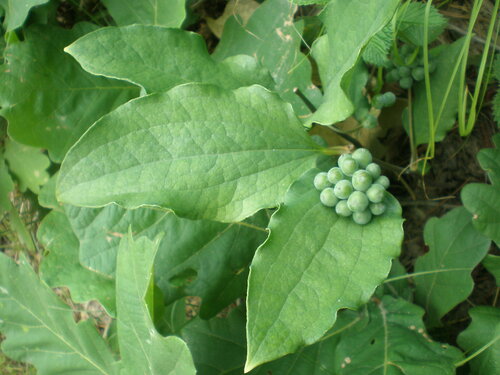
iNaturalist· cc0
no rights reserved, uploaded by 葉子
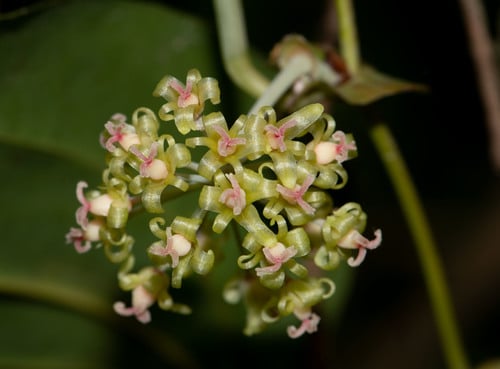
iNaturalist· cc-by-nc
(c) Stargazer, some rights reserved (CC BY-NC)
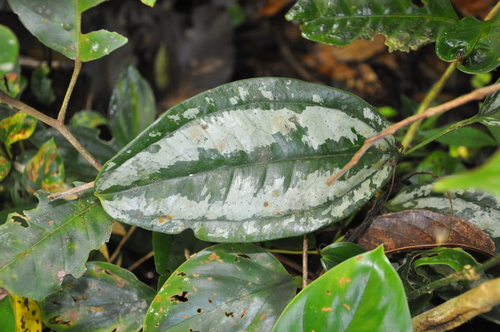
iNaturalist· cc-by-nc
(c) 山羌, some rights reserved (CC BY-NC)
Summary
Source: WikipediaSmilax china is a climbing plant species in the genus Smilax. It is native to China, Korea, Taiwan, Japan (including Ryukyu and Bonin Islands), Philippines, Vietnam, Thailand, Myanmar, and India. It is also known as china root, china-root, or chinaroot, as is the related Smilax glabra.
Description
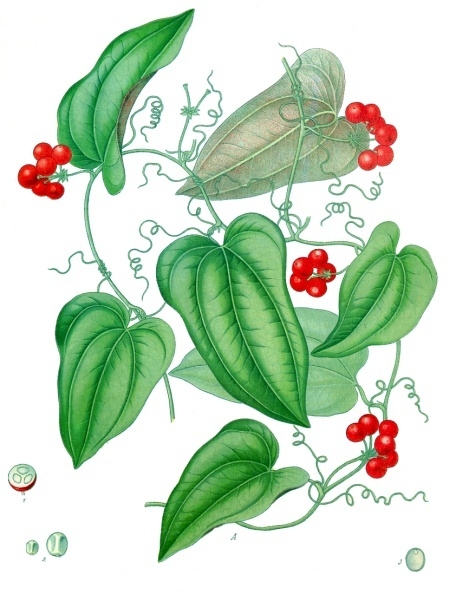
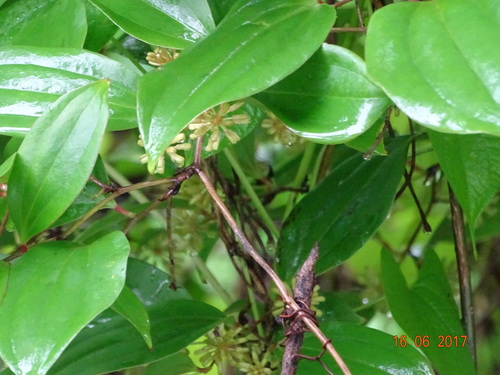
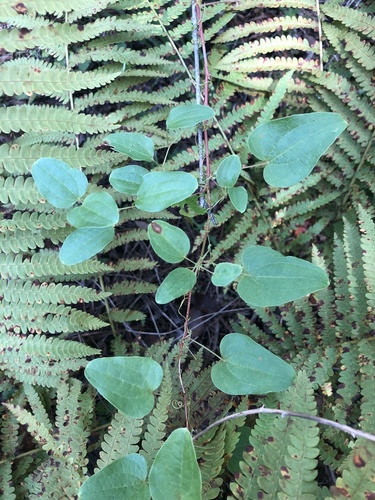
A climbing vine. It loses its leaves during the year. The roots are brown and feel woody and grow horizontally. The rhizomes are irregular and like tubers. The stems are branched and 1-5 m long. They are woody with some prickles. The leaf stalk is 0.5-1.5 cm long with narrow wings for more than half the length. There are tendrils. The leaf blade is oval and 3-10 cm long by 1.5-6 cm wide. The flowers are borne in the axil of a young leaf. The flower stalk is 1-2 cm long. There are 10-25 flowers of both sexes. They are yellowish green. The fruit are red berries. They are round and 0.6-1.5 cm wide.
Edible Uses
The root is cooked — large, fleshy and rich in starch, it can be dried and ground into a powder. Roots are harvested by severing the larger ones near the crown and leaving the smaller roots to continue growing. Young shoots and leaves can be eaten raw or cooked as a potherb. The leaves are said to contain rutin, though no quantity was given. The fruit, about 9mm in diameter, is eaten raw to quench thirst. A tea is also made from the leaves.
Traditional Uses
The young leaves are eaten with oil and salt. They are also boiled as a vegetable. The leaves are also used to make a tea drink. The fruit are eaten to quench thirst. The roots are eaten. The are boiled and made into stock.
Medicinal Uses
The root is alterative, antiscrophulatic, carminative, depurative, diaphoretic, diuretic and tonic. It is considered useful internally for old syphilitic cases and for certain skin diseases including psoriasis, as well as for rheumatoid arthritis, gout, enteritis, urinary tract infections and skin ulcers. Large doses can cause nausea and vomiting, which is considered beneficial in weakened or depraved conditions resulting from a poisoned state of the blood. The root is harvested in autumn and dried for later use.
Distribution
It grows in forests and thickets on hillsides and grassy slopes in shady places near streams. In China it can be from sea level to 2000 m. In Sichuan and Yunnan.
Where It Grows
Asia, Australia, Britain, China, Egypt, Europe, France, Germany, Hong Kong, India, Indochina, Indonesia, Iran, Italy, Japan, Korea, Malaysia, Mediterranean, Middle East, Myanmar, Netherlands, North Africa, Northeastern India, Pacific, Philippines, SE Asia, Spain, Taiwan, Thailand, Vietnam,
Cultivation
Succeeds in most well-drained soils in sun or semi-shade. Hardy to about -15°c. A climbing plant, supporting itself by means of tendrils and thorns as it scrambles through small trees and shrubs. A young plant is growing and thriving close to a west-facing wall at Kew Botanical gardens. This species is not the true 'China root' of medicine, see the record for S. pseudo-china. Dioecious. Male and female plants must be grown if seed is required.
Propagation
Sow seed in March in a warm greenhouse — though this guidance likely applies to tropical members of the genus. Seeds from plants of cooler regions appear to need a period of cold stratification, and some species can take two or more years to germinate. For temperate species, sow in a cold frame as soon as seed is received, or ideally as soon as it is ripe. When seedlings germinate, prick out into individual pots and grow on in a greenhouse for at least the first year, though keeping them in pots for two years is preferable. Plant out into permanent positions in early summer. Divide in early spring as new growth begins; larger divisions can go straight into permanent positions, while smaller ones are best potted up and grown on in a lightly shaded cold frame until well established, then planted out in summer. Cuttings of half-ripe shoots can be taken in July in a frame.
Other Uses
A yellow dye is made from the root and leaves using alum as a mordant. With iron sulphate as the mordant, the resulting colour is brown.
Other Information
It is sold in local markets in China.
Notes
There are about 300 Smilax species. It is used in medicine.
Synonyms
Also Known As
Akar restong, Ba qia, Cheongmiraedeonggul, Chob-chini, Galong China, Greenbrier, Hhqqiqhmqhav, Jun se-pi, Ma-chia, Ma jia ci, Reucheu, Susni, Thassap
References (27)
- Altschul, S.V.R., 1973, Drugs and Foods from Little-known Plants. Notes in Harvard University Herbaria. Harvard Univ. Press. Massachusetts. no. 369
- Ambasta, S.P. (Ed.), 2000, The Useful Plants of India. CSIR India. p 577
- Bodkin, F., 1991, Encyclopedia Botanica. Cornstalk publishing, p 932
- Brickell, C. (Ed.), 1999, The Royal Horticultural Society A-Z Encyclopedia of Garden Plants. Convent Garden Books. p 963
- Burkill, I.H., 1966, A Dictionary of the Economic Products of the Malay Peninsula. Ministry of Agriculture and Cooperatives, Kuala Lumpur, Malaysia. Vol 2 (I-Z) p 2073
Show all 27 references Hide references
- Chen, B. & Qiu, Z., Consumer's Attitudes towards Edible Wild Plants, Ishikawa Prefecture, Japan. p 26 www.hindawi.com/journals/ijfr/aip/872413.pdf
- Chen Xinqi, Liang Songyun, Xu Jiemei, Tamura M.N., Liliaceae. Flora of China. p 30
- Facciola, S., 1998, Cornucopia 2: a Source Book of Edible Plants. Kampong Publications, p 230
- Ghorbani, A., et al, 2012, A comparison of the wild food plant use knowledge of ethnic minorities in Naban River Watershed Nature Reserve, Yunnan, SW China. Journal of Ethnobiology and Ethnomedicine; 8:17
- Hani Medicine of Xishuangbanna, 1999, p 311
- Hedrick, U.P., 1919, (Ed.), Sturtevant's edible plants of the world. p 610
- Hwang, H., et al, 2013, A Study on the Flora of 15 Islands in the Western Sea of Jeollanamdo Province, Korea. Journal of Asia-Pacific Biodiversity Vol. 6, No. 2 281-310
- Hwang, HS, et al, 2014, Distribution characteristics of plant in the Ungseokbong Mountain, Gyeongsangnam-do, Korea. Journal of Asia-Pacific Biodiversity. 7(2014) e164-e178
- Kim, H. & Song, M., 2013, Ethnobotanical analysis for traditional knowledge of wild edible plants in North Jeolla Province (Korea). Genetic. Resour. Crop Evol. (2013) 60:1571-1585
- Kuo, W. H. J., (Ed.) Taiwan's Ethnobotanical Database (1900-2000), http://tk.agron.ntu.edu.tw/ethnobot/DB1.htm
- Li, D. et al, 2017, Ethnobotanical survey of herbal tea plants from the traditional markets in Chaoshan, China. Journal of Ethnopharmacology. 205 (2017) 195-206
- Lim, T. K., 2015, Edible Medicinal and Non Medicinal Plants. Volume 9, Modified Stems, Roots, Bulbs. Springer p 77
- Medhi, P. & Borthakur, S. K., 2012, Phytoresources from North Cachur Hills of Assam -3: Edible plants sold at Hflong market. Indian Journal of Natural Products and Resources. 3(1) pp 84-109
- Medhi, P. & Borthakur, S. K., 2013, Wild edible plants sold by the Zeme Nagas at the makeshift market of Mahur, Dima Hasao district of Assam. Pleione 7(1): 84 - 93. 2013
- Medhi, P., Sarma, A and Borthakur, S. K., 2014, Wild edible plants from the Dima Hasao district of Assam, India. Pleione 8(1): 133-148
- Plants for a Future database, The Field, Penpol, Lostwithiel, Cornwall, PL22 0NG, UK. http://www.scs.leeds.ac.uk/pfaf/
- READ,
- Reis, S. V. and Lipp, F. L., 1982, New Plant Sources for Drugs and Foods from the New York Botanical Garden herbarium. Harvard. p 27 (As Smilax thomsoniana)
- Song, M., et al, 2013, Traditional knowledge of wild edible plants in Jeju Island, Korea. Indian Journal of Traditional Knowledge. 12(2) pp 177-194
- Sp. pl. 2:1029. 1753
- Tanaka,
- UPHOF,