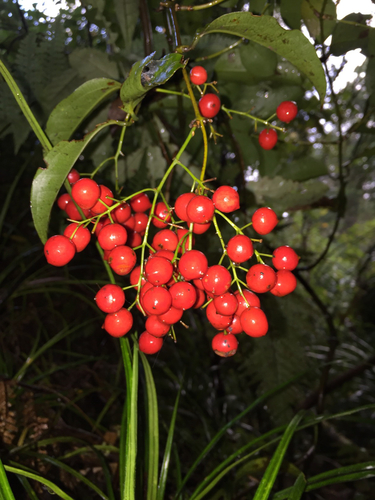
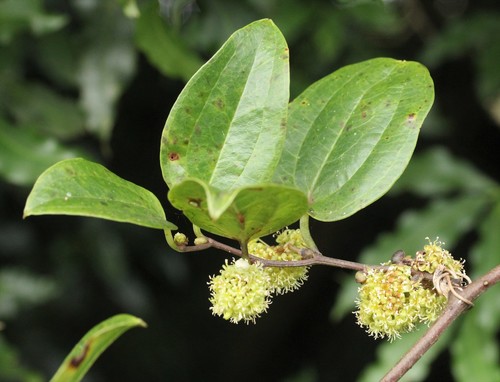
Smilax auriculata
Walter
Earleaf greenbrier
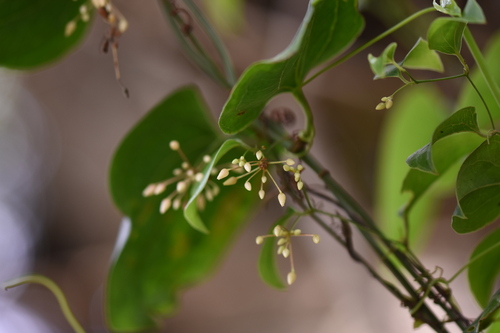
iNaturalist· cc-by-nc-sa
(c) Mary Keim, some rights reserved (CC BY-NC-SA)
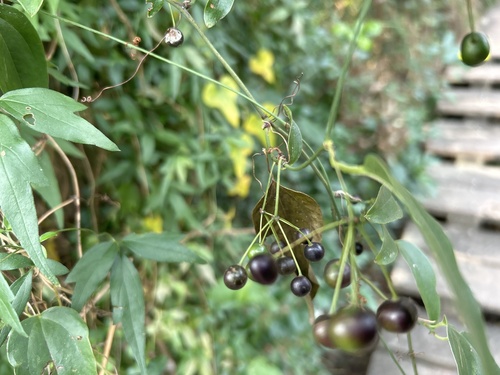
iNaturalist· cc-by-nc
(c) Janet Wright, some rights reserved (CC BY-NC)
Summary
Source: WikipediaSmilax auriculata is a North American plant species native to the Bahamas, the Turks & Caicos Islands, and the southeastern United States. Common names include earleaf greenbrier and wild-bamboo, despite the fact that it is not closely related to bamboo. It is reported from Florida, Georgia, North and South Carolina, Alabama, Mississippi, and Louisiana. It grows on coastal sand dunes and in sun-lit locations in sandy woodlands at elevations of less than 100 m (333 feet). Smilax auriculata is a perennial vine, producing underground rhizomes and sometimes tubers. Plants are climbers with zigzag branching, sometimes reaching a height of 9 m (30 feet). Prickles on the stem are flattened and rigid, about 4 mm (0.16 inches) long. Leaves are evergreen, narrowly ovate, not waxy, up to 8.5 cm (3.4 inches) long. Flowers are green, borne in umbels of 3–8 flowers. Berries are dark purple, almost black, about 6 mm (0.24 inches) in diameter.
Description
An evergreen vine. It keeps growing from year to year. It can be 9 m long. It has prickles on the stem. The leaves are oval. and 8 cm long. The flowers are green and in groups of 3-8 flowers. The fruit are dark purple berries 6 mm across.
Edible Uses
The root is cooked and is rich in starch. It can be dried and ground into a powder for use alongside cereal flours in breads, soups, jellies and similar preparations. The plant produces dense masses of potato-like tubers.
Traditional Uses
Starch is extracted from the roots by pounding.
This uses section is brief — help expand it
Medicinal Uses
The stem prickles have been rubbed on the skin as a counter-irritant to relieve localised pains, muscle cramps and twitching. A tea made from the leaves and stems has been used to treat rheumatism and stomach problems. Wilted leaves are applied as a poultice to boils. A tea brewed from the roots is used to assist in expelling the afterbirth. Reports that the roots contain the hormone testosterone have not been confirmed, though they may contain steroid precursors.
Distribution
It is a warm temperate plant. It grows on coastal sand dunes.
Where It Grows
Bahamas, North America, USA,
Cultivation
We have very little information on this species and do not know if it will be hardy in Britain, though judging by its native range it should succeed outdoors at least in the milder parts of the country. The following notes are based on the general needs of the genus. Succeeds in most soils in sun or semi-shade. Dioecious. Male and female plants must be grown if seed is required.
Propagation
Sow seed in March in a warm greenhouse — though this guidance likely applies to tropical members of the genus. Seeds from plants of cooler regions appear to need a period of cold stratification, and some species can take two or more years to germinate. For temperate species, sow in a cold frame as soon as seed is received, or ideally as soon as it is ripe. When seedlings germinate, prick out into individual pots and grow on in a greenhouse for at least the first year, though keeping them in pots for two years is preferable. Plant out into permanent positions in early summer. Divide in early spring as new growth begins; larger divisions can go straight into permanent positions, while smaller ones are best potted up and grown on in a lightly shaded cold frame until well established, then planted out in summer. Cuttings of half-ripe shoots can be taken in July in a frame.
Other Uses
None known Special Uses
Notes
There are about 300 Smilax species.
References (2)
- Kermath, B. M., et al, 2014, Food Plants in the Americas: A survey of the domesticated, cultivated and wild plants used for Human food in North, Central and South America and the Caribbean. On line draft. p 809
- Plants for a Future database, The Field, Penpol, Lostwithiel, Cornwall, PL22 0NG, UK. http://www.scs.leeds.ac.uk/pfaf/