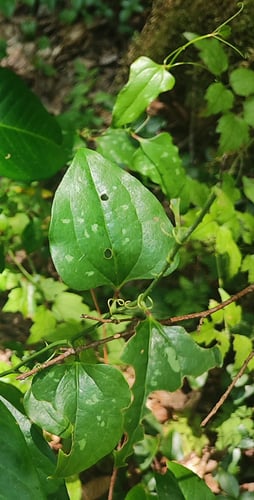
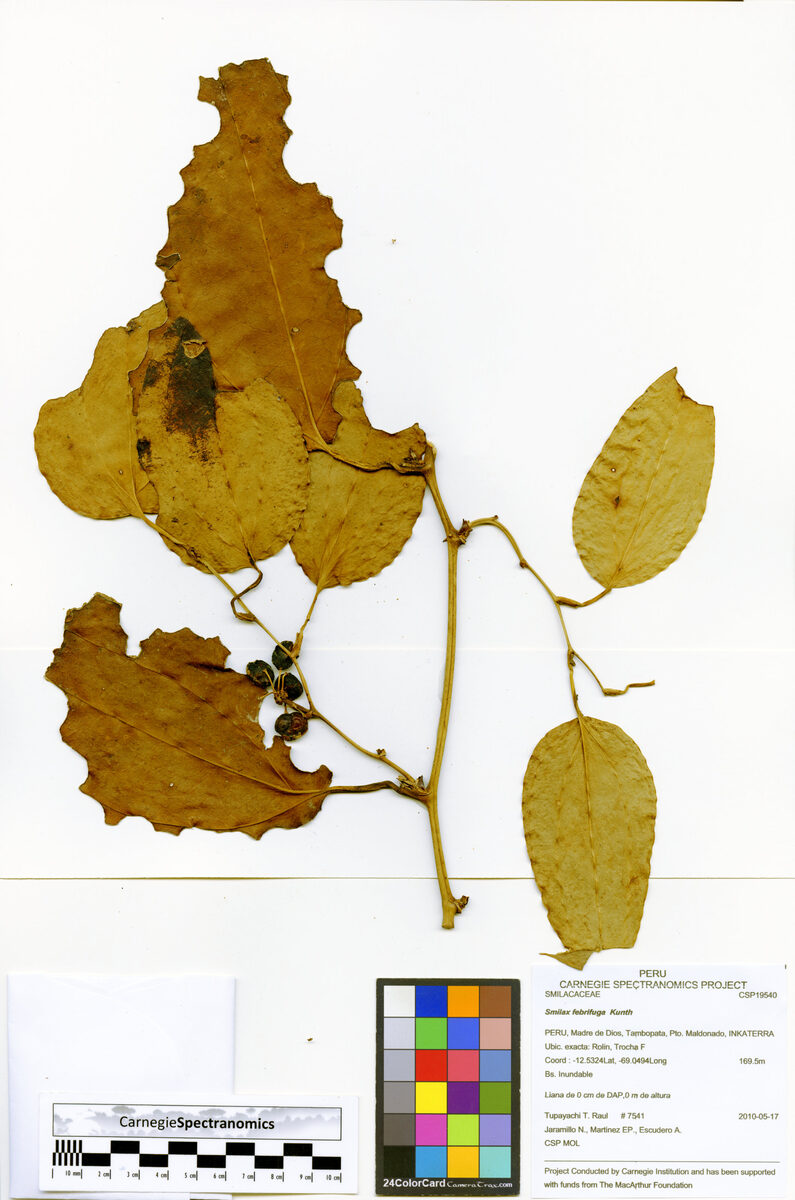
Smilax trinervula
Miq.
San mai ba qia, Cat briar
iNaturalist· cc-by-nc
(c) *みかん丼19杯のささどん, some rights reserved (CC BY-NC)
iNaturalist· cc-by-nc
(c) *みかん丼19杯のささどん, some rights reserved (CC BY-NC)
Summary
A deciduous perennial reaching 1m, flowering April to May with seed maturation October to November. Adapts to light sandy, medium loamy, and heavy clay soils with mildly acid to basic pH. Grows in semi-shaded woodland or full sun, preferring moist conditions. Dioecious species requiring both male and female plants for seed production.
Description
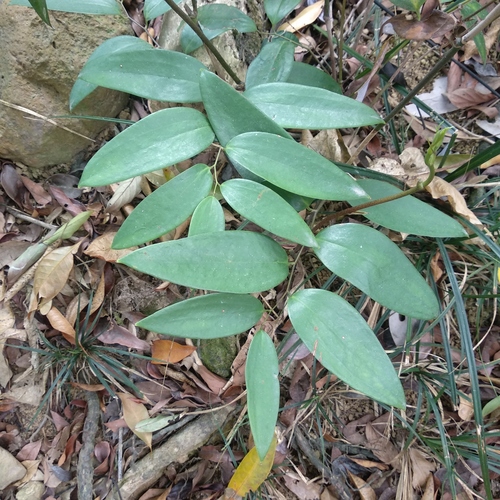
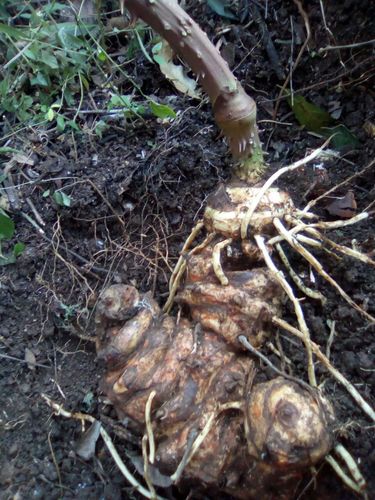
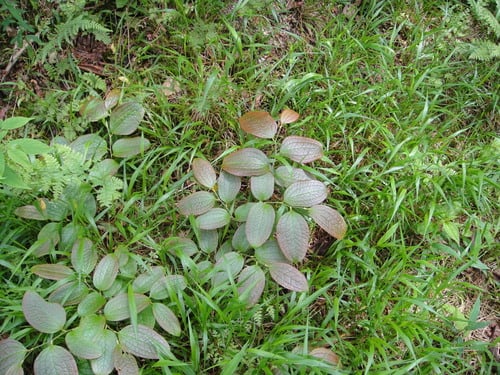
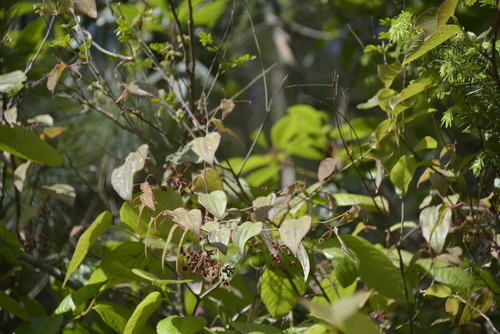
A small shrub which can be climbing. It loses its leaves during the year. The stem is branched. It has few or no prickles. The leaf stalk is 3-5 mm long and with narrow wings. Tendrils are present. The leaf blade is 2-5 cm long by 1-2.5 cm wide. It is papery. The flowering stalk is in the axil of a young leaf. Flowers of both sexes are present and they are greenish yellow. The fruit is a round, red berry. It is 5-6 mm across.
Edible Uses
Young plants are eaten cooked. The red berries, around 6mm in diameter, can be eaten raw.
Medicinal Uses
None known.
Distribution
It is a temperate plant. It grows in forests between 400-1700 m altitude in N & E China.
Where It Grows
Asia, China, Japan,
Cultivation
We have very little information on this species and do not know if it will be hardy in Britain, though judging by its native range it should succeed outdoors in many parts of the country. The following notes are based on the general needs of the genus. Succeeds in most soils in sun or semi-shade. Dioecious. Male and female plants must be grown if seed is required.
Propagation
Seed - sow March in a warm greenhouse. This note probably refers to tropical members of the genus; seeds from cooler areas seem to require cold stratification, with some species taking 2 or more years to germinate. Temperate species are best sown in a cold frame as soon as seed is received, or as soon as it is ripe. When seedlings germinate, prick out into individual pots when large enough to handle and grow on in the greenhouse for at least the first year, though growing on in pots for 2 years is preferable. Plant out into permanent positions in early summer. Division in early spring as new growth begins. Larger divisions can go directly into permanent positions; smaller divisions are best potted up and grown on in a lightly shaded cold frame, planting out once well established in summer. Cuttings of half-ripe shoots, July in a frame.
Other Uses
None known.
Notes
There are about 300 Smilax species.
Synonyms
References (2)
- Chen Xinqi, Liang Songyun, Xu Jiemei, Tamura M.N., Liliaceae. Flora of China. p 30
- READ,