Skimmia laureola
(DC.) Siebold. & Zucc. ex Walp.
wikimedia· cc0
Wikimedia Commons - Francisco Manuel Blanco (O.S.A.)
wikimedia· cc0
Wikimedia Commons - Francisco Manuel Blanco (O.S.A.)
Summary
Source: WikipediaSkimmia laureola is a species of shrub grown as an ornamental plant. The leaves are edible when cooked. The leaves give an aromatic smell when crushed. It produces white flowers that develop into small round red berries. The berries are eaten by birds, which disperse the seeds through their droppings. Its distribution ranges from northern China to the Northern Himalayas. S. laureola is also used in bonsai.
Description
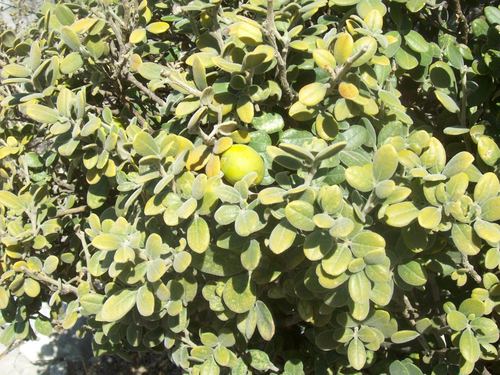
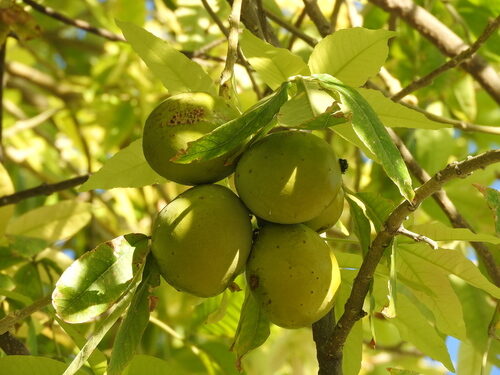
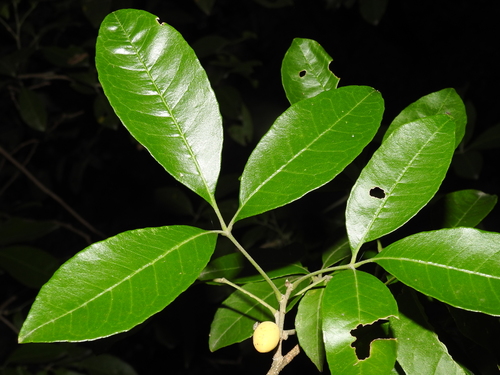
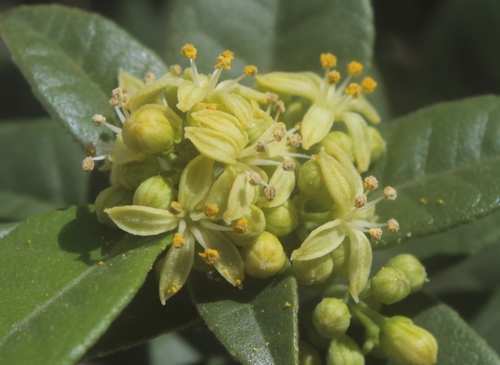
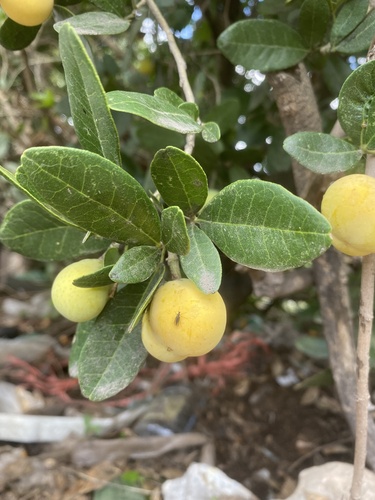
A shrub. It is erect and evergreen. It grows about 2 m high. The bark is smooth. The leaves have stalks. They are crowded at the ends of branches. The leaves are 7-15 cm long by 2-4 cm wide. They are oblong to sword shaped. They taper to the tip and are leathery. They are dotted with glands. Male and female flowers can be on separate plants or the same plant. The flowers are greenish yellow. They have a scent. They are in a branched flower arrangement. The fruit is fleshy with a hard covering over the seed. It is oval and red when ripe.
Edible Uses
The leaves are cooked and used as a condiment. Strongly aromatic, they work well added to curries or as a flavouring in other dishes.
Traditional Uses
The leaves are used as a flavouring. They are also eaten in curries. Caution: The leaves contain skimnianine which is poisonous.
This uses section is brief — help expand it
Medicinal Uses
The leaves are used in the treatment of smallpox. Burning them is said to purify the air through the smoke produced.
Distribution
It is a warm temperate plant. In Nepal it grows between 2400-3100 m altitude. It grows in shady places in the forest. It forms dense patches. It suits hardiness zones 7-10.
Where It Grows
Afghanistan, Asia, Australia, Bhutan, China, Himalayas, India, Myanmar, Nepal, Northeastern India, Pakistan, SE Asia,
Cultivation
Plants are grown from seed or cuttings.
Propagation
Seed can be sown as soon as it is ripe in a cold frame, or in early spring. Prick seedlings out into individual pots when large enough to handle and grow on in a shady position in a cold frame for at least the first winter. Plant out into permanent positions in late spring or early summer, after the last expected frosts. Where seed is plentiful, it can be sown in an outdoor seedbed in early spring and grown on for a couple of years before planting out in late autumn or early spring. Cuttings of half-ripe wood can be taken in July or August in a cold frame. Nearly mature side shoot cuttings, 7–10cm with a heel, taken in September in a cold frame are slow to root and should be left for 18 months before moving to permanent positions; success rate is good. Layering in autumn takes 18 months and gives a good to high success rate.
Other Uses
An essential oil extracted from the leaves is used to scent soap. The dried leaves serve as an incense, while fresh leaves are made into garlands for weddings. Plants can be used as ground cover when spaced about 1 metre apart in each direction. The wood is used to make handles for small farming implements such as hoes and axes.
Notes
A small genus.
Synonyms
Also Known As
Aranth, Chamlani, Narapati, Ner
References (7)
- Cundall, P., (ed.), 2004, Gardening Australia: flora: the gardener's bible. ABC Books. p 1344
- Facciola, S., 1998, Cornucopia 2: a Source Book of Edible Plants. Kampong Publications, p 221
- Manandhar, N.P., 2002, Plants and People of Nepal. Timber Press. Portland, Oregon. p 428
- Martin, F. W., et al, 1987, Perennial Edible Fruits of the Tropics. USDA Handbook 642 p 77
- Plants for a Future database, The Field, Penpol, Lostwithiel, Cornwall, PL22 0NG, UK. http://www.scs.leeds.ac.uk/pfaf/
Show all 7 references Hide references
- Repert. bot. syst. 5:405. 1846
- Singh, H.B., Arora R.K.,1978, Wild edible Plants of India. Indian Council of Agricultural Research, New Delhi. p 37