Ardisia purpurea
Reinw. ex Blume
Purple ardisia.
iNaturalist· cc-by-nc
(c) Gavin, some rights reserved (CC BY-NC), uploaded by Gavin
gbif· cc0
President and Fellows of Harvard College
gbif· cc0
President and Fellows of Harvard College
Description
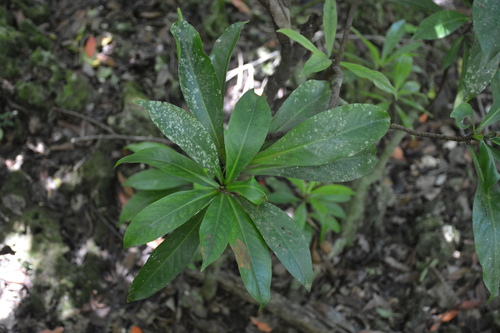
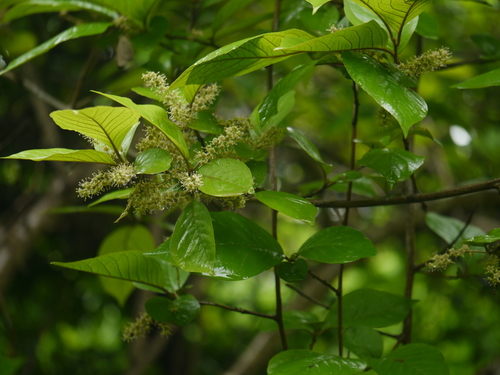
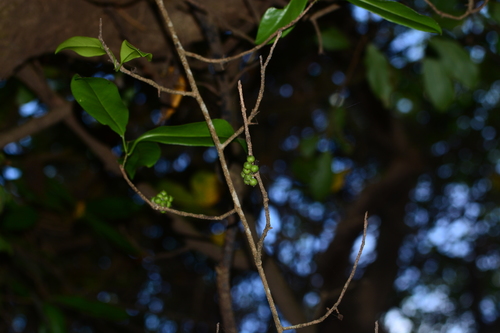
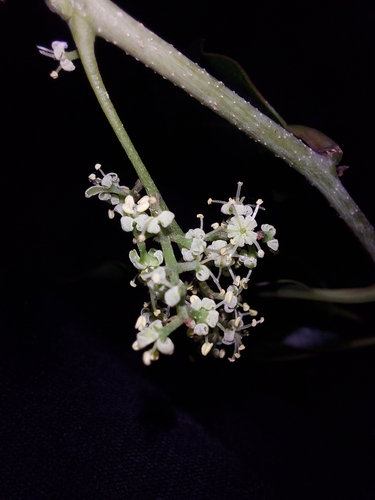
A small tree. It grows to a height of 10 m tall. The trunk can be 15 cm across. The leaves are alternate and rather slender. They are pointed at both ends. The flowers are about 1 cm long. They grow on branched stalks at the ends of branches. The flowers are white or pink. They have a sweet scent. The flower stalks are about 3 cm long. The fruit are dark blue or purple. They are round and about 1 cm across.
Edible Uses
The flowers and fruit are cooked as a flavouring with fish; the leaves are also edible.
Traditional Uses
The flowers and fruit are cooked as a flavouring with fish.
This uses section is brief — help expand it
Distribution
A tropical plant. It occurs from Luzon to Mindanao in the Philippines. It grows in undisturbed mixed dipterocarp forests up to 1,000 m above sea level.
Where It Grows
Asia, Indonesia, Malaysia, Pacific, Philippines, SE Asia, Thailand,
Cultivation
Plants can be grown from seeds.
Notes
There are about 250-300 Ardisia species. They are mainly in the tropics. Also put in the family Myrsinaceae.
Synonyms
Also Known As
Baluluos, Jempri, Kayu lundong, Kayu mubu, Lempeni kembang ungu, Obah, Raho-raho, Sarusop, Tagpo, Tinbulus
References (4)
- Brown, W.H., 1920, Wild Food Plants of the Philippines. Bureau of Forestry Bulletin No. 21 Manila. p 142 (As Ardisia boiseri)
- Burkill, I.H., 1966, A Dictionary of the Economic Products of the Malay Peninsula. Ministry of Agriculture and Cooperatives, Kuala Lumpur, Malaysia. Vol 1 (A-H) p 219 (As Ardisia boiseri)
- Martin, F.W. & Ruberte, R.M., 1979, Edible Leaves of the Tropics. Antillian College Press, Mayaguez, Puerto Rico. p 206 (As Ardisia boiseri)
- Sukarya, D. G., (Ed.) 2013, 3,500 Plant Species of the Botanic Gardens of Indonesia. LIPI p 584