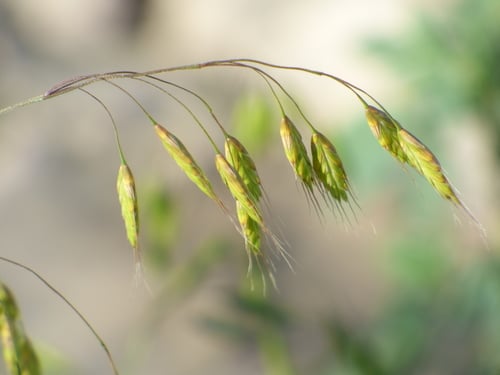
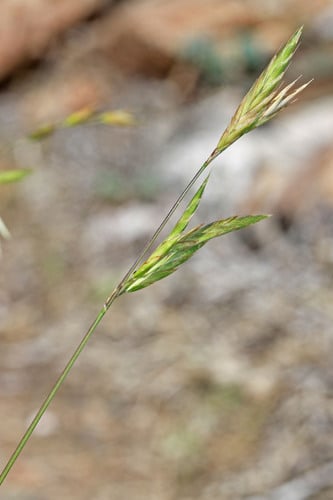
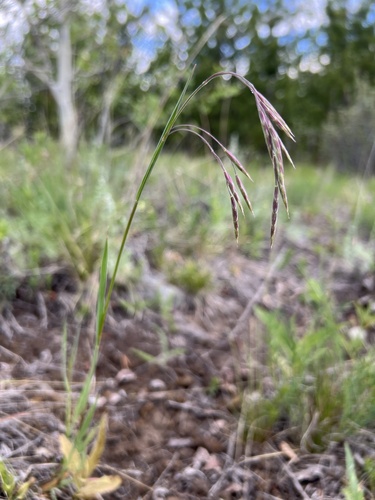
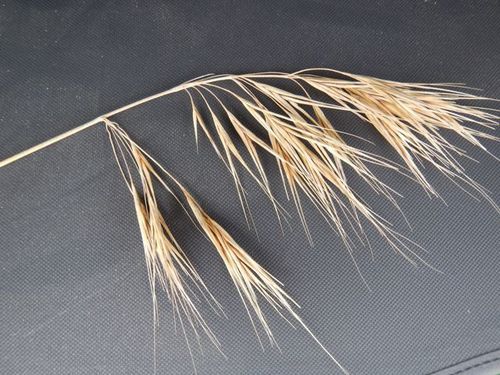
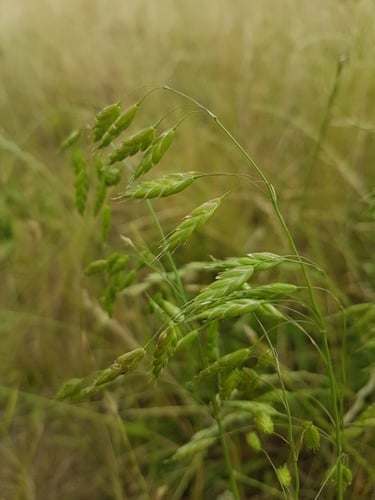
Setaria palmifolia
(J. Koenig) Stapf
Short pitpit, Pleated pigeon-grass
iNaturalist· cc-by-nc
(c) Kinmatsu Lin, some rights reserved (CC BY-NC), uploaded by Kinmatsu Lin
iNaturalist· cc-by-nc-nd
(c) Jim Huang(松葉蕨), some rights reserved (CC BY-NC-ND), uploaded by Jim Huang(松葉蕨)
iNaturalist· cc0
no rights reserved, uploaded by 葉子
Summary
Source: WikipediaSetaria palmifolia is a species of grass known by the common names palmgrass, highland pitpit, hailans pitpit, short pitpit, broadleaved bristlegrass, and knotroot.
Description
A grass with a broad leaf blade. A plant grows from 60 cm to one metre tall. It has a knotty rhizome or underground stem. The leaves are 2 to 8 cm wide, 30-40 cm long and folded along their length. The leaf blade is folded like a fan and is hairy. The plant forms a clump of shoots and is about 1 m high. The shoots are thickened near the end in cultivated types. The flower is a loose open grass flower. A range of different varieties occur. These have different amounts of red, green and white colouring on the leaf and also where the leaves wrap around the stem. The seeds are about 3 mm long and borne in large numbers on shoots at the ends of the stalks. Normally a plant produces a clump of shoots due to both suckers near the base and buds growing from the side of the short stem. There are several cultivated varieties.
Edible Uses
The seeds can be boiled or roasted and used as a substitute for rice. The hearts of young shoots are edible raw, steamed, or cooked with rice. Very young plants are eaten raw as a side dish with rice.
Traditional Uses
The fattened shoots are eaten. They can be steamed, eaten raw or cooked with rice. The seeds are used as a substitute for rice in times of shortage. They are boiled or roasted.
Medicinal Uses
The plant is used medicinally.
Distribution
A tropical plant. They are common and widely distributed from Luzon to Palawan and Mindanao in the Philippines. It grows from near sea level up to about 2400 m. It can grow in shady places and suits wet climates. This grass occurs as a wild plant, insignificantly used for food in several countries. These include Taiwan, Philippines, Malaysia, Indonesia, Papua New Guinea, Solomon Islands, and Hawaii. Sometimes either the shoots or seeds of this wild plant are used as a famine food reserve. In Papua New Guinea, and to a smaller extent in other places, this species reaches significance as a domesticated, cultivated food plant. A number of named cultivated varieties occur. In the Cairns Botanical Gardens. In Sichuan and Yunnan.
Where It Grows
Africa, Asia, Australia, Bangladesh, China, Guianas, Guyana, Hawaii, Himalayas, India, Indochina, Indonesia, Laos, Malaysia, Myanmar, Nepal, Pacific, Pakistan, Papua New Guinea, PNG, Philippines, Samoa, SE Asia, Sierra Leone, Sikkim, Solomon Islands, Suriname, Taiwan, Tibet, USA, West Africa, West Papua,
Cultivation
Wild plants grow from seed. Garden types grow from pieces of the shoots. Plants are normally propagated by planting shoots. The young shoots are broken off the side of the plant. Shoots near the ground often have roots already growing on them so these shoots start growing more quickly. Portions of the stem can be planted because buds near the joints along the stem can produce new shoots. Wild plants are seed propagated. Cultivated types exist as fully domesticated plants independently of the weedy grass. It needs a reasonably fertile soil and is often planted on steep sides and edges of gardens. Its optimum altitudinal range is 1200m to 2400m. It can tolerate light shade. Plant spacings of about 1 m apart are used. Harvesting commences about 5 months after planting and may continue for up to 2 years.
Propagation
Seed or division.
Other Uses
Cultivated as an ornamental for its palm-like pleated leaves. A folk belief in Taiwan holds that the number of latitudinal creases on a leaf predicts how many typhoons will hit the area in the coming or current typhoon season — giving the plant its local name, typhoon grass.
Production
Harvesting commences about 5 months after planting and may continue for up to 2 years. A yield of 4.8 kg per plant in a year, of the stripped edible shoots has been recorded.
Other Information
It is a commercially cultivated vegetable. An important vegetable in Highland areas of Papua New Guinea. It is used for food in China.
Notes
There are about 130 Setaria species. They are mainly in the tropics and subtropics. Demo
Nutrition
| Part | Moisture | kJ | kcal | Protein | Vit A | Vit C | Iron | Zinc |
|---|---|---|---|---|---|---|---|---|
| Leaves | 91 | 141 | 34 | 1.6 | 3 | 19 | 0.9 | 1 |
Synonyms
Also Known As
Agusahis, Ayas-as, Banspaate kaaguno, Dhoti sara, Highland pitpit, Koir, Jun, Kot, Lachang, Luluwan kebo, Mafene, Mini, Moi, Palm grass, Pandi, Paundi, Pombiy, Seria, Tabu, Teabu, Teiye, Wasia, Yeni, Zong ye gou wei cao
References (36)
- Barrau, J., 1976, Subsistence Agriculture in Melanesia. Bernice P. Bishop Museu, Bulletin 219 Honolulu Hawaii. Kraus reprint. p 59
- Borrell, O.W., 1989, An Annotated Checklist of the Flora of Kairiru Island, New Guinea. Marcellin College, Victoria Australia. p 25
- Brown, W.H., 1920, Wild Food Plants of the Philippines. Bureau of Forestry Bulletin No. 21 Manila. p 28
- Burkill, I.H., 1966, A Dictionary of the Economic Products of the Malay Peninsula. Ministry of Agriculture and Cooperatives, Kuala Lumpur, Malaysia. Vol 2 (I-Z) p 2035
- Facciola, S., 1998, Cornucopia 2: a Source Book of Edible Plants. Kampong Publications, p 179
Show all 36 references Hide references
- Flora of Australia Volume 49, Oceanic Islands 1, Australian Government Publishing Service, Canberra. (1994) p 487
- Flora of Pakistan. www.eFloras.org
- French, B.R., 1986, Food Plants of Papua New Guinea, A Compendium. Asia Pacific Science Foundation p 96
- French, B.R., 2010, Food Plants of Solomon Islands. A Compendium. Food Plants International Inc. p 126
- Grubben, G. J. H. and Denton, O. A. (eds), 2004, Plant Resources of Tropical Africa 2. Vegetables. PROTA, Wageningen, Netherlands. p 565
- Hibbert, M., 2002, The Aussie Plant Finder 2002, Florilegium. p 291
- Hide, R., et al, 1979, A checklist of some plants in the territory of the Sinasina Nimai (Simbai Province, Papua New Guinea), with notes on their uses. Department Anthropology, University of Aukland
- Hussey, B.M.J., Keighery, G.J., Cousens, R.D., Dodd, J., Lloyd, S.G., 1997, Western Weeds. A guide to the weeds of Western Australia. Plant Protection Society of Western Australia. p 70
- J. Linn. Soc., Bot. 42:186. 1914
- Kays, S. J., and Dias, J. C. S., 1995, Common Names of Commercially Cultivated Vegetables of the World in 15 languages. Economic Botany, Vol. 49, No. 2, pp. 115-152
- Kuo, W. H. J., (Ed.) Taiwan's Ethnobotanical Database (1900-2000), http://tk.agron.ntu.edu.tw/ethnobot/DB1.htm
- Lord, E.E., & Willis, J.H., 1999, Shrubs and Trees for Australian gardens. Lothian. p 99
- Martin, F.W. & Ruberte, R.M., 1979, Edible Leaves of the Tropics. Antillian College Press, Mayaguez, Puerto Rico. p 194
- Massal, E. and Barrau, J., 1973, Food Plants of the South Sea Islands. SPC Technical Paper No 94. Nounea, New Caledonia. p 33
- May,
- Milliken, W., 2000, Ethnobotany of the Yali of West Papua. Royal Botanical Garden, Edinburgh. p 10 (wild form) (near Baliem)
- Monsalud, M.R., Tongacan, A.L., Lopez, F.R., & Lagrimas, M.Q., 1966, Edible Wild Plants in Philippine Forests. Philippine Journal of Science. p 472
- Ochse, J.J. et al, 1931, Vegetables of the Dutch East Indies. Asher reprint. p 335
- Paczkowska, G. & Chapman, A.R., 2000, The Western Australian Flora. A Descriptive Catalogue. Western Australian Herbarium. p 116
- Parham, B. E. V., 1972, Plants of Samoa. New Zealand Department of Scientific and Industrial Research. Information Series. No. 85 p 143
- Powell, J.M., Ethnobotany. In Paijmans, K., 1976, New Guinea Vegetation. Australian National University Press. p 111
- Reis, S. V. and Lipp, F. L., 1982, New Plant Sources for Drugs and Foods from the New York Botanical Garden herbarium. Harvard. p 14
- Ryan, S., 2008, Dicksonia. Rare Plants Manual. Hyland House. p 91
- Sillitoe, P. 1995, An Ethnobotanical Account of the Plant Resources of the Wola Region, Southern Highlands Province, Papua New Guinea. J. Ethnobiol. 15(2): 201-235
- Staples, G.W. and Herbst, D.R., 2005, A tropical Garden Flora. Bishop Museum Press, Honolulu, Hawaii. p 749
- Tanaka,
- The Pacific Islands Food Composition Tables http://www.fao.org/docrep No D004
- van Wyk, B., 2005, Food Plants of the World. An illustrated guide. Timber press. p 345
- Wiersema, J. H. & Leon, B., 2013, World Economic Plants. A Standard Reference CRC Press. 2nd Ed. p 633
- Wiriadinata, H., 1995, Ethnobotany of Economic Plants in the Baliem Valley, Jayawijaya, Irian Jaya, Indonesian Institute of Science, Bogor, Indonesia
- World Checklist of Useful Plant Species 2020. Royal Botanic Gardens, Kew