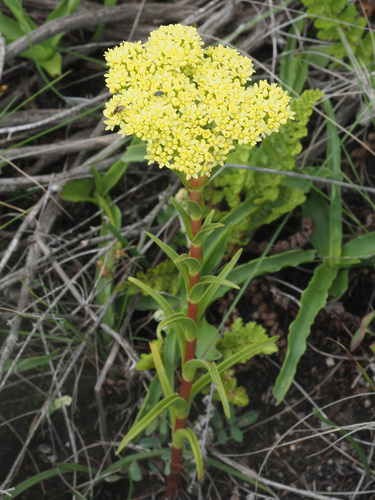
Sedum divergens
Watson
Pacific stonecrop
iNaturalist· cc-by-nc
(c) Micah Lauer, some rights reserved (CC BY-NC), uploaded by Micah Lauer
iNaturalist· cc-by-nc
(c) nicholas-szatkowski, some rights reserved (CC BY-NC)
iNaturalist· cc-by-nc
(c) nicholas-szatkowski, some rights reserved (CC BY-NC)
Summary
Source: WikipediaSedum divergens, commonly called spreading stonecrop, Cascade stonecrop or Pacific stonecrop, is a low growing flowering plant of the genus Sedum. It is native to western North America from Alaska to northern California. This plant is common in the lava beds of Northwest British Columbia where it is one of the food plants of the Nisga'a first nation.
Description
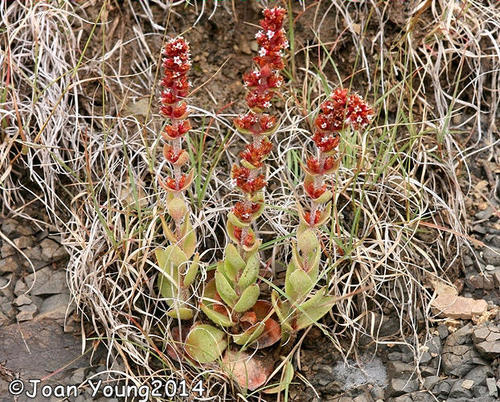
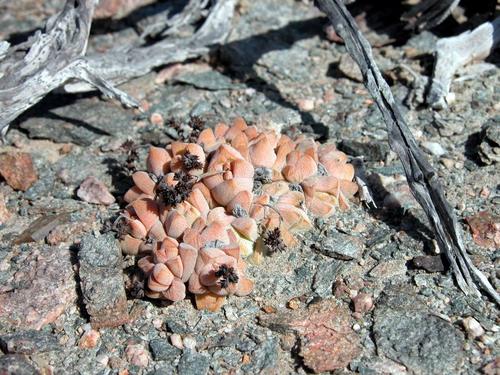
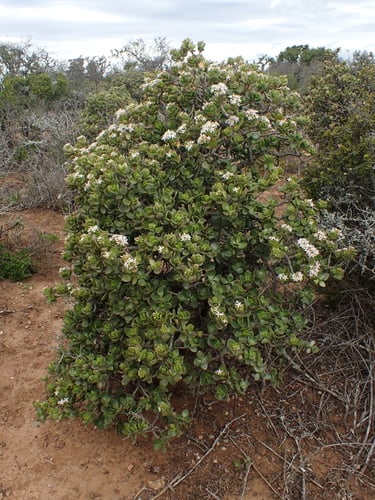
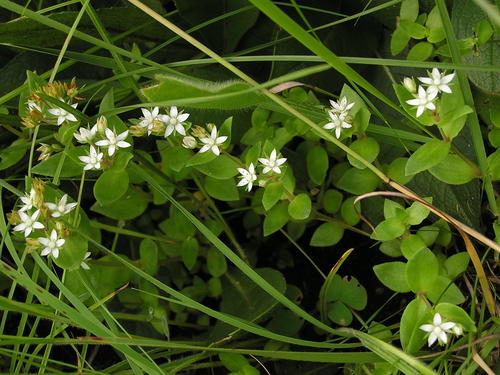
A plant that keeps growing from year to year and forms mats. The stems are short. They have small succulent leaves. Flowerings stems stick upwards. These are 5-10 cm tall. The flowers are in leafy flat-topped clusters. They are yellow.
Edible Uses
The leaves can be eaten raw or cooked. They are very small and round, resembling tiny green berries, with a crisp texture. Some North American Indian tribes valued them as a food and ate them raw.
Traditional Uses
The round fleshy leaves are eaten raw.
This uses section is brief — help expand it
Medicinal Uses
The plant has been used in the treatment of piles and has also been given to children as a laxative.
Known Hazards
Although not poisonous, if large quantities of this plant are eaten it can cause a stomach upset.
Distribution
It grows on rocky ledges and slopes. It can be on the coast but is usually in the mountains.
Where It Grows
Canada, North America, USA,
Cultivation
Succeeds in most soils but prefers a fertile well-drained soil and requires a sunny position. Established plants are drought tolerant. All members of this genus are said to have edible leaves, though those species, such as this one, that have yellow flowers can cause stomach upsets if they are eaten in quantity. Plants in this genus seem to be immune to the predations of rabbits.
Propagation
Surface sow seed in spring in well-drained soil in a sunny greenhouse position, keeping the soil moist. Prick out seedlings into individual pots when large enough. Plant out during summer if growth is sufficient; otherwise overwinter in a cold frame or greenhouse and plant out in early summer the following year. Division can be carried out at almost any time in the growing season, though spring or early summer is best. Large divisions can go directly into permanent positions; smaller ones are best potted up and grown on in a lightly shaded cold frame until well established.
Other Uses
None known.
Notes
There are about 400 Sedum species.
References (4)
- MacKinnon, A., et al, 2009, Edible & Medicinal Plants of Canada. Lone Pine. p 254
- Moerman, D. F., 2010, Native American Ethnobotany. Timber Press. p 525
- Plants for a Future database, The Field, Penpol, Lostwithiel, Cornwall, PL22 0NG, UK. http://www.scs.leeds.ac.uk/pfaf/
- Turner, N., 1995, Food Plants of Coastal First Peoples. Royal BC Museum Handbook p 72