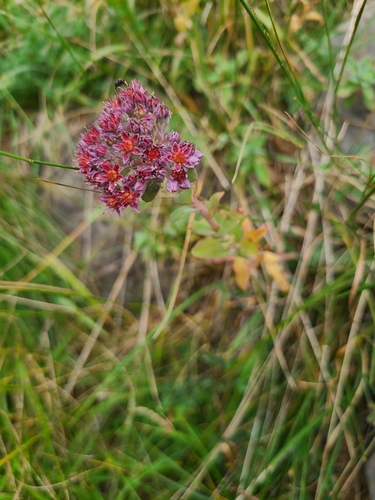
Sedum album
L.
Small houseleek, Stone crop
iNaturalist· cc-by-nc
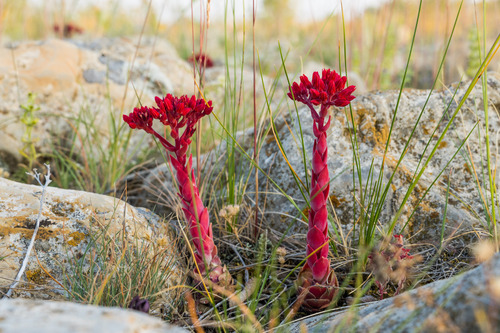
(c) mobbini, some rights reserved (CC BY-NC), uploaded by mobbini
iNaturalist· cc-by
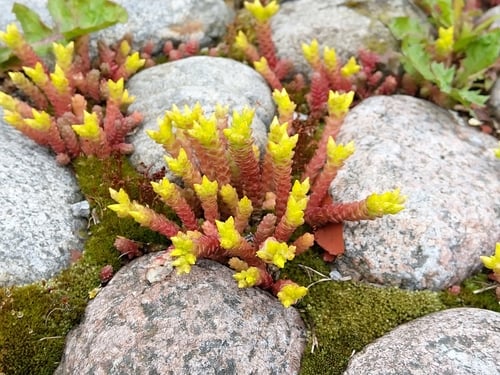
(c) Katja Schulz, some rights reserved (CC BY)
iNaturalist· cc-by-nc
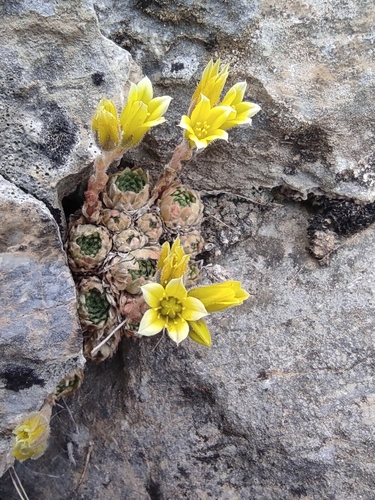
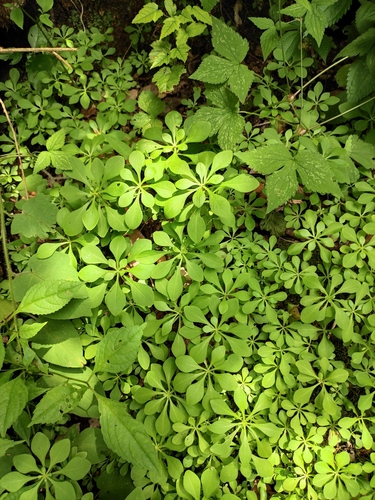
(c) Matthieu Gauvain, some rights reserved (CC BY-NC), uploaded by Matthieu Gauvain
Summary
Source: WikipediaSedum album, the white stonecrop, is a flowering plant of the genus Sedum in the family Crassulaceae. It is found in the northern temperate regions of the world, often growing in crevices or free-draining rocky soil. As a long-day plant it grows vegetatively for most of the year and flowers in summer.
Description
A small succulent plant. It grows 5-10 cm high and spreads 20-50 cm wide. It spreads and forms mats. It keeps growing from year to year. The leaves are 6-18 mm long. They are narrow and cylinder shaped and often have a red tint. The flowers are small and white and in heads.
Edible Uses
The leaves can be eaten raw or cooked. They are most commonly prepared as a pickle, but can also be added to salads or cooked alongside other leafy vegetables.
Traditional Uses
The leaves are eaten as a snack. They add flavour and are used in salads. Caution: The plant contains 2 alkaloids sedine and sedamine so should not be eaten in large amounts when raw but these get destroyed with cooking.
Medicinal Uses
The leaves and stems are applied externally as a poultice to inflammations and are especially recommended for treating painful haemorrhoids.
Distribution
It is a temperate plant. It grows on rocky places and stone walls. It suits hardiness zones 6-10.
Where It Grows
Africa, Asia, Australia, Balkans, Bosnia, Britain, Czech Republic, Europe, France, Greece, Ireland, Italy, Luxembourg, Mediterranean, North Africa, Norway, Portugal, Scandinavia, Sedum, Slovenia, Spain, Tasmania, Turkey, Türkiye, USA,
Cultivation
A very easily grown plant, it succeeds in most soils but prefers a fertile well-drained soil. Established plants are drought tolerant, they grow well in dry soils and succeed on a wall. Requires a sunny position. Plants spread rapidly and aggressively at the roots. If clearing the plant from an area it is quite important to try and remove every part of the plant since even a leaf or a small part of the stem, if left on the ground, can form roots and develop into a new plant. This species has white flowers. All members of this genus are said to have edible leaves, though those species that have yellow flowers can cause stomach upsets if they are eaten in quantity. Plants in this genus seem to be immune to the predations of rabbits. An evergreen.
Propagation
Surface sow seed in spring in well-drained soil in a sunny greenhouse position, keeping the soil moist. Prick out seedlings into individual pots when large enough. Plant out during summer if growth is sufficient; otherwise overwinter in a cold frame or greenhouse and plant out in early summer the following year. Division can be done at almost any time in the growing season, though spring or early summer is best. Large divisions can go directly into permanent positions; smaller ones are best potted up and grown on in a lightly shaded cold frame until well established.
Other Uses
The plant spreads aggressively and is well suited to ground cover in sunny spots among plants tall enough not to be overrun. Space plants approximately 45cm apart each way. Strong-growing bulbs such as certain lilies will grow happily through this ground cover. The plant tolerates very low moisture levels and has been used as a green covering on roofs. Green roofs of this kind provide wildlife habitat, insulate the building, and help improve the environment. The subspecies minima and the cultivars 'Athorum' and 'Coral Carpet' have been specifically noted for this use.
Notes
There are about 400 Sedum species.
Synonyms
Also Known As
ArrozBela homulica, Bijeli zednjak, çoban kavurgası, Hvitbergknapp, Pizzagallina, Risino, Una de gato
References (17)
- Baker, M. L. & de Salas, M. F., 2012, A Census of the Vascular Plants of Tasmania. (On line)
- Blamey, M and Grey-Wilson, C., 2005, Wild flowers of the Mediterranean. A & C Black London. p 72
- Blanco-Salas, J., et al, 2019, Wild Plants Potentially Used in Human Food in the Protected Area “Sierra Grande de Hornachos” of Extremadura (Spain). Sustainability 2019, 11, 456
- Cundall, P., (ed.), 2004, Gardening Australia: flora: the gardener's bible. ABC Books. p 1329
- Ertug, F, Yenen Bitkiler. Resimli Türkiye Florası -I- Flora of Turkey - Ethnobotany supplement
Show all 17 references Hide references
- Girard, N. J., 2020, Sustainable Foraging of Wild Edible Plants in Norway. A Biocultural Approach. M. Sc. thesis Norwegian University. p 130
- Hammer, K. & Spahillari, M., 1999, Crops of European origin. in Report of a networking group on minor crops. IPGRI p 46
- Hedrick, U.P., 1919, (Ed.), Sturtevant's edible plants of the world. p 601
- http://www.botanic-gardens-ljubljana.com/en/plants
- Irving, M., 2009, The Forager Handbook, A Guide to the Edible Plants of Britain. Ebury Press p 290
- Jackes, D. A., 2007, Edible Forest Gardens
- Pieroni, A., 1999, Gathered wild food plants in the Upper Valley of the Serchio River (Garfagnana), Central Italy. Economic Botany 53(3) pp 327-341
- Plants for a Future database, The Field, Penpol, Lostwithiel, Cornwall, PL22 0NG, UK. http://www.scs.leeds.ac.uk/pfaf/
- Redzic, S. J., 2006, Wild Edible Plants and their Traditional Use in the Human Nutrition in Bosnia-Herzegovina. Ecology of Food and Nutrition, 45:189-232
- Simkova, K. et al, 2014, Ethnobotanical review of wild edible plants used in the Czech Republic. Journal of Applied Botany and Food Quality 88, 49-67
- Sp. pl. 1:432. 1753
- Tardio, J., et al, Ethnobotanical review of wild edible plants in Spain. Botanical J. Linnean Soc. 152 (2006), 27-71