Arctostaphylos glauca
Lindl.
Bigberry manzanita, Great-berried manzanita
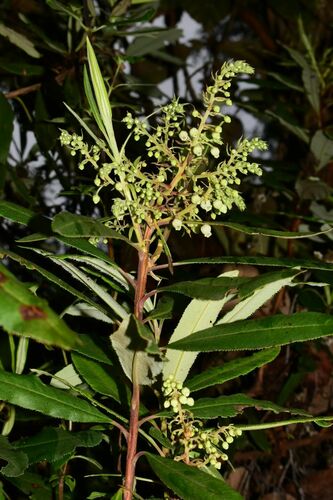
iNaturalist· cc-by-nc-sa
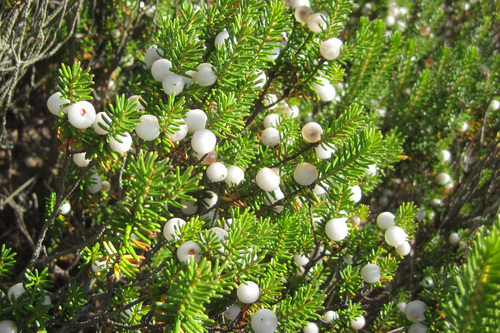
(c) Paul G. Johnson, some rights reserved (CC BY-NC-SA), uploaded by Paul G. Johnson
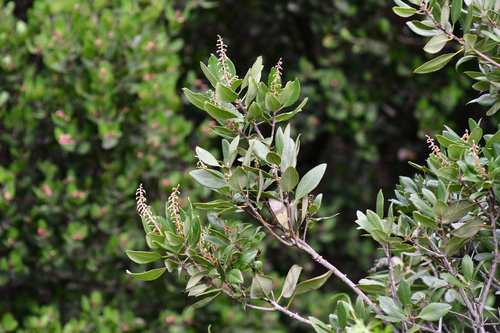
iNaturalist· cc-by-nc
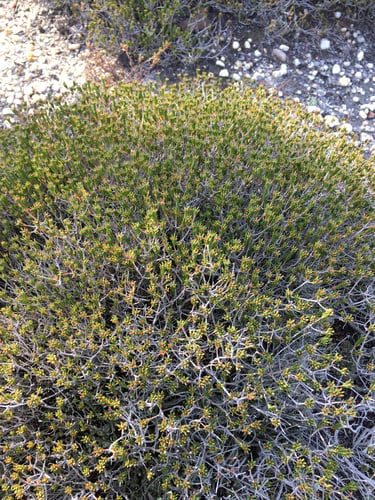
(c) Diego Tamayo, some rights reserved (CC BY-NC), uploaded by Diego Tamayo
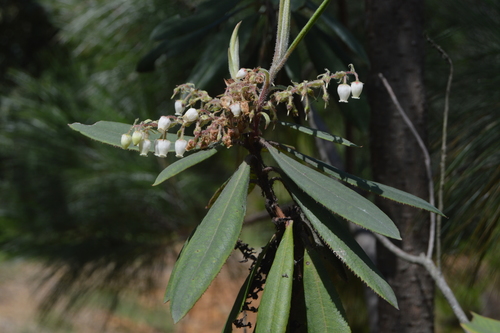
iNaturalist· cc-by-nc
(c) Diego Tamayo, some rights reserved (CC BY-NC), uploaded by Diego Tamayo
Summary
Source: WikipediaArctostaphylos glauca is a species of manzanita known by the common name bigberry manzanita. It is native to California and Baja California, where it grows in the chaparral and woodland of coastal and inland hills. In October 2025, Arctostaphylos glauca was established as the State Shrub of California.
Description
A large shrub or small tree. It grows 3-6 m high. The bark is red brown. The leaves are dull greyish-green. The leaves are 35 mm long. They are oval in shape. The flowers are white or pink. The fruit grow in clusters. The fruit are white but turn red then black.
Edible Uses
Edible Parts: Fruit Edible Uses: Drink Fruit - raw or cooked. The fruit is used fresh or it can be dried and ground into a powder then used to make mush or added to soups etc. It can also be used to make preserves or a beverage that resembles cider in flavour. A drink is made from the berries by sprinkling them with water, kneading them with the hands, mashing them and then soaking them in the sun for about 12 hours. The liquid is then sieved to remove the pulp before being drunk on its own or with Chia (see Salvia columbiana). Water could be drained through the pulp a second time. The liquid was said to be sweet and fattening. The fruit is dry and with little flavour. The seeds can be dried, ground into a powder and used to make a mush or cakes. The seed is rather small, it would most probably have been used together with the fruit and not have been separated from it.
Traditional Uses
The fresh fruit are eaten raw. They are also used for jelly and drinks. The dried fruit can be ground into flour. Caution: Raw fruit eaten in large amounts can have ill side affects.
Medicinal Uses
Antiseptic Astringent Diuretic Skin Urinary The dried leaves are used in the treatment of a variety of complaints. These leaves should be harvested in early autumn, only green leaves being selected, and then dried in gentle heat. A tea made from the dried leaves is strongly astringent, diuretic and an antiseptic for the urinary tract. It is much used for kidney and bladder complaints and inflammation of the urinary tract, but it should be used with caution because it contains arbutin which hydrolyzes into the toxic urinary antiseptic hydroquinone. Externally, an infusion is used to treat poison oak rash.
Distribution
It is a warm temperate plant. It is native to California in the USA. It will tolerate temperatures down to -10°C. It grows best in full sun. It suits hardiness zones 8-10.
Where It Grows
Australia, Canada, North America, USA,
Cultivation
Requires a deep moist well-drained light or medium lime-free loam in sun or semi-shade but plants produces less fruit when they are grown in the shade. Prefers a warm sunny position. Found on dry soils in the wild, one report says that it succeeds in a hot dry position. Hardy to between -5 and -10°c, succeeding outdoors in the milder parts of Britain. Plants resent root disturbance and should be placed in their final positions as soon as possible.
Propagation
Seed - best sown in a greenhouse as soon as it is ripe. Pre-soak dried seed in boiling water for 10 - 20 seconds or burn some straw on top of them and then stratify at 2 - 5°c for 2 months. The seed usually germinates in 2 - 3 months at 15°c. When large enough to handle, prick the seedlings out into individual pots and grow them on in a greenhouse or cold frame for at least their first winter, Plant out in late spring or early summer. Cuttings of side shoots of the current season's growth, 5 - 8cm with a heel, August to December in a frame. Takes one year. Division in early spring. Take care because the plant resents root disturbance. Pot the divisions up and keep them in a lightly shaded position in a cold frame or greenhouse until they are growing away actively. Layering in spring.
Other Uses
Broom Dye Fuel Wood A yellowish-brown dye is obtained from the leaves, it does not require a mordant. The branches have been used to make a broom. The wood makes a good fuel, producing a lot of heat and burning for a long time. The wood is hard and tough. It is used for making small tools, awl handles etc. Special Uses
Notes
There are about 50 Arctostaphylos species.
Synonyms
References (11)
- Beckstrom-Sternberg, Stephen M., and James A. Duke. "The Foodplant Database." http://probe.nalusda.gov:8300/cgi-bin/browse/foodplantdb.(ACEDB version 4.0 - data version July 1994)
- Bircher, A. G. & Bircher, W. H., 2000, Encyclopedia of Fruit Trees and Edible Flowering Plants in Egypt and the Subtropics. AUC Press. p 38
- Cundall, P., (ed.), 2004, Gardening Australia: flora: the gardener's bible. ABC Books. p 175
- Edward's Bot. Reg. 21: sub t. 1791. 1835
- Etherington, K., & Imwold, D., (Eds), 2001, Botanica's Trees & Shrubs. The illustrated A-Z of over 8500 trees and shrubs. Random House, Australia. p 101
Show all 11 references Hide references
- Facciola, S., 1998, Cornucopia 2: a Source Book of Edible Plants. Kampong Publications, p 95
- Glowinski, L., 1999, The Complete Book of Fruit Growing in Australia. Lothian. p 181
- Hedrick, U.P., 1919, (Ed.), Sturtevant's edible plants of the world. p 69
- Lyle, S., 2006, Discovering fruit and nuts. Land Links. p 76
- Plants for a Future database, The Field, Penpol, Lostwithiel, Cornwall, PL22 0NG, UK. http://www.scs.leeds.ac.uk/pfaf/
- Tozer, F., 2007, The Uses of Wild Plants. Green Man Publishing. p 34