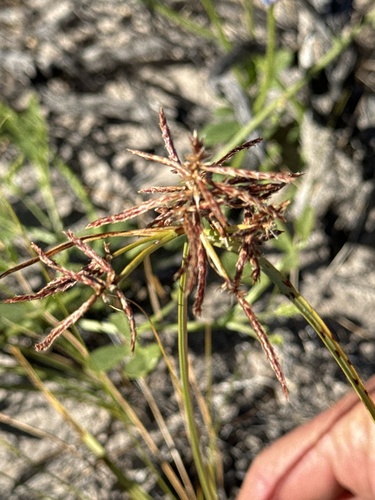
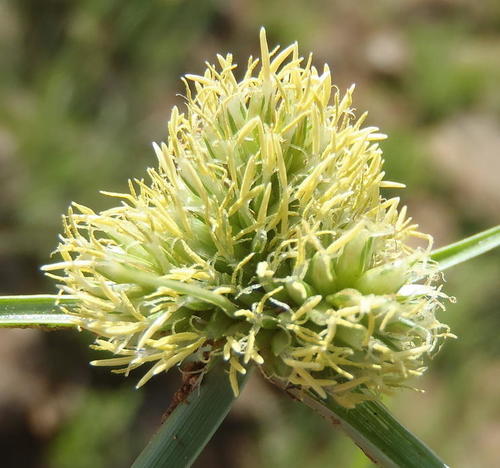
Scirpus validus subsp. creber
Fernald.
Glaucous Bulrush
iNaturalist· cc-by-nc
(c) naturalistchu, some rights reserved (CC BY-NC)
iNaturalist· cc-by-nc
(c) naturalistchu, some rights reserved (CC BY-NC)
iNaturalist· cc-by-nc
(c) naturalistchu, some rights reserved (CC BY-NC)
Description
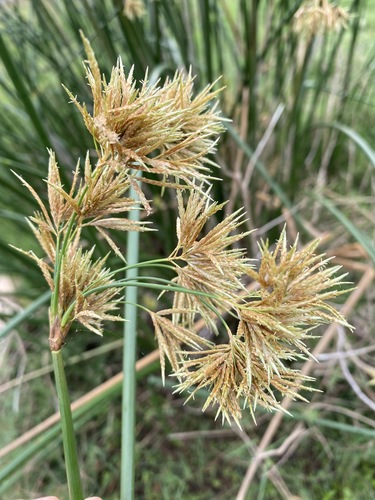
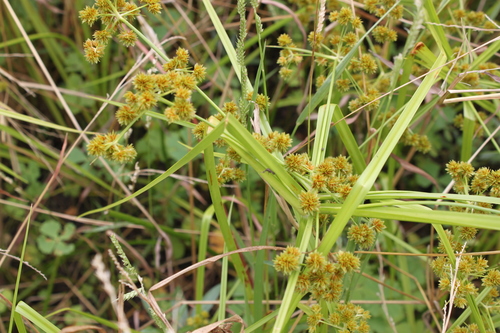
A sedge. These grow in clumps and have grass like leaves and solid stalks. They keep growing from year to year. They grow 3.5 m tall. The roots or rhizomes are tough and scaly brown. The stems are rounded and soft. They are not branched. The flowers are in spikes near the stem tips. Each flower has several stalks in clusters. The clusters are up to 1 cm long. They are flat and have overlapping scales. The seeds are hard and flat. They are 5 mm long.
Edible Uses
Young shoots and roots are eaten cooked or preserved in rice bran. The tender base of the stem is eaten raw in salads. The pollen is used in soups and bread. Young roots can be bruised and boiled in water to make a sweet syrup. The seeds are also edible.
Traditional Uses
The young shoots and roots are eaten cooked They are also preserved in rice bran. The tender base of the stem is eaten raw in salads. The pollen is used in soups and bread. The bruised young roots boiled in water give a sweet syrup. The seeds can be eaten.
Known Hazards
No hazards mentioned.
Distribution
It is a temperate plant. It is best in partly shaded areas. It needs moist soil.
Where It Grows
North America, USA,
Cultivation
It can be grown from seed.
References (4)
- Esperanca, M. J., 1988. Surviving in the wild. A glance at the wild plants and their uses. Vol. 1. p 393
- Facciola, S., 1998, Cornucopia 2: a Source Book of Edible Plants. Kampong Publications, p 90
- Plants for a Future database, The Field, Penpol, Lostwithiel, Cornwall, PL22 0NG, UK. http://www.scs.leeds.ac.uk/pfaf/
- Tanaka,