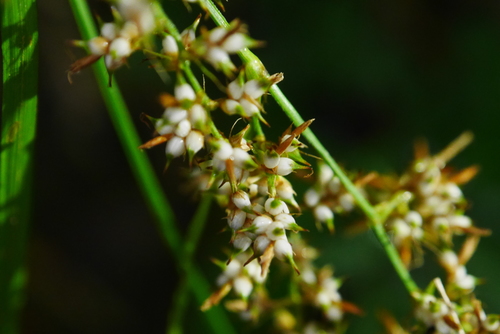
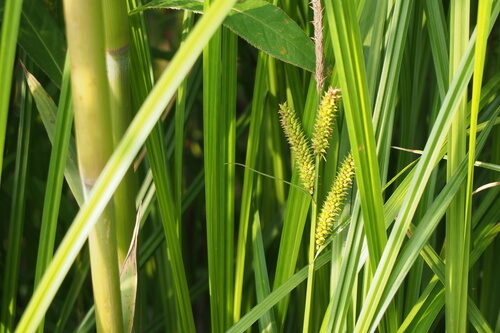
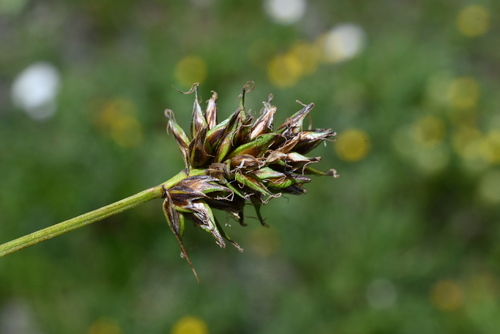
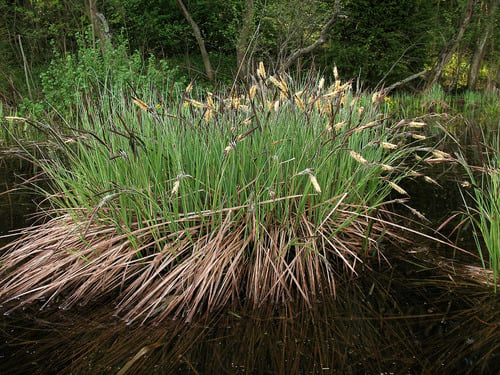
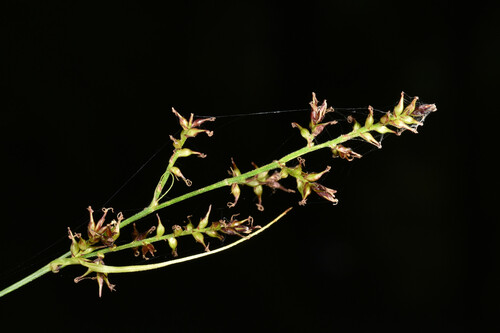
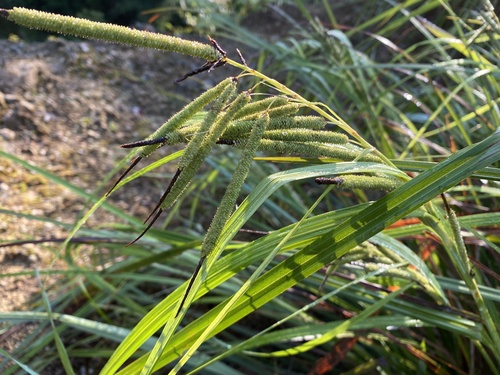
Scirpus maritimus
L.
Seaside Bulrush. Cosmopolitan Bulrush
gbif· cc-by-nc
Brigham Young University
gbif· cc0
Colorado Mesa University
gbif· cc-by-nc-nd
Grouard Jean-Christophe
Description
Scirpus maritimus is a PERENNIAL growing to 1 m (3ft 3in) by 1 m (3ft 3in). See above for USDA hardiness. It is hardy to UK zone 6. It is in flower from July to August, and the seeds ripen from August to September. The species is monoecious (individual flowers are either male or female, but both sexes can be found on the same plant) and is pollinated by Wind. Suitable for: light (sandy), medium (loamy) and heavy (clay) soils. Suitable pH: mildly acid, neutral and basic (mildly alkaline) soils and can grow in saline soils. It cannot grow in the shade. It prefers moist or wet soil and can grow in water. The plant can tolerate maritime exposure.
Edible Uses
Root - raw or cooked. Rich in starch, it is usually dried and ground into a powder. The roots form tubers at intervals along their length and new plants are formed from these tubers. When first formed, the tubers are white and starchy with a sweet coconut-milk flavour, they become black and woody with age. Tubers can be up to 2.5cm in diameter. Seed - cooked. They can be ground into a powder and used as a mush.
Medicinal Uses
Astringent Diuretic. The root is astringent and diuretic. It is used in the treatment of amenorrhoea, dysmenorrhoea, abdominal pain or tumours for post-partum females, abdominal distension and indigestion.
Distribution
Found in most regions of the world, including Britain, but absent from the Arctic.
Where It Grows
TEMPERATE ASIA: Oman, Afghanistan, Cyprus, Egypt (Sinai), Iran, Iraq, Israel, Jordan, Lebanon, Syria, Turkey, Russian Federation-Ciscaucasia (Ciscaucasia), Armenia, Azerbaijan, Georgia, Russian Federation (Dagestan), Russian Federation-Western Siberia (Western Siberia), Russian Federation-Eastern Siberia (Eastern Siberia), Kazakhstan, Kyrgyzstan, Tajikistan, Turkmenistan, Uzbekistan, Russian Federation (Habarovskij kraj, Primorye, Amur, Kamcatskij kraj, Sakhalin) TROPICAL ASIA: India (north), Pakistan, Indochina, Thailand NORTHERN AMERICA: Canada (Northwest Territories, Québec, Nova Scotia, Ontario, Prince Edward Island, New Brunswick, Saskatchewan, Alberta, Manitoba, British Columbia), United States (Alaska, Maine, Massachusetts, Michigan, New Hampshire, New Jersey, New York, Rhode Island, Connecticut, Illinois, Iowa, Kansas, Minnesota, Missouri, Nebraska, North Dakota, Oklahoma, South Dakota, Colorado, Idaho, Montana, Oregon, Washington, Wyoming, New Mexico, Texas, Arizona, California, Nevada, Utah), Mexico (Sinaloa, Sonora, Baja California (Norte) Colima, México, Ciudad de México) SOUTHERN AMERICA: Suriname, Peru, Argentina (Buenos Aires, Chubut, Formosa, Mendoza, Río Negro, Tucumán) PACIFIC: United States (Hawaii) EUROPE: Denmark, Finland, United Kingdom, Ireland, Norway, Sweden, Austria, Belgium, Switzerland, Czech Republic, Germany, Hungary, Netherlands, Poland, Slovakia, Russian Federation (European part), Belarus, Estonia, Lithuania, Latvia, Moldova, Russian Federation (Kalmykija, Respublika, Astrakhan, Saratov, Volgogradskaja oblast), Ukraine (incl. Krym), Albania, Bulgaria, Greece (incl. Crete), Croatia, Italy (incl. Sardinia, Sicily), Montenegro, Romania, Serbia, Slovenia, Spain (incl. Baleares), France (incl. Corsica), Portugal AFRICA: Spain (Canarias), Portugal (Azores, Madeira Islands), Algeria, Libya, Morocco, Tunisia, Ethiopia, Somalia, Kenya, Tanzania, Mali, Mauritania, Senegal, South Africa (Eastern Cape, Northern Cape, Western Cape, Gauteng)
Cultivation
Succeeds in any wet to moisture retentive ground, pond margins and shallow water in full sun or shade.
Propagation
Seed - sow in a cold frame as soon as it is ripe in a pot standing in 3cm of water. Only just cover the seed with soil. The seed usually germinates fairly quickly. Prick out the plants when large enough to handle and plant out in their permanent positions in early summer. Division in spring. Very easy, larger divisions can be planted out direct into their permanent positions. We have found it best to pot up the smaller divisions and grow them on in a lightly shaded position in a cold frame, planting them out once they are well established in the summer.
Other Uses
Basketry Weaving. The leaves are used in weaving and basketry. The leaves have been used to secure the edges of woven mats, as the warp for sandals, as the warps and twining wefts for clothing, to secure the edges of skirts etc. They have been used to make twined mats for the insides of houses.