Archontophoenix cunninghamiana
(Wendl.) Wendl. & Drude
Bangalow palm, Piccabeen palm
iNaturalist· cc-by-nc
(c) Scott W. Gavins, some rights reserved (CC BY-NC), uploaded by Scott W. Gavins
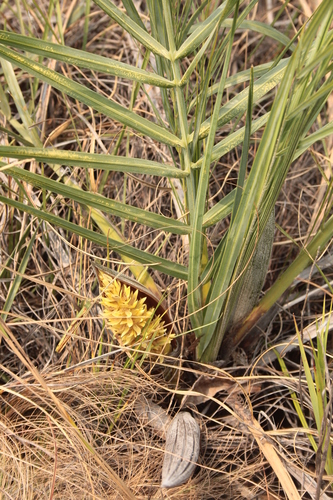
iNaturalist· cc0
no rights reserved, uploaded by Tiago Lubiana
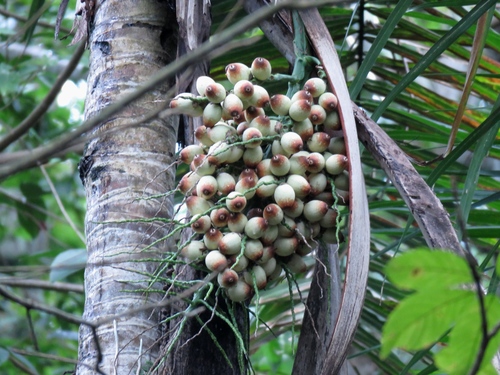
iNaturalist· cc-by
(c) Peter Crowcroft, some rights reserved (CC BY), uploaded by Peter Crowcroft
Summary
Source: WikipediaArchontophoenix cunninghamiana – commonly known as Bangalow palm, king palm, Illawarra palm or piccabeen palm – is a tree in the palm family Arecaceae, which is endemic to the east coast of New South Wales and Queensland, Australia.
Description
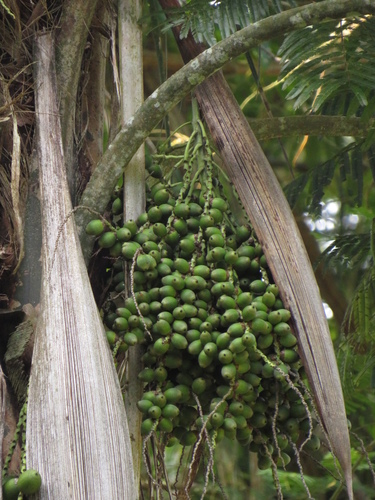
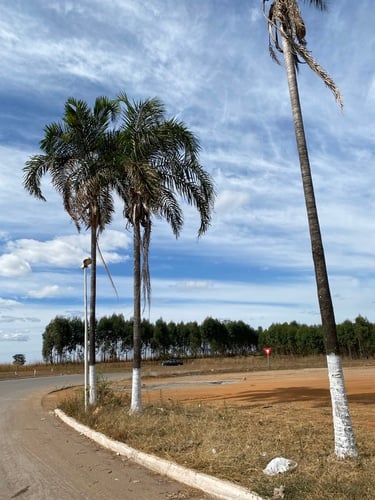
A tall single stemmed feather leafed palm. It has a bright green to rusty brown crown shaft formed by the leaf sheaths. This is 1 m long. The fronds are long and curved and form an umbrella shaped crown. The trunk is brown to grey. It grows to 25 m tall and is 30 cm across. It has rings of leaf scars along the trunk. The leaves are 2-4 m long and divided into drooping leaflets along its length. The leaflets are 60-100 cm long and 5-10 cm wide. They have long pointed tips. The leaf stalk twists along its length making the end fronds vertical. The flowering stalk is large and branched. It is 40-90 cm long. Several flowering stalks are often present at the same time. Two large papery bracts which are thin and pointed enclose the flowers but fall before flowers open. The flowers are pink, stalk-less and 1 cm across. Male and female flowers are on the same stalk. They are in spiral arrangements of irregular groups of 3. The fruit are orange red when ripe. They are 10-15 mm across.
Edible Uses
The young shoots emerging from the ground and the palm heart can be eaten raw, though harvesting the shoots kills the palm and is not normally undertaken.
Traditional Uses
The young shoots just coming out of the ground can be eaten raw. As this kills the palm it is not normally useful.
This uses section is brief — help expand it
Distribution
It is a warm temperate and subtropical plant. It grows along stream banks. In northern Australia it grows from sea level to 700 m altitude. They require well-drained soil. They need high humidity. It suits hardiness zones 10-11. In Melbourne Botanical Gardens.
Where It Grows
Africa, Australia, Brazil, East Africa, Pacific, South America, Tasmania, USA, Zimbabwe,
Cultivation
Plants are grown from fresh seed. Seed germinate within 6 months. Seedlings do not transplant easily.
Production
Seedlings grow quickly.
Notes
There are 6 Archontophoenix species.
Synonyms
References (33)
- Blomberry, A.M., 1979, Australian Native Plants. Angus and Robertson p 150
- Blomberry, A. & Rodd, T., 1982, Palms. An informative practical guide. Angus & Robertson. p 48
- Bodkin, F., 1991, Encyclopedia Botanica. Cornstalk publishing, p 96
- Brickell, C. (Ed.), 1999, The Royal Horticultural Society A-Z Encyclopedia of Garden Plants. Convent Garden Books. p 131
- Cooper, W. and Cooper, W., 2004, Fruits of the Australian Tropical Rainforest. Nokomis Editions, Victoria, Australia. p 67
Show all 33 references Hide references
- Cronin, L., 1989, The Concise Australian Flora. Reed. p 205
- Cronin, L., 2000, Australian Palms, Ferns, Cycads and Pandans. Cronin Publications. p 16
- Cundall, P., (ed.), 2004, Gardening Australia: flora: the gardener's bible. ABC Books. p 174
- Elliot, W.R., & Jones, D.L., 1982, Encyclopedia of Australian Plants suitable for cultivation. Vol 2. Lothian. p 224
- Etherington, K., & Imwold, D., (Eds), 2001, Botanica's Trees & Shrubs. The illustrated A-Z of over 8500 trees and shrubs. Random House, Australia. p 101
- Gibbons, M., 1993, Palms. Compact study Guide and Identifier. Sandstone. p 16
- Gibbons, M., 2003, A pocket guide to Palms. Chartwell Books. p 36
- Greig, D., 1996, Flowering Natives for Home Gardens. Angus & Robertson. p 56
- Haslam, S., 2004, Noosa's Native Plants. Noosa Integrated Catchment Assn. Inc. p 320
- Hearne, D.A., & Rance, S.J., 1975, Trees for Darwin and Northern Australia. AGPS, Canberra p 24
- Hibbert, M., 2002, The Aussie Plant Finder 2002, Florilegium. p 31
- Holliday, I., 1989, A Field Guide to Australian Trees. Hamlyn. p 60
- Jones D, L, 1986, Ornamental Rainforest Plants in Australia, Reed Books, p 326
- Jones, D.L., 1994, Palms throughout the World. Smithtonian Institution, Washington. p 57
- Jones, D.L., 2000, Palms of Australia 3rd edition. Reed/New Holland. p 76
- Lazarides, M. & Hince, B., 1993, Handbook of Economic Plants of Australia, CSIRO. p 23
- Leiper, G & Houser, J., Mutooroo. Plant Use by Australian Aboriginal People. Assembly press, Queensland.
- Linnaea 39:214. 1875
- Lord, E.E., & Willis, J.H., 1999, Shrubs and Trees for Australian gardens. Lothian. p 92
- Low, T., 1992, Bush Tucker. Australia’s Wild Food Harvest. Angus & Robertson. p 128
- Melzer, R., & Plumb, J., 2011, Plants of Capricornia. Belgamba, Rockhampton. p 41
- Molyneux, B & Forrester, S., 1997, The Austraflora A-Z of Australian Plants. Reed. p 46
- Morley, B.D., & Toelken, H.R., (Eds), 1983, Flowering Plants in Australia. Rigby. p 394
- Nicholson, N & H., 1996, Australian Rainforest Plants 2, Terania Rainforest Publishing. NSW. p 9
- Recher, P, 2001, Fruit Spirit Botanical Gardens Plant Index. www.nrg.com.au/~recher/ seedlist.html p 7
- Riffle, R.L. & Craft, P., 2003, An Encyclopedia of Cultivated Palms. Timber Press. p 27, 251
- Townsend, K., 1994, Across the Top. Gardening with Australian Plants in the tropics. Society for Growing Australian Plants, Townsville Branch Inc. p 86
- Williams, J.B., Harden, G.J., and McDonald, W.J.F., 1984, Trees and shrubs in rainforests of New South Wales and Southern Queensland. Univ. of New England, Armidale. p 19