Archirhodomyrtus beckleri
(F. Muell.) A.J.Scott
Pink myrtle, Rose myrtle, Beckler's myrtle
iNaturalist· cc-by-nc
(c) Adrian Gale, some rights reserved (CC BY-NC), uploaded by Adrian Gale
iNaturalist· cc-by-nc
(c) Adrian Gale, some rights reserved (CC BY-NC), uploaded by Adrian Gale
iNaturalist· cc-by-nc-nd
(c) sea-kangaroo, some rights reserved (CC BY-NC-ND), uploaded by sea-kangaroo
Summary
Source: WikipediaArchirhodomyrtus beckleri, known as small-leaved myrtle or rose myrtle, is a shrub or small tree native to rainforest areas of eastern Australia. Rose myrtle leaves are 2–8 cm long and 1.5-2.5 cm wide, lanceolate, glossy and pleasantly fragrant when crushed. Flowers are 1 cm across, white, mauve or pink. The edible berry is 0.5-0.8 cm across, globular, yellow orange or red, containing numerous small seeds.
Description
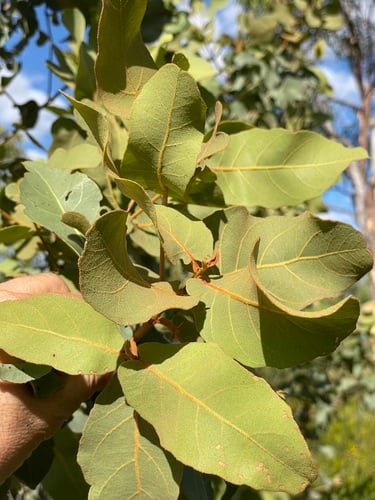
A shrub or small tree. It grows 3-5 m high and spreads 1.5-3 m across. It can be twice that size. The bark is light brown and flaky. The leaves are bright green and glossy. They are simple and 4-8 cm long by 1.5-2.5 cm wide. The leaves can have scattered hairs. The flowers are about 1 cm across. They are white, mauve or pink. They can occur singly or as 2-3 together. The fruit are 5-12 mm long and occur singly or in bunches. They can be in the axils of leaves or at the ends of branches. There are 20-40 seeds inside. The flesh of the fruit is edible.
Edible Uses
The berry has a pleasant aromatic flavor reminiscent of Brazilian cherry. It can be eaten out-of-hand or used in sauces and preserves.
Traditional Uses
The fruit are eaten.
This uses section is brief — help expand it
Distribution
It grows naturally in rainforest in Queensland and New South Wales in Australia. It can grow in tropical, subtropical and temperate regions. It grows from sea level to 1200 m altitude. It needs moist well drained soils. It can grow in full sun or light shade. It can tolerate light frosts.
Where It Grows
Australia*,
Cultivation
Plants can be grown from cuttings. They can also be grown from seed. The seed are small so should be sown shallowly.
Notes
There are 5-10 Archirhodomyrtus species.
Synonyms
References (12)
- Cooper W & Cooper W T, 1994, Fruits of the Rain Forest. RD Press p 40
- Cooper, W. and Cooper, W., 2004, Fruits of the Australian Tropical Rainforest. Nokomis Editions, Victoria, Australia. p 341
- Cronin, L., 1989, The Concise Australian Flora. Reed. p 142
- Elliot, W.R., & Jones, D.L., 1982, Encyclopedia of Australian Plants suitable for cultivation. Vol 2. Lothian. p 222
- Hibbert, M., 2002, The Aussie Plant Finder 2002, Florilegium. p 31
Show all 12 references Hide references
- Jackes, B.R., 2001, Plants of the Tropics. Rainforest to Heath. An Identification Guide. James Cook University. p 68
- Molyneux, B. and Forrester, S., 1997, The Austraflora A-Z of Australian Plants. Reed. p 16, 45
- Nicholson, N & H., 1996, Australian Rainforest Plants, Terania Rainforest Publishing. NSW. p 12
- Ratcliffe D & P., 1987, Australian Native Plants for Indoors. Little Hills press. p 56
- Smith, K & I., 1999, Grow your own bushfoods. New Holland. Australia. p 62
- Williams, J.B., Harden, G.J., and McDonald, W.J.F., 1984, Trees and shrubs in rainforests of New South Wales and Southern Queensland. Univ. of New England, Armidale. p 108, 111
- Williams, K.A.W., 1999, Native Plants of Queensland Volume 4. Keith A.W. Williams North Ipswich, Australia. p 60