Scaevola spinescens
R. Br.
Prickly Fanflower, Spiny Scaevola, Currant bush
iNaturalist· cc0
no rights reserved, uploaded by Connor Margetts
iNaturalist· cc0
no rights reserved
iNaturalist· cc-by
(c) Kym Nicolson, some rights reserved (CC BY), uploaded by Kym Nicolson
Summary
Source: WikipediaScaevola spinescens (common names of currant bush & maroon bush) is a shrub in the family Goodeniaceae, found in all mainland Australian states and territories, in the drier parts. Common names by which it is known in the Northern Territory are spiny fanflower, prickly fanflower, and Incense bush, while the common names listed for New South Wales are maroon bush, fan bush, prickly fan flower. It was first described in 1810 by Robert Brown who named it Scaevola spinescens. In south west Western Australia, the Noongar people called it Murin Murin and made decoctions from the whole plant for the treatment of cancer, intestinal complaints, heart disease, and urinary and kidney complaints.
Description
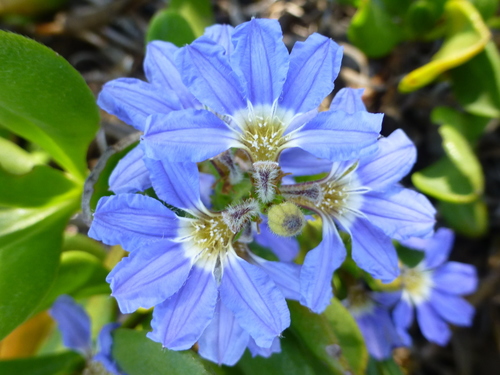
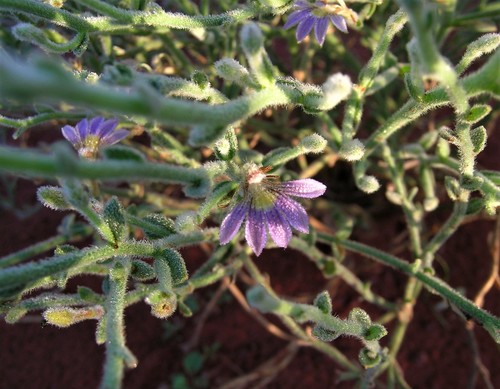
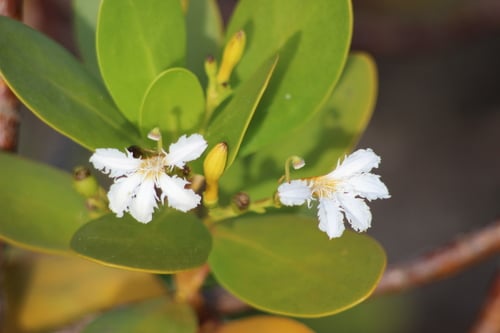
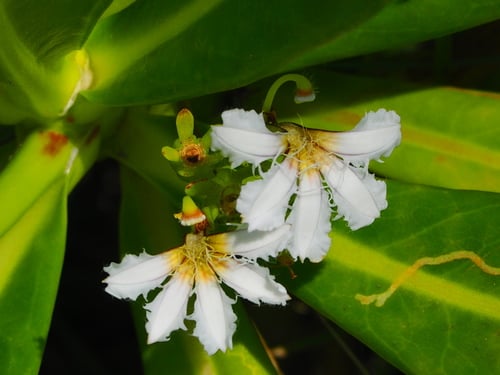
A spiny shrub. It grows 1 m high. The flower is split down one side and has five spreading petals. This makes it look like an open fan.
This description is brief — help expand it
Edible Uses
Fruit can be eaten raw or cooked and is sweet and juicy.
Traditional Uses
The fruit were eaten by people in the Flinder's ranges.
This uses section is brief — help expand it
Medicinal Uses
Diuretic and stomachic. Also used in the treatment of skin disorders.
Distribution
A tropical plant. It grows in the drier inland regions of Western Australia. It is mostly in tropical and subtropical places.
Where It Grows
Australia*,
Cultivation
Not known
Propagation
Sow seed.
Other Uses
None known
Notes
There are about 100 Scaevola species.
References (12)
- Bindon, P., 1996, Useful Bush Plants. Western Australian Museum. p 224
- Bodkin, F., 1991, Encyclopedia Botanica. Cornstalk publishing, p 913
- Cancilla, D., 2018, Ethnobotanical and Ethnozoological Values Desktop Assessment - Eliwana Project. p 14
- Cleland, J.B., 1957, Mankind. 5(4):149-162.
- Cribb, A.B. & J.W., 1976, Wild Food in Australia, Fontana. p 75
Show all 12 references Hide references
- Lazarides, M. & Hince, B., 1993, Handbook of Economic Plants of Australia, CSIRO. p 212
- Morley, B.D., & Toelken, H.R., (Eds), 1983, Flowering Plants in Australia. Rigby. p 299
- Paczkowska, G. & Chapman, A.R., 2000, The Western Australian Flora. A Descriptive Catalogue. Western Australian Herbarium. p 264
- Plants for a Future database, The Field, Penpol, Lostwithiel, Cornwall, PL22 0NG, UK. http://www.scs.leeds.ac.uk/pfaf/
- Rolsh, 1994, Wildflowers of the Western State, Rolsh Productions Albany WA. p 13
- Urban, A., 1990, Wildflowers of Inland Australia. Portside editions. p 195
- Wheeler, J.R.(ed.), 1992, Flora of the Kimberley Region. CALM, Western Australian Herbarium, p 904