Scaevola taccada
(Gaertn.) Roxb.
Fan flower, Sea Lettuce
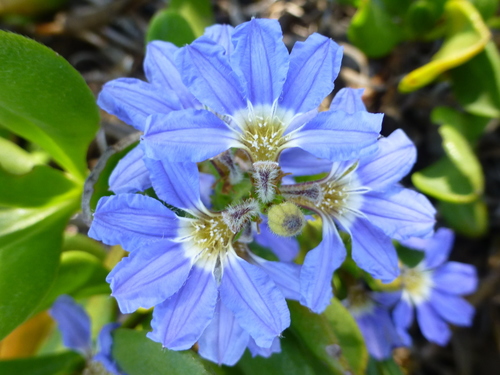
iNaturalist· cc0
no rights reserved, uploaded by 葉子
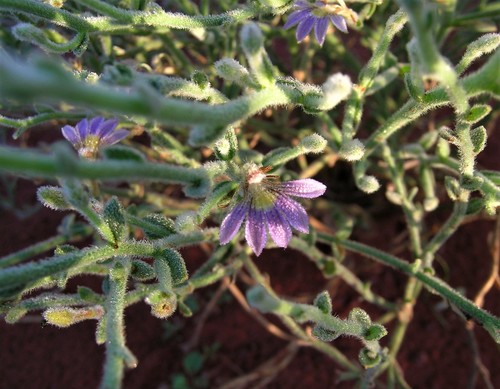
iNaturalist· cc-by-sa
(c) Douglas Goldman, some rights reserved (CC BY-SA), uploaded by Douglas Goldman
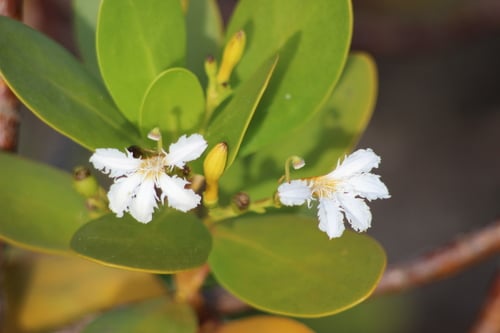
iNaturalist· cc-by-nc
(c) sprosja93, some rights reserved (CC BY-NC), uploaded by sprosja93
Summary
Source: WikipediaScaevola taccada, also known as beach cabbage, sea lettuce, or beach naupaka, is a flowering plant in the family Goodeniaceae found in mangrove swamps and rocky or sandy coastal locations in the tropical areas of the Indo-Pacific. It is a common beach shrub throughout the Arabian Sea, the tropical Indian Ocean and the tropical islands of the Pacific Ocean. There has long been confusion over the correct scientific name for this species. It is also known by the synonym Scaevola sericea.
Description
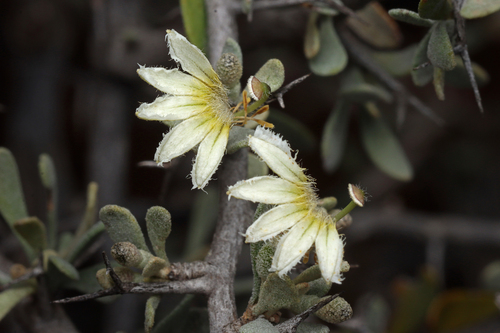
A shrub with many branches. It grows 3 m high. The wood is soft and pale green. The leaves are glossy and oblong. They are thick and leathery. They are rounded at the tip and narrow at the base. They are 5-20 cm long by 4-7 cm wide. The flowers are in the axils of leaves. They are white and paper like and have 5 lobes. These are about 1 cm long. The flowering groups are 2-5 cm long. The fruit is round and 1 cm long. It is white and fleshy.
Edible Uses
The leaves are eaten as a vegetable and used to wrap food in earth ovens. The fruit is also edible. The leaves serve as a famine food when other food is scarce.
Traditional Uses
The leaves are used to wrap food in earth ovens. The leaves are eaten as a vegetable.
This uses section is brief — help expand it
Medicinal Uses
In some islands of the Pacific, Scaevola taccada is used to prevent coastal erosion as well as for landscaping. It is also planted on the beach crests to protect other cultivated plants from the salt spray. S. taccada trees provide a safe and shady environment for female green turtles coming to shore to lay their eggs. Parts of the plant are also used in Polynesian and Asian traditional medicine. Drops from the plant were used in cases of eye irritation by Chamorro breath-hold spearfishermen in the Mariana Islands. Historically in the Maldives the leaves of this plant were often used as famine food.
Distribution
A tropical plant. They occur on tropical seashores. It needs sandy, well-drained soils. It needs full sun. It suits hardiness zones 10-12.
Where It Grows
Africa, American Samoa, Anguilla, Asia, Australia, British Indian Ocean Terr., Caroline Islands, Cayman Islands, China, Chuuk, East Africa, East Timor, Fiji, Hawaii, India, Indochina, Indonesia, Japan, Kenya, Kiribati, Madagascar, Malaysia, Maldives, Mariana Islands, Marshall Islands, Micronesia, Myanmar, North America, Pacific, Pakistan, Palau, Papua New Guinea, PNG, Pakistan, Palau, Philippines, Pohnpei, Samoa, SE Asia, South Africa, Southern Africa, Sri Lanka, Taiwan, Thailand, Timor-Leste, Tokelau, Tuvalu, USA, Vanuatu, Vietnam, Wallis & Futuna, Yap,
Cultivation
It can be grown from fresh seeds or cuttings.
Propagation
Seed - preferably pre-soaked in cool water for 24 hours and then covered lightly by soil in a well-drained potting mix. Germination may take 3 - 9 months. Seeds that have been soaked in saltwater are said to germinate better, reducing germination time by 1 - 2 weeks. Cuttings can be up to 50 cm long, with the lower leaves removed, and the upper ones cut in half. Planting should be in a light well-drained potting mix or a sandy soil, with watering once a day. Rooting should be achieved in 2 - 3 months Large branches can also be used as cuttings as long as they are kept moist until rooted. Air layering.
Other Uses
The soft, snow-white pith, 25mm or more in diameter, is sometimes cut into thin paper-like flakes and then made into artificial flowers, butterflies, and other objects. The leaves are boiled with grass skirts to dye them brown and make them durable. The hollow branches are used as popguns or blowguns in games. The wood from the base of the mature stems is used as nails in traditional boat building. The wood is coarse, fibrous and useless. It is used locally for for roofing strips, rafters, supports, and house decking, rafts, canoe paddles and poles, scoop-net handles, eel traps, reef markers, net gauges, shark rattles, throwing sticks, and toy darts. The plant is used for soil stabilization, especially of sand dunes. It makes a good, dense hedge and so is of value to provide protection from the wind and salt spray in coastal zones. Large branches can usually be used as cuttings to create an instant hedge. This species is one of the first colonizers of the strip-mined areas in Nauru.
Other Information
It is a famine food as leaves are eaten when food is scarce.
Notes
There are about 100 Scaevola species.
Synonyms
Also Known As
Beach naupaka, Beach-berry, Beach plum, Bhadrak, Bhadraksh, Cardwell Cabbage, Dredre, Gahu, Geraa, Hailstones, Half flower, Huahekili, Magoo, Nanasu, Naupaka-kahakai, Romok, Te mao, To'ito'i, Vella-muttagam, Vella modagam
References (30)
- Ambasta S.P. (Ed.), 2000, The Useful Plants of India. CSIR India. p 554 (As Scaevola frutescens)
- Anon., 2003, Native Plants for the Fitzroy basin. Society for Growing Australian Plants Inc. (Rockhampton Branch) p 73
- Cooper, W. and Cooper, W., 2004, Fruits of the Australian Tropical Rainforest. Nokomis Editions, Victoria, Australia. p 225
- Cowie, I, 2006, A Survey of Flora and vegetation of the proposed Jaco-Tutuala-Lore National Park. Timor-Lests (East Timor) www.territorystories.nt/gov.au p 48
- H. G. A. Engler, Pflanzenr. IV. 277(Heft 54):125-126. 1912 - an illegitimate, superfluous name (ICBN Art. 52) (As Scaevola frutescens)
Show all 30 references Hide references
- Flora of Pakistan. www.eFloras.org
- Franklin, J., Keppel, G., & Whistler, W., 2008, The vegetation and flora of Lakeba, Nayau and Aiwa Islands, Central Lau Group, Fiji. Micronesica 40(1/2): 169–225, 2008
- Hedrick, U.P., 1919, (Ed.), Sturtevant's edible plants of the world. p 596 (As Scaevola koenigii)
- Hibbert, M., 2002, The Aussie Plant Finder 2002, Florilegium. p 287
- Hort. bengal. 15. 1814
- Lamoureux, C.H., 1976, Trailside Plants of Hawaii's National Parks. Hawaii Natural History Association. p 70
- Levitt, D., 1981, Plants and people. Aboriginal uses of plants on Groote Eylandt. Australian Institute of Aboriginal Studies, Canberra. p 96
- Llamas, K.A., 2003, Tropical Flowering Plants. Timber Press. p 228
- Mohd, N. G. et al, 2014, A Preliminary Flora Survey in Gunung Kajang, Pulau Tioman, Pahang Darul Makmur, Malaysia. Malays. Appl. Biol. 43(2): 17-23 (As Scaevola sericea)
- Paczkowska, G. & Chapman, A.R., 2000, The Western Australian Flora. A Descriptive Catalogue. Western Australian Herbarium. p 264
- Parham, B. E. V., 1971, The Vegetation of the Tokelau Islands with special reference to the Plants of Nukunonu Atoll. New Zealand Journal of Botany. 9:4, 576-609
- Parham, B. E. V., 1972, Plants of Samoa. New Zealand Department of Scientific and Industrial Research. Information Series. No. 85 p 130
- Scarth-Johnson, V., 2000, National Treasures. Flowering Plants of Cooktown and Northern Australia. Vera Scarth-Johnson Gallery Association. Cooktown, Australia. p 47
- Selvam, V., 2007, Trees and shrubs of the Maldives. RAP Publication No. 2007/12 p 148
- Singh, H.B., Arora R.K.,1978, Wild edible Plants of India. Indian Council of Agricultural Research, New Delhi. p 37
- Smith, N., Mori, S.A., et al, 2004, Flowering Plants of the Neotropics. Princeton. p 173
- Sotheeswaran, S., and Sharif, M. R. et al, 1994, Lipids from the seeds of seven Fijian plant species. Food Chemistry. 49:11-13
- Staples, G.W. and Herbst, D.R., 2005, A tropical Garden Flora. Bishop Museum Press, Honolulu, Hawaii. p 348 (Drawing)
- Thaman, R. and W. Clarke, Paper on Agroforestry on Aneityum and Tanna, Vanuatu from Internet (As Scaevola sericea)
- Thaman, R. R., 1987, Plants of Kiribati: A listing and analysis of vernacular names. Atoll Research Bulletin No. 296
- Thaman, R. R, 2016, The flora of Tuvalu. Atoll Research Bulletin No. 611. Smithsonian Institute p 93
- Townsend, K., 1994, Across the Top. Gardening with Australian Plants in the tropics. Society for Growing Australian Plants, Townsville Branch Inc. p 331
- www.manoa.hawaii.edu/botany/plants of micronesia
- Yang, R., et al, 2008, Content and distribution of flavonoids among 91 edible plant species. Asia Pac. J. Clin. Nutru. 17(S1): 275-279 (As Scaevola sericea)
- World Checklist of Useful Plant Species 2020. Royal Botanic Gardens, Kew (As Scaevola sericea)