Saxifraga fortunei
(Maxim.) Hook. f.
iNaturalist· cc-by-sa
(c) Qwert1234, some rights reserved (CC BY-SA)
iNaturalist· cc-by
(c) Hibiki Katayama, some rights reserved (CC BY)
iNaturalist· cc-by
(c) Hibiki Katayama, some rights reserved (CC BY)
Summary
Source: WikipediaSaxifraga fortunei (齿瓣虎耳草), the fortune saxifrage, is a species of flowering plant in the family Saxifragaceae, native to China, Japan and Korea. Growing to just 40 cm (16 in) tall and broad, it is a shade-loving herbaceous perennial with large round fleshy leaves. Slender branched stalks bear panicles of small white starry flowers in summer. The two lower petals of each bloom are significantly longer than the others. Both the flowers and the leaves are sometimes flushed red or pink.
Description
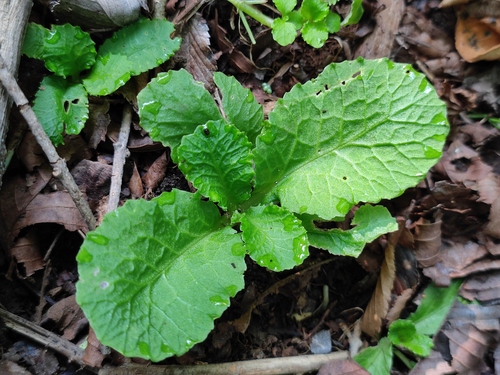
A perennial herb. It grows 30-45 cm high and 30-38 cm wide. The leaves are overlapping and with scalloped edges. The leaves are kidney shaped or round. They are 10 cm long. They are purplish red underneath. There is one or more petals in each flower that is longer than the others. The flowers are white and on stems 50 cm long.
Edible Uses
Young leaves are edible when cooked. They can be added to soups or cooked together with rice.
Medicinal Uses
None known.
Distribution
It is a temperate plant. It is frost hardy. In China it grows between 2,200-2,900 m above sea level. It suits hardiness zones 6-8. In Sichuan.
Where It Grows
Asia, Australia, China, Japan, Korea, Russia, Siberia,
Cultivation
Prefers a cool position in a moist humus-rich soil. Prefers an acid soil. Grows well in light woodland or in a shady position in a rock garden. The plant is hardy to at least -15°c, the leaves and the flowers, however, are liable to be damaged by autumn frosts. A polymorphic species, there are several named forms selected for their ornamental value.
Propagation
No specific information is available for this species, but sowing seed in a cold frame in spring is recommended. Surface sow or barely cover the seed, keeping the compost consistently moist. Prick out seedlings into individual pots once large enough to handle and grow them on in a greenhouse or cold frame through their first winter. Plant out in late spring after the last expected frosts. Division in spring is also an option — larger divisions can go directly into their permanent positions, while smaller ones are best potted up and grown on in a lightly shaded cold frame until well established, then planted out in summer.
Other Uses
None known.
Notes
There are about 440 Saxifraga species.
Synonyms
References (7)
- Bot. Mag. 89: t. 5377. 1863
- Chen, B. & Qiu, Z., Consumer's Attitudes towards Edible Wild Plants, Ishikawa Prefecture, Japan. p 24 www.hindawi.com/journals/ijfr/aip/872413.pdf (var. incisolobata)
- Cundall, P., (ed.), 2004, Gardening Australia: flora: the gardener's bible. ABC Books. p 1318
- Flora of China @ efloras.org Volume 8
- Joyce, D., 1998, The Garden Plant Selector. Ryland, Peters and Small. p 267
Show all 7 references Hide references
- Morley, B. & Everard, B., 1970, Wild Flowers of the World. Ebury press. Plate 99
- Plants for a Future database, The Field, Penpol, Lostwithiel, Cornwall, PL22 0NG, UK. http://www.scs.leeds.ac.uk/pfaf/