Saraca dives
Pierre
Vang-anh
iNaturalist· cc-by-nc
(c) 小铖/Smalltown, some rights reserved (CC BY-NC), uploaded by 小铖/Smalltown
iNaturalist· cc-by-nc
(c) 小铖/Smalltown, some rights reserved (CC BY-NC), uploaded by 小铖/Smalltown
iNaturalist· cc-by-nc
(c) 小铖/Smalltown, some rights reserved (CC BY-NC), uploaded by 小铖/Smalltown
Summary
Source: WikipediaSaraca dives, is a tree species in genus Saraca belonging to the family Fabaceae, native to China, Laos, and Vietnam.
Description
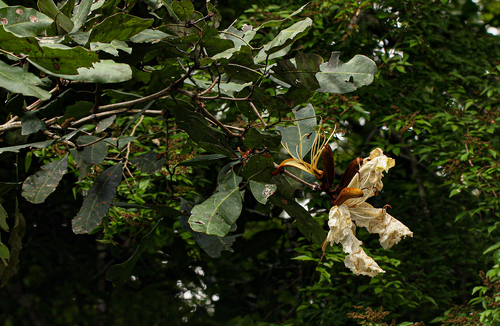
A tree. It grows to 7-20 m tall. The trunk is 25 cm across. The leaves have 5 or 6 pairs of leaflets. They hang down. They are oval and 15-35 cm long by 5-12 cm wide. The flowers are yellow but do not have petals. The fruit or pod is on 4 cm long stalks. The pod is 22-30 cm long by 5-7 cm wide. The valves are twisted. There are 5-9 seeds.
Medicinal Uses
Used in traditional medicine.
Distribution
A tropical plant. It grows naturally by riversides and is also cultivated. It grows between 200-1,000 m above sea level. In XTBG Yunnan.
Where It Grows
Asia, China, Indochina, Laos, SE Asia, Vietnam,
Cultivation
Succeeds in full sun and in moderate shade. Requires a moist, well-drained soil rich in organic matter. Although many species within the family Fabaceae have a symbiotic relationship with soil bacteria, this species is said to be devoid of such a relationship and therefore does not fix atmospheric nitrogen.
Propagation
Seed - if the seed is harvested when ripe and sown immediately, preferably after soaking in water for 12 hours, it will germinate within 3 weeks and will be ready to plant out within 6 - 12 months. Air layering.
Other Uses
The reddish wood is soft. It is not used commercially.
Notes
There are about 10 Saraca species. They occur in tropical Asia. Also as Caesalpinaceae.
Nutrition
| Part | Moisture | kJ | kcal | Protein | Vit A | Vit C | Iron | Zinc |
|---|---|---|---|---|---|---|---|---|
| Leaves | 93.7 | 60 | 14 | 0.9 | — | 19 | — | — |
Synonyms
Also Known As
Vang-anh
References (2)
- Mot So Rau Dai an Duoc O Vietnam. Wild edible Vegetables. Ha Noi 1994, p 110
- Pham-Hoang Ho, 1999, An Illustrated Flora of Vietnam. Nha Xuat Ban Tre. p 865