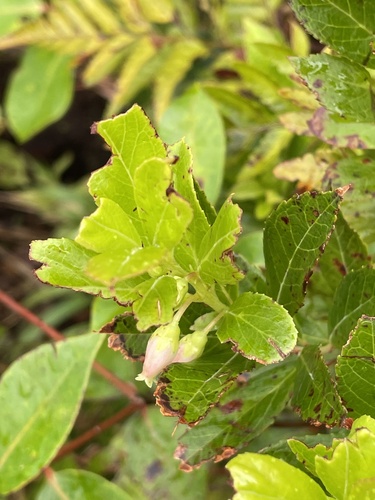
Arbutus texana
Buckley
Texas madrone
iNaturalist· cc-by
(c) Kaden Slone, some rights reserved (CC BY)
iNaturalist· cc-by
(c) Kaden Slone, some rights reserved (CC BY)
iNaturalist· cc-by
(c) Kaden Slone, some rights reserved (CC BY)
Summary
Source: WikipediaAn evergreen tree reaching 8 m tall, growing at slow rate. Flowers in March with seeds ripening in August. Hermaphroditic and bee-pollinated, self-fertile. Tolerates light sandy and medium loamy well-drained soils in mildly acid pH. Grows in semi-shade to full sun, adapts to dry or moist soil. Hardy to UK zone 8.
Description
A small evergreen tree. The trunk is short and often crooked. It is 20 cm wide. The branches are crooked and spreading. The bark on the branches is pink and smooth. It can grow 6 m tall. The leaves are 2.5-9 cm long by 1.5-4 cm wide. They are oval and do not have teeth. The leaves are thick and stiff. The leaf stalks are slender and hairy. The leaves are shiny green above and paler and slightly hairy underneath. The flowers are 6 mm long. They are jug shaped and white or with a tinge of pink. They are in upright branched clusters. These are 6 cm long and wide. The fruit are 10 mm across and berry-like. They are red or yellowish and with a finely rough skin. There is a large stone with many seeds. The pulp is mealy and sweet.
Edible Uses
Edible Parts: Fruit Edible Uses: Fruit - raw or cooked. A sweetish taste, the fruit has a dry mealy flesh. It has narcotic properties. The fruit is up to 1cm in diameter.
Medicinal Uses
Astringent The bitter principles in the bark and leaves can be used as an astringent.
Known Hazards
Fruit has narcotic properties.
Distribution
It is a temperate plant. It grows in canyons and rocky slopes in mountains between 600-1800 m altitude in SE regions of the USA.
Where It Grows
Central America, Mexico, North America, USA,
Cultivation
Requires a lime-free nutrient-rich well-drained moisture-retentive soil in sun or semi-shade and shelter from cold drying winds, especially when young. Succeeds on dry soils. This species is unlikely to be hardy in the colder areas of the country, it probably tolerates temperatures down to between -5 and -10°c. There is some confusion over the name of this plant, some books suggest that A texana is a synonym of A xalapensis. HBK. whilst others say that A texana exists in its own right and has a synonym of A. xalapensis. non HBK. A. texana is very closely related to A. xalapense and is considered by many botanists to be indistinguishable from that species.
Propagation
Seed - best surface sown in a cold frame as soon as it is ripe. Stored seed should be soaked for 5 - 6 days in warm water and then surface sown in a shady position in a greenhouse. Do not allow the compost to become dry. 6 weeks cold stratification helps. The seed usually germinates well in 2 - 3 months at 20°c. Seedlings are prone to damp off, they are best transplanted to individual pots as soon as they are large enough to handle and should be kept well ventilated. Grow them on in a greenhouse for their first winter and then plant out in late spring after the last expected frosts. Basal cuttings in late winter. Cuttings of mature wood of the current season's growth, November/December in a frame. Poor percentage. Layering of young wood - can take 2 years.
Other Uses
Charcoal Fuel Wood Wood - heavy, hard, close grained. Used for small tools, mathematical instruments, rollers etc. It is a good fuel and also produces a fine grade of charcoal. Special Uses
Notes
There are 14 Arbutus species.
Synonyms
References (3)
- Little, E.L., 1980, National Audubon Society Field Guide to North American Trees. Alfred A. Knopf. p 621
- Loughmiller, C & L., 1985, Texas Wildflowers. A Field Guide. University of Texas, Austin. p 93
- Plants for a Future database, The Field, Penpol, Lostwithiel, Cornwall, PL22 0NG, UK. http://www.scs.leeds.ac.uk/pfaf/