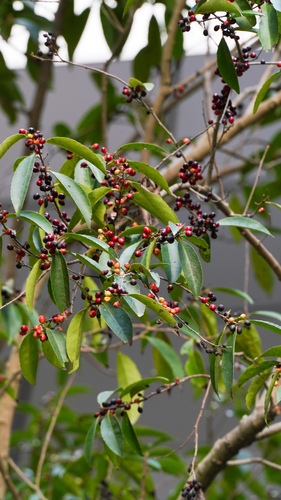
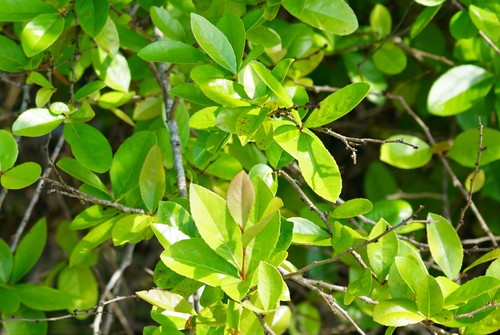
Salix gracilistyla
Miq.
Rosegold pussy willow, Japanese pussy willow, Neko-yanagi
iNaturalist· cc-by-nc
(c) John, some rights reserved (CC BY-NC)
iNaturalist· cc-by-nc
(c) Mizuki Shimoda, some rights reserved (CC BY-NC)
Summary
Source: WikipediaSalix gracilistyla is a species of willow native to Japan, Korea and China known in English as the rose-gold pussy willow. It is a deciduous shrub that reaches a height of 1–6 m.
Description
A shrub. It grows 3-4.5 m high and spreads 3-4.5 m wide. The leaves are oblong and 10 cm long. The flower catkins appear before the leaves. The male catkins are red and later orange, then yellow. The female catkins are silky grey.
Edible Uses
The inner bark can be eaten raw or cooked, or dried and ground into a powder to blend with cereal flour for bread-making. It has a very bitter flavour and is regarded as a famine food, used only when all else fails. Young leaves and flowers can be parboiled and eaten as a vegetable, though they are not very palatable. The leaves can also be used as a tea substitute.
Traditional Uses
The young leaves and flowers are parboiled and eaten as a vegetable. The leaves are used as a substitute for tea.
This uses section is brief — help expand it
Medicinal Uses
The fresh bark contains salicin, which probably decomposes into salicylic acid (closely related to aspirin) in the human body. This gives it anodyne and febrifuge properties.
Known Hazards
None mentioned.
Distribution
It is a temperate plant. It suits hardiness zones 6-10.
Where It Grows
Asia, Australia, China, Japan, Korea,
Cultivation
Succeeds in most soils, including wet, ill-drained or intermittently flooded soils, but prefers a damp, heavy soil in a sunny position. Rarely thrives on chalk. A very ornamental plant. Hybridizes freely with other members of this genus. Although the flowers are produced in catkins early in the year, they are pollinated by bees and other insects rather than by the wind. Plants in this genus are notably susceptible to honey fungus. Dioecious. Male and female plants must be grown if seed is required.
Propagation
Seed must be surface sown as soon as it is ripe in late spring, as viability is very short — perhaps only a few days. Cuttings of mature wood from the current year's growth can be taken November to February and rooted in a sheltered outdoor bed or planted directly into their permanent position with a weed-suppressing mulch; success is very easy. Plant out into permanent positions in autumn. Half-ripe cuttings can be taken June to August and rooted in a frame, also very easily.
Other Uses
The stems are used in basket making. Plants can be established along streamsides to prevent bank erosion. This is also a highly ornamental species and a dynamic accumulator.
Notes
There are about 300 Salix species.
References (7)
- Ann. Mus. Bot. Lugduno-Batavum 3:26. 1867
- Cundall, P., (ed.), 2004, Gardening Australia: flora: the gardener's bible. ABC Books. p 1297
- Facciola, S., 1998, Cornucopia 2: a Source Book of Edible Plants. Kampong Publications, p 222
- Hibbert, M., 2002, The Aussie Plant Finder 2002, Florilegium. p 284
- Lord, E.E., & Willis, J.H., 1999, Shrubs and Trees for Australian gardens. Lothian. p 72
Show all 7 references Hide references
- Plants for a Future database, The Field, Penpol, Lostwithiel, Cornwall, PL22 0NG, UK. http://www.scs.leeds.ac.uk/pfaf/
- Tanaka,