Salix fragilis
L.
Crack willow, Brittle willow, Red-wood willow, Kashmir willow, Tilchang, Snap willow
iNaturalist· cc-by-nc
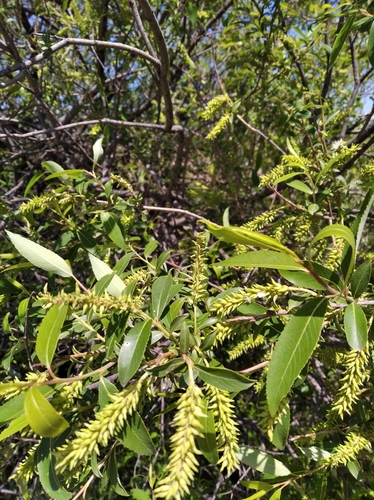
(c) Misha Zitser, some rights reserved (CC BY-NC)
iNaturalist· cc-by-nc
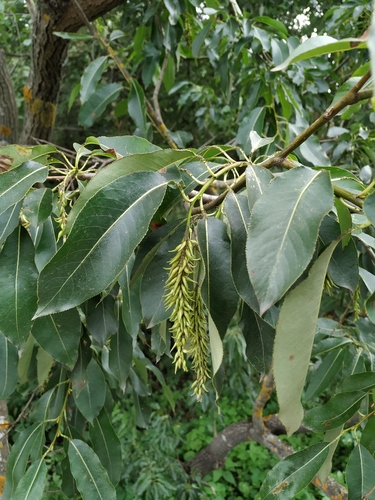
(c) Misha Zitser, some rights reserved (CC BY-NC)
iNaturalist· cc-by-nc
(c) Misha Zitser, some rights reserved (CC BY-NC)
Summary
Source: WikipediaSalix fragilis is a scientific name that has historically been used for two different willows: Salix euxina, a non-hybrid species Salix × fragilis, the hybrid between Salix euxina and Salix alba
Description
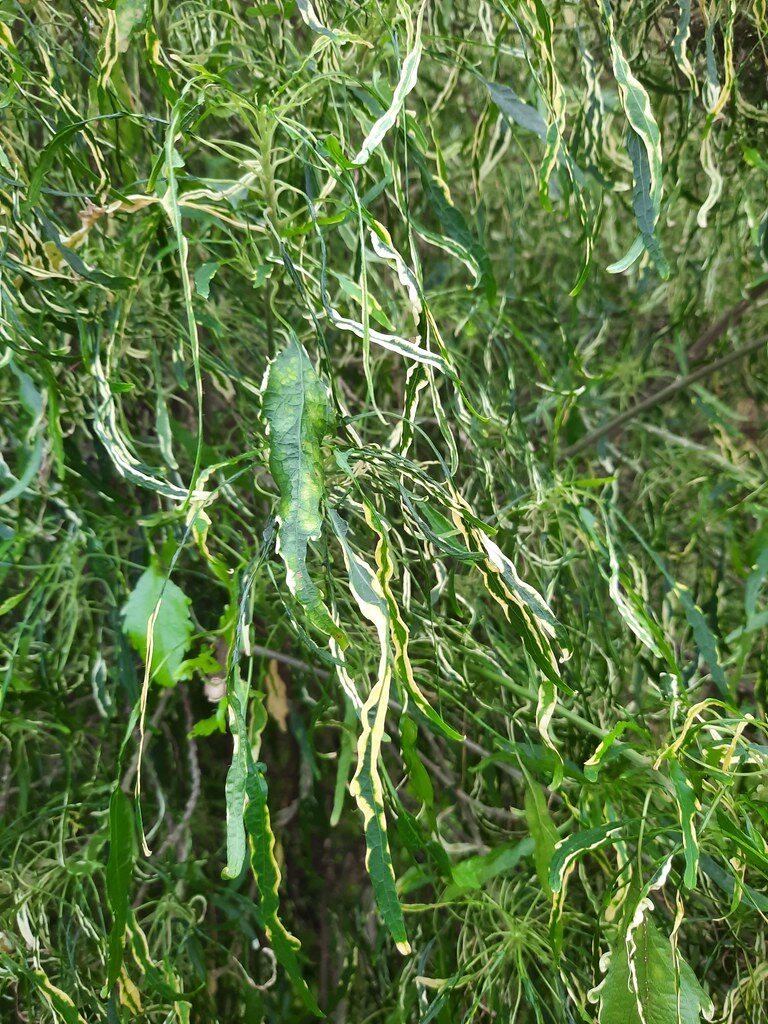
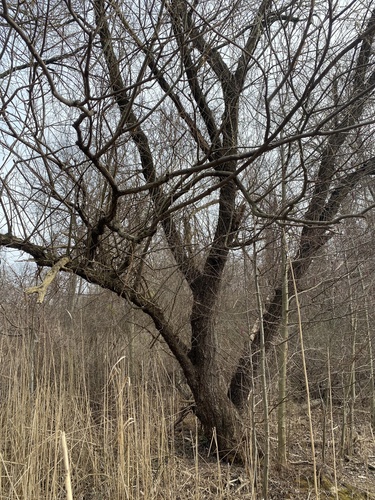
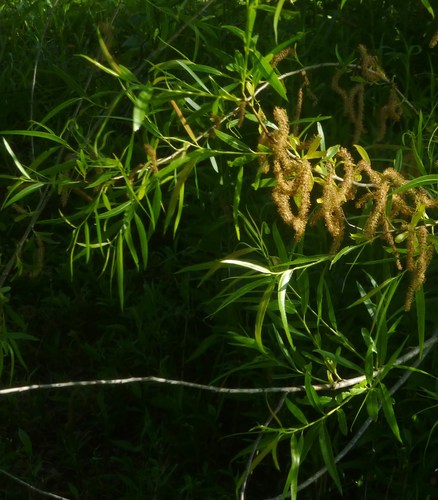
A medium sized tree. It grows 24-30 m high. The trunk can be 100 cm across. The crown is rounded and green. The small branches break off easily in wind. The bark is grey and deeply ridged and cracked. The leaves are long and narrow and 7-15 cm long. They are shiny green on top and grey green underneath and do not have hairs. The leaves are often twisted. The male catkins are yellow and the female catkins are green.
Edible Uses
The inner bark can be eaten raw or cooked, or dried and ground into a powder to blend with cereal flour for bread-making. It has a very bitter flavour and is considered a famine food, used only as a last resort. Young shoots can be eaten raw or cooked, though they are not very palatable. A saccharine exudation from the leaves and young branches is also used as a food sweetener.
Traditional Uses
The sap is sweet and sugary.
This uses section is brief — help expand it
Medicinal Uses
The fresh bark contains salicin, which probably decomposes into salicylic acid (closely related to aspirin) in the human body, giving it anodyne, astringent, and febrifuge properties. The bark is used interchangeably with S. alba and is taken internally for rheumatism, arthritis, gout, inflammatory stages of auto-immune diseases, diarrhoea, dysentery, feverish illnesses, neuralgia, and headache. A bark poultice can be applied to sores as a styptic and healing agent. Bark is harvested in summer and dried for later use. The leaves are used internally for minor feverish illnesses and colic, and can be harvested throughout the growing season for use fresh or dried. The German Commission E Monographs approve Salix for diseases accompanied by fever, rheumatic ailments, and headaches.
Known Hazards
Gastrointestinal bleeding & kidney damage possible. Avoid concurrent administration with other aspirin-like drugs. Avoid during pregnancy. Drug interactions associated with salicylates applicable.
Distribution
It is a warm temperate plant. It is native to Asia and Europe. It normally grows near rivers. They can grow in salty air near the sea coast. In Argentina it grows from sea level to 900 m above sea level. It suits hardiness zones 6-10. Tasmania Herbarium. Arboretum Tasmania.
Where It Grows
Andorra, Argentina, Asia, Australia, Britain, Canada, Europe, Germany, Greece, India, Iran, Iraq, Luxembourg, Mediterranean, Middle East, North America, Slovenia, South America, Tasmania, Turkey, Türkiye, Uruguay, USA,
Cultivation
Succeeds in most soils, including wet, ill-drained or intermittently flooded soils, but prefers a deep damp, heavy soil in a sunny position. Rarely thrives on chalk. Succeeds in an exposed position. Closely allied to S. alba, with which it freely hybridizes, though it tolerates poorer soils than that species. A very important food plant for the caterpillars of many butterfly species and a good bee plant, providing an early source of nectar and pollen. The cultivar 'Basfordiana' is used for basket making. Best if planted into its permanent position as soon as possible. The root system is rather aggressive and can cause problems with drains. Plants in this genus are notably susceptible to honey fungus. Plants are very amenable to coppicing or pollarding and can be cut back annually if required. Dioecious. Male and female plants must be grown if seed is required.
Propagation
Seed must be surface sown as soon as it is ripe in late spring, as viability is very short — perhaps only a few days. Cuttings of mature wood from the current year's growth can be taken November to February and rooted in a sheltered outdoor bed or planted directly into their permanent position with a weed-suppressing mulch; success is very easy. Plant out into permanent positions in autumn. Half-ripe cuttings can be taken June to August and rooted in a frame, also very easily.
Other Uses
The very flexible stems are used in basket making. The plant is usually coppiced annually for this purpose, though coppicing every two years yields thicker poles suitable for use as uprights. The bark contains around 10% tannin. The wood is tough and resistant to friction, making it suitable for floors and the bases of carts. A good quality charcoal is also obtained from the wood. This species is also valued as a dynamic accumulator and for attracting wildlife.
Notes
There are about 300 Salix species.
Also Known As
Krhka vrba
References (15)
- Ambasta, S.P. (Ed.), 2000, The Useful Plants of India. CSIR India. p 541
- Coombes, A.J., 2000, Trees. Dorling Kindersley Handbooks. p 293
- Cundall, P., (ed.), 2004, Gardening Australia: flora: the gardener's bible. ABC Books. p 1297
- Facciola, S., 1998, Cornucopia 2: a Source Book of Edible Plants. Kampong Publications, p 222
- Farrar, J.L., 1995, Trees of the Northern United States and Canada. Iowa State University press/Ames p 327
Show all 15 references Hide references
- Harris, E & J., 1983, Field Guide to the Trees and Shrubs of Britain. Reader's Digest. p 118
- Hedrick, U.P., 1919, (Ed.), Sturtevant's edible plants of the world. p 320
- Hedrick, U.P., 1919, (Ed.), Sturtevant's edible plants of the world. p 589
- http://www.botanic-gardens-ljubljana.com/en/plants
- Little, E.L., 1980, National Audubon Society Field Guide to North American Trees. Alfred A. Knopf. p 334
- Lord, E.E., & Willis, J.H., 1999, Shrubs and Trees for Australian gardens. Lothian. p 72
- Plants for a Future database, The Field, Penpol, Lostwithiel, Cornwall, PL22 0NG, UK. http://www.scs.leeds.ac.uk/pfaf/
- Sfikas, G., 1984, Trees and shrubs of Greece. Efstathiadis Group. Athens. p 166
- Sp. pl. 2:1017. 1753
- Tasmanian Herbarium Vascular Plants list p 53