Aralia racemosa
L.
American spikenard
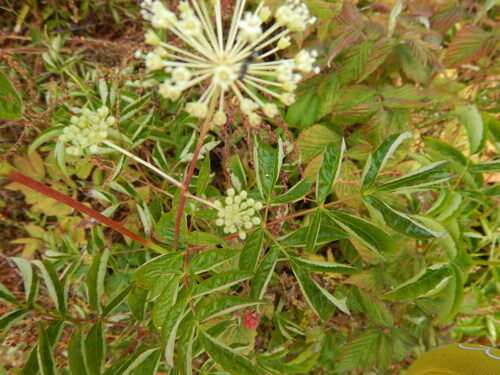
iNaturalist· cc-by-nc
(c) cgbb2004, some rights reserved (CC BY-NC), uploaded by cgbb2004
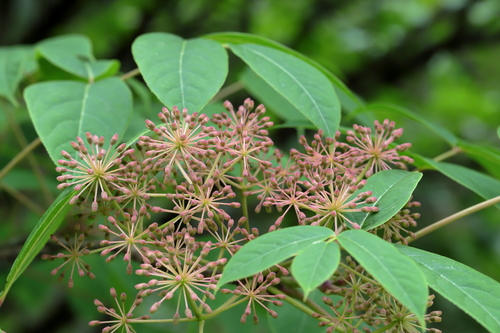
iNaturalist· cc-by-nc
(c) Janet Wright, some rights reserved (CC BY-NC), uploaded by Janet Wright
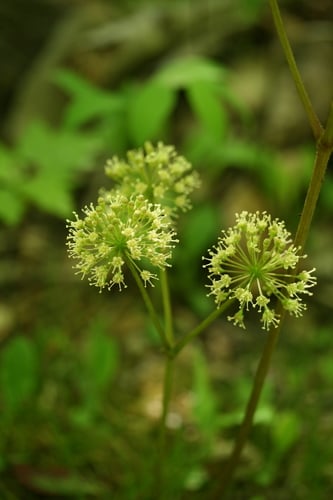
iNaturalist· cc-by-sa
(c) Douglas Goldman, some rights reserved (CC BY-SA), uploaded by Douglas Goldman
Summary
Source: WikipediaAralia racemosa, with common names American spikenard, small spikenard, Indian root, spice berry, spignet, life-of-man, petty morel, is an ornamental plant in the family Araliaceae native to the United States and Canada. It is a herbaceous plant, about 1 to 2 m (3 ft 3 in to 6 ft 7 in) tall, which grows in shady areas. Its native range includes most of the eastern United States.
Description
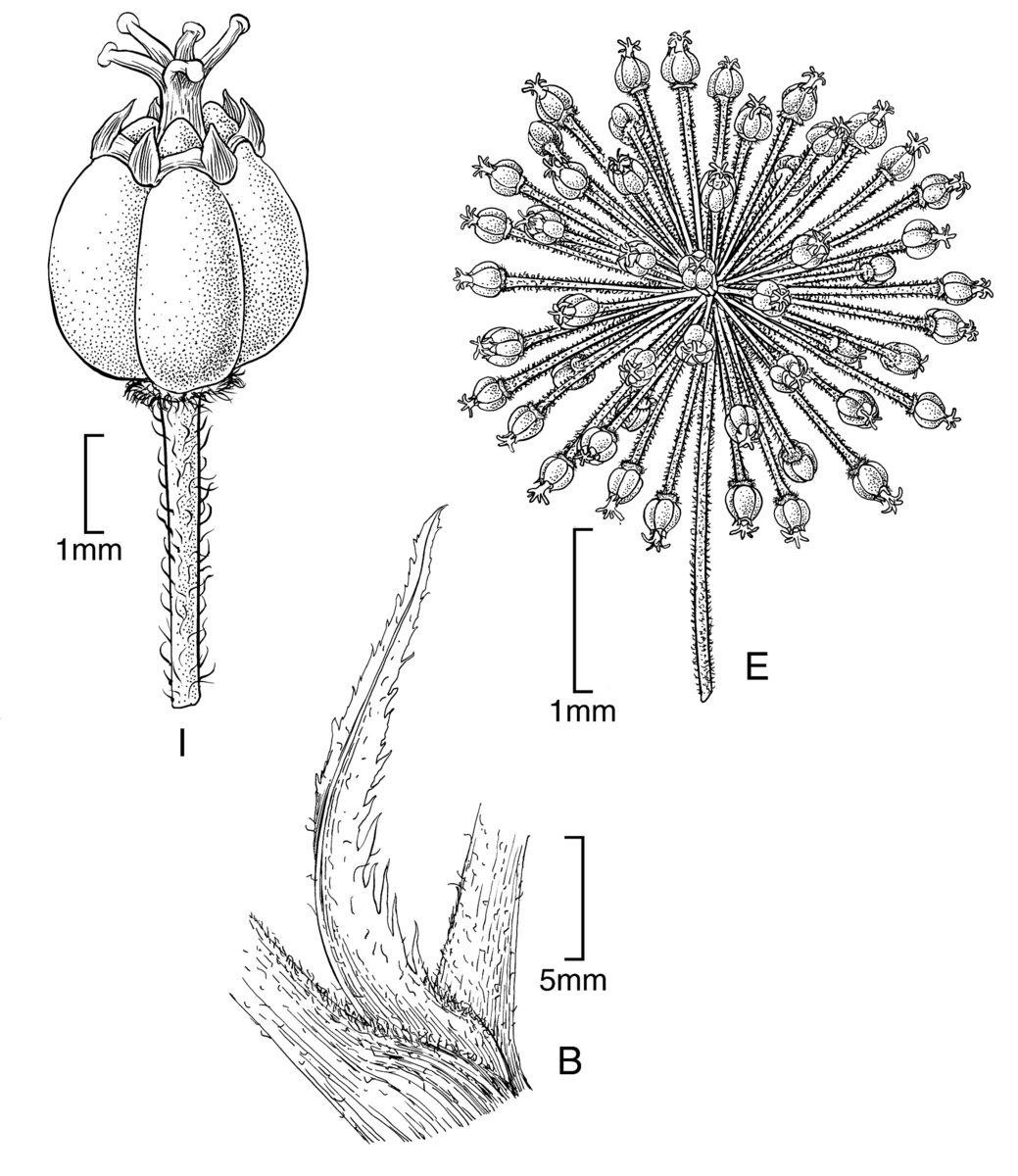
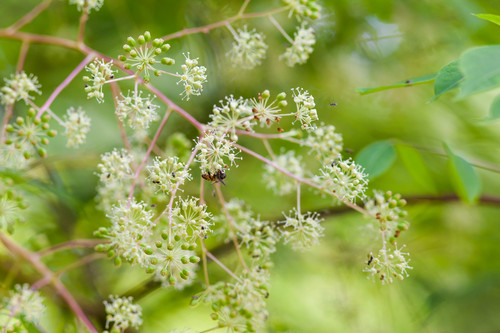
A shrub that keeps growing from year to year. It grows 1-2.2 m high and spreads 60 cm to 2 m wide. The roots have an aroma. The leaves are compound and 75 cm long. The flowers are small and green-white. They are in flattened heads. The fruit are purple-brown.
Edible Uses
Edible Parts: Fruit Leaves Root Shoots Edible Uses: Condiment Several parts of American spikenard are edible—roots, shoots, leaves, and fruits—but most are unappealing or require cooking to temper acrid saponins and resins. The roots are large and sustaining but unpleasantly flavored, even after boiling, with harsh medicinal overtones that make them difficult to recommend as food. Shoots and leaves are similarly acrid, yielding a bitter green broth when cooked, though occasionally eaten as potherbs. The fruits, however, are by far the most palatable. Berry-like drupes ripen from August to September, turning purple-black in large drooping clusters. They taste pleasantly sweet, resinous, and grape-like, with a balsamic aroma, and can be eaten fresh or dried like raisins. Seeds contribute a faintly resinous undertone but are soft enough to chew. Although described as a potential jelly fruit and noted in a few traditional food mixtures, overall references to spikenard fruit as food are rare. Given the variability in flavor reports and the plant’s stronger reputation as a medicinal herb, fruits are best enjoyed in small amounts [2-3]. Young shoot tips - cooked. Used as a potherb or as a flavouring in soups. Root - cooked. Large and spicy, it is used in soups. Pleasantly aromatic, imparting a liquorice-like flavour. A substitute for sarsaparilla (Smilax spp.), it is also used in making 'root beer'. Fruit - raw or cooked. Pleasant and wholesome to eat. They can be made into a jelly. The fruit is about 4mm in diameter. The roots have an aroma. The fruit are purple-brown [1-4].
Traditional Uses
The roots are used as an ingredient in root beer. It gives a licorice flavour. The berries are made into jelly. The young leaves are eaten boiled and added to soups.
Medicinal Uses
Alterative Antirheumatic Diaphoretic Eczema Expectorant Poultice Skin Stimulant American spikenard is a sweet pungent tonic herb that is often used in modern herbalism where it acts as an alterative. It had a wide range of traditional uses amongst the North American Indians and was at one time widely used as a substitute for the tropical medicinal herb sarsaparilla. The root is alterative, diaphoretic, diuretic, pectoral and stimulant. The herb encourages sweating, is stimulating and detoxifying and so is used internally in the treatment of pulmonary diseases, asthma, rheumatism etc. Externally it is used as a poultice in treating rheumatism and skin problems such as eczema. The root is collected in late summer and the autumn and dried for later use. A drink made from the pulverised roots is used as a cough treatment. A poultice made from the roots and/or the fruit is applied to sores, burns, itchy skin, ulcers, swellings etc.
Distribution
It is a temperate plant. It suits hardiness zones 5-9.
Where It Grows
Asia, Canada, Central America, Europe, India, Mexico, North America*, Northeastern India, Turkey, Türkiye, USA,
Cultivation
American spikenard thrives along mountain streams, riparian thickets, and moist forest margins, preferring elevations of 1,000–2,500 m (3,500–8,000 ft). It occurs mainly in the eastern United States but extends westward into Utah, Arizona, and the Mogollon Mountains of New Mexico. Flowering occurs in summer, with dense umbels of small white blossoms that attract bees and other pollinators. Fruits persist into autumn and are a significant wildlife food. An easily grown plant, succeeding in sun or part shade in any fertile soil. Prefers a good deep loam and a semi-shady position. Requires a sheltered position. Plants are hardier when grown in poorer soils. The young growth in spring, even on mature plants, is frost-tender and so it is best to grow the plants in a position sheltered from the early morning sun. Grows well by water.
Propagation
Seed - best sown as soon as ripe in a cold frame. Stored seed requires 3 - 5 months of cold stratification. Germination usually takes place within 1 - 4 months at 20°c. When large enough to handle, prick the seedlings out into individual pots and grow them on in light shade in a greenhouse for at least their first winter. Once the plants are 25cm or more tall, they can be planted out into their permanent positions, late spring or early summer being the best time to do this. Root cuttings 8cm long, December in a cold frame. Store the roots upside down in sand and pot up in March/April. High percentage. Division of suckers in late winter. Very easy, the suckers can be planted out direct into their permanent positions if required.
Other Uses
A specialist nectary plant [1-2]. Primarily valued as a wildlife resource: its dense foliage provides cover, and its abundant fruits are eaten by birds and mammals in late summer. Special Uses Food Forest
Notes
There are about 40-55 Aralia species.
Synonyms
Also Known As
Chimchawk, Pettymorrel
References (14)
- Beckstrom-Sternberg, Stephen M., and James A. Duke. "The Foodplant Database." http://probe.nalusda.gov:8300/cgi-bin/browse/foodplantdb.(ACEDB version 4.0 - data version July 1994)
- Bircher, A. G. & Bircher, W. H., 2000, Encyclopedia of Fruit Trees and Edible Flowering Plants in Egypt and the Subtropics. AUC Press. p 37
- Brickell, C. (Ed.), 1999, The Royal Horticultural Society A-Z Encyclopedia of Garden Plants. Convent Garden Books. p 129
- Brown, D., 2002, The Royal Horticultural Society encyclopedia of Herbs and their uses. DK Books. p 126
- Facciola, S., 1998, Cornucopia 2: a Source Book of Edible Plants. Kampong Publications, p 25
Show all 14 references Hide references
- Kar, A., et al, 2013, Wild Edible Plant Resources used by the Mizos of Mizoram, India. Kathmandu University Journal of Science, Engineering and Technology. Vol. 9, No. 1, July, 2013, 106-126 (As var. foliosa)
- Jackes, D. A., Edible Forest Gardens
- Lim, T. K., 2015, Edible Medicinal and Non Medicinal Plants. Volume 9, Modified Stems, Roots, Bulbs. Springer p 11
- MacKinnon, A., et al, 2009, Edible & Medicinal Plants of Canada. Lone Pine. p 184
- Plants for a Future database, The Field, Penpol, Lostwithiel, Cornwall, PL22 0NG, UK. http://www.scs.leeds.ac.uk/pfaf/
- Sp. pl. 1:273. 1753
- Tozer, F., 2007, The Uses of Wild Plants. Green Man Publishing. p 31
- Wiersema, J. H. & Leon, B., 2013, World Economic Plants. A Standard Reference CRC Press. 2nd Ed. p 63
- World Checklist of Useful Plant Species 2020. Royal Botanic Gardens, Kew