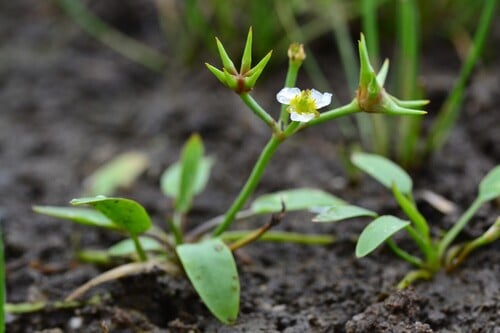
Sagittaria latifolia
Willd.
Broadleaf arrowhead
iNaturalist· cc-by-nc
(c) Susan Elliott, some rights reserved (CC BY-NC), uploaded by Susan Elliott
Summary
Source: WikipediaSagittaria latifolia is a wetland plant in the family Alismataceae, native to North America and northern South America; common names include broadleaf arrowhead, duck-potato, Indian potato, or wapato. This plant produces edible tubers that have traditionally been extensively used by Native Americans.
Description
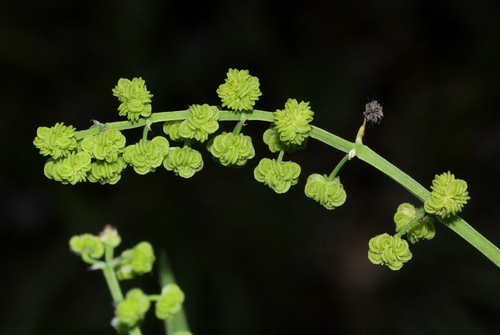
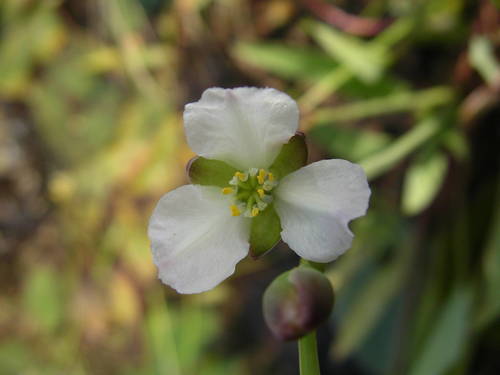
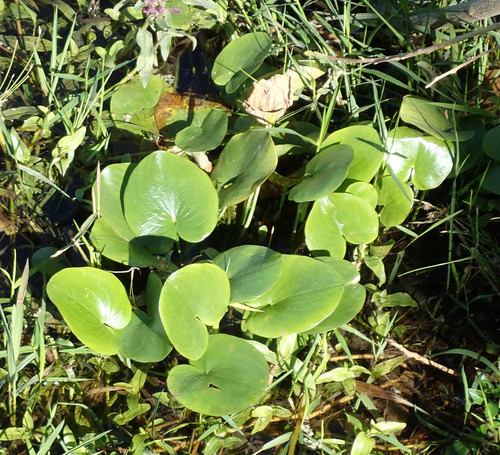
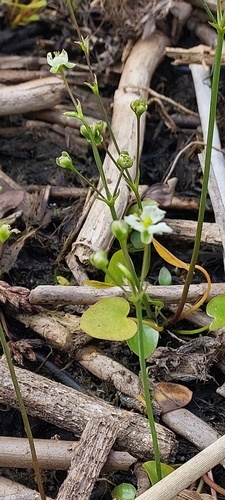
A herb which grows in water and keeps growing from year to year. It grows 1-2 m tall. The leaves are sword shaped and the leaf stalks and leaf blade stick upright. The leaf stalk and blade are 60-100 cm long. The leaves under water are narrow. The flowers are of one sex. There are 3 petals and they are white. They are on a branched flowering stalk. This can be 2 m long.
Edible Uses
The tubers can be eaten raw or cooked, though raw ones are rather bitter, particularly the skin, which is best removed after cooking. Roasted tubers are excellent — the texture is somewhat like potato with a flavour reminiscent of sweet chestnuts. They can also be dried and ground into a powder for use as a gruel or blended with cereal flours to make bread. Native Americans would slice boiled roots into thin sections and string them on ropes to dry, much like apples. The egg-shaped tubers measure 4–5cm long and grow at the ends of slender roots, often 30cm deep in the soil and some distance from the parent plant. They are best harvested in late summer as the leaves die back. Because the tops break off easily, the plant cannot simply be pulled up to retrieve the tubers.
Traditional Uses
The root tubers are boiled and eaten. They can also be fried or roasted. They are also dried and made into flour.
This uses section is brief — help expand it
Medicinal Uses
A poultice of the leaves has been used to stop milk production. A tea made from the roots is used as a digestive aid. A poultice of the roots is applied to wounds and sores.
Distribution
It grows in warm temperate to tropical places. They grow in the shallow water of ponds. The water can be 25 cm deep. It occurs naturally in mild temperate and tropical wetlands in the Americas. It suits hardiness zones 9-11. It needs fertile soil and accumulated rotting matter in ponds. It needs full sun.
Where It Grows
Asia, Australia, Canada, Central America, Colombia, Costa Rica, Ecuador, Europe, French Polynesia, Guatemala, Hawaii, Honduras, Mexico, Nicaragua, North America, Pacific, Puerto Rico, Singapore, Slovenia, South America, USA, Venezuela, West Indies,
Cultivation
A pond or bog garden plant, it requires a moist or wet loamy soil in a sunny position. Prefers shallow, still or slowly flowing water up to 12cm deep. Hardy to at least -20°c. A polymorphic species.
Propagation
Sow seed as soon as it is ripe in a pot standing in about 5cm of water. Prick seedlings into individual pots when large enough to handle, gradually increasing the water depth as plants grow until it reaches about 5cm above the top of the pot. Plant out in late spring or early summer of the following year. Tubers can be divided in spring or autumn — a straightforward process. Runners can be potted up at any point during the growing season.
Other Uses
None known Special Uses
Other Information
The tubers were an important food for Native Americans.
Nutrition
| Part | Moisture | kJ | kcal | Protein | Vit A | Vit C | Iron | Zinc |
|---|---|---|---|---|---|---|---|---|
| Root raw- sprout + skin | 72.5 | 414 | 99 | 5.3 | 0 | 1 | 2.6 | 0.3 |
Synonyms
Also Known As
Blue-tongue arrowhead, Chee koo, Duck potato, širokolistna streluša, Wapato, Wappatoo
References (29)
- Beckstrom-Sternberg, Stephen M., and James A. Duke. "The Foodplant Database." http://probe.nalusda.gov:8300/cgi-bin/browse/foodplantdb.(ACEDB version 4.0 - data version July 1994)
- Bodkin, F., 1991, Encyclopedia Botanica. Cornstalk publishing, p 900
- Brickell, C. (Ed.), 1999, The Royal Horticultural Society A-Z Encyclopedia of Garden Plants. Convent Garden Books. p 921
- Crawford, M., 2012, How to grow Perennial Vegetables. Green Books. p 68
- Duke, J.A., 1992, Handbook of Edible Weeds. CRC Press. p 174
Show all 29 references Hide references
- Elias, T.S. & Dykeman P.A., 1990, Edible Wild Plants. A North American Field guide. Sterling, New York p 213
- Esperanca, M. J., 1988. Surviving in the wild. A glance at the wild plants and their uses. Vol. 1. p 60
- Facciola, S., 1998, Cornucopia 2: a Source Book of Edible Plants. Kampong Publications, p 4
- Heywood, V.H., Brummitt, R.K., Culham, A., and Seberg, O. 2007, Flowering Plant Families of the World. Royal Botanical Gardens, Kew. p 340
- Hibbert, M., 2002, The Aussie Plant Finder 2002, Florilegium. p 283
- http://www.botanic-gardens-ljubljana.com/en/plants
- Kermath, B. M., et al, 2014, Food Plants in the Americas: A survey of the domesticated, cultivated and wild plants used for Human food in North, Central and South America and the Caribbean. On line draft. p 774
- Kiple, K.F. & Ornelas, K.C., (eds), 2000, The Cambridge World History of Food. CUP p 1721
- Kuhnlein, H. V. and Turner, N. J., 1991, Traditional Plant Foods of Canadian Indigenous Peoples. Food and Nutrition in History and Anthropology Volume 8. Gordon and Breach. p 45
- Lim, T. K., 2015, Edible Medicinal and Non Medicinal Plants. Volume 9, Modified Stems, Roots, Bulbs. Springer p 74
- Llamas, K.A., 2003, Tropical Flowering Plants. Timber Press. p 50
- MacKinnon, A., et al, 2009, Edible & Medicinal Plants of Canada. Lone Pine. p 318
- Moerman, D. F., 2010, Native American Ethnobotany. Timber Press. p 500
- Plants for a Future database, The Field, Penpol, Lostwithiel, Cornwall, PL22 0NG, UK. http://www.scs.leeds.ac.uk/pfaf/
- Romanowski, N., 2007, Edible Water Gardens. Hyland House. p 67
- Saunders, C.F., 1948, Edible and Useful Wild Plants. Dover. New York. p 31 (As Sagittaria variabilis)
- Slocum, P.D. & Robinson, P., 1999, Water Gardening. Water Lilies and Lotuses. Timber Press. p 86, 100
- Sp. pl. 4(1):409. 1805
- Standley, P. & Steyermark, J., 1958, Flora of Guatemala. Fieldiana: Botany, Volume 24 part 1 p 80
- Staples, G.W. and Herbst, D.R., 2005, A tropical Garden Flora. Bishop Museum Press, Honolulu, Hawaii. p 584
- Toupal, R. S. & Hollenback, K., 2009, An Ethnobotany of Indiana Dunes National Lakeshore: Plant Uses of the Ojibwa People. Bureau of Applied Research in Anthropology. University of Arizona
- Turner, N., 1995, Food Plants of Coastal First Peoples. Royal BC Museum Handbook p 36
- Turner, N., 1997, Food Plants of Interior First Peoples. Royal BC Museum Handbook p 160
- www.ediblewildfood.com