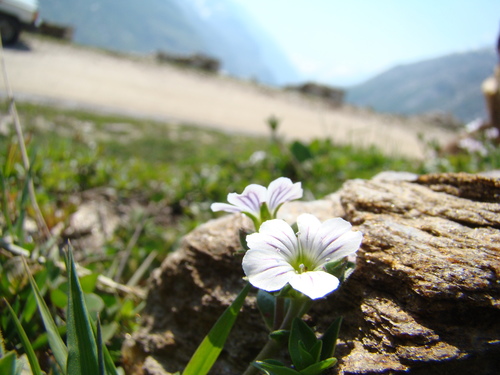
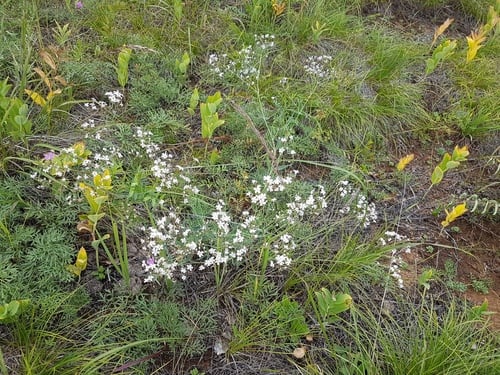
Sagina japonica
(Sw.) Ohwi.
Japanese Pearlwort
iNaturalist· cc0
no rights reserved, uploaded by 葉子
iNaturalist· cc-by-nc
(c) jean0108, some rights reserved (CC BY-NC)
Summary
A small annual or biennial reaching 20cm tall with hermaphrodite flowers appearing May to June, seeds maturing June to July. Adaptable to sandy, loamy, and clay soils across mildly acidic to basic pH ranges. Tolerates semi-shade or full sun and prefers consistently moist conditions.
Description
A herb. It grows each year from seeds. The stems are tufted and can be creeping. It grows 5-20 cm tall. The leaves are narrow and 5-20 mm long by 1-2 mm wide.
Edible Uses
The leaves are edible when cooked.
Medicinal Uses
The leaves are used in the treatment of alopecia, caries, nerves, jaundice, fevers, foul sores, skin diseases, and vaginitis. A decoction of the whole plant is used to treat boils, caries, and dermatitis, and as an antidote to varnish poisoning.
Distribution
It is a temperate plant. In China it grows between 600-1,900 m above sea level.
Where It Grows
Asia, Bhutan, China, Himalayas, India, Japan, Korea, Nepal, Northeastern India, Russia, Sikkim,
Propagation
Sow seed in a cold frame in spring. When seedlings are large enough to handle, prick them out into individual pots and plant out during summer. If seed is plentiful, it may be worth sowing some directly in situ in April.
Other Uses
None known Special Uses
Notes
Used in medicine. There are about 20-25 Sagina species.
Synonyms
Also Known As
Qi gu cao
References (4)
- Flora of China @ efloras.org Volume 6
- J. Jap. Bot. 13:438. 1937
- Lu Dequan, Wu Zhengyi, Zhou Lihua, Chen Shilong; Michael G. Gilbert, Magnus Lidén, John McNeill, John K. Morton, Bengt Oxelman, Richard K. Rabeler, Mats Thulin, Nicholas J. Turland, Warren L. Wagner, CARYOPHYLLACEAE, Flora of China.
- Plants for a Future database, The Field, Penpol, Lostwithiel, Cornwall, PL22 0NG, UK. http://www.scs.leeds.ac.uk/pfaf/