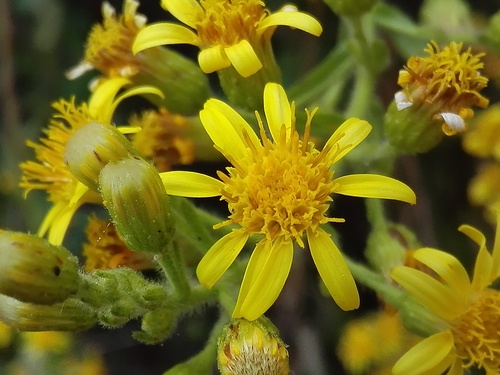
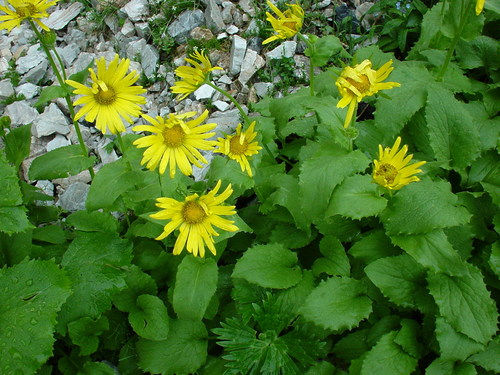
Rudbeckia laciniata
L.
Cut-leaf coneflower, Wild golden glow
iNaturalist· cc-by-nc
(c) kenttrulsson, some rights reserved (CC BY-NC), uploaded by kenttrulsson
iNaturalist· cc-by
(c) Will Kuhn, some rights reserved (CC BY)
iNaturalist· cc-by-nc
(c) Annie Wall, some rights reserved (CC BY-NC)
Summary
Source: WikipediaRudbeckia laciniata, the cutleaf coneflower, is a species of flowering plant in the family Asteraceae. Other common names include cutleaf, goldenglow, green-headed coneflower, tall coneflower, sochan and thimbleweed. It is native to North American floodplains, stream banks, and moist forests. Although toxic to animals, the leaves have culinary uses.
Description
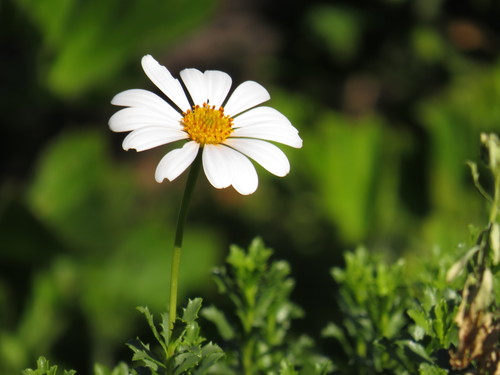
A daisy family plant. It grows 2-3 m high and spreads 0.9-2 m wide. It keeps growing from year to year. The leaves are deeply lobed or divided into leaflets along the stalk. They are blue-green and often hairy underneath. The flower heads are 12 cm wide. The flowers are yellow and yellow green in the centre.
Edible Uses
The young stems are edible when cooked, traditionally eaten in spring for good health. They can be prepared like celery and may also be dried for later use. Some caution is advised regarding toxicity.
Traditional Uses
The leaves are cooked as a vegetable. They are boiled or fried. They are also dried and stored for later use. The young stems are eaten like celery.
Medicinal Uses
A tea made from the root, combined with Caulophyllum thalictroides, is used to treat indigestion. A poultice of the flowers, mixed with Agastache anisatum and Solidago sp., is applied to burns.
Known Hazards
The plant is somewhat toxic to livestock. One report cites circumstantial evidence of poisoning to horses, sheep and pigs.
Distribution
It is a temperate plant. It will grow in most moist soils. It needs an open sunny position. It is resistant to frost but sensitive to drought. It suits hardiness zones 3-9.
Where It Grows
Asia, Australia, Canada*, Central Asia, China, India, Korea, North America*, Slovenia, Tajikistan, Tasmania, USA,
Cultivation
Succeeds in an ordinary medium soil in sun or shade. Requires a moist soil. Prefers a well-drained soil. Tolerates considerable wind exposure without support. Plants can be grown in quite coarse grass, which can be cut annually in the autumn. They grow particularly well in long hot late summers. Dormant plants are hardy to about -25°c. Some named forms have been selected for their ornamental value. Members of this genus are rarely if ever troubled by browsing deer. Plants can be invasive.
Propagation
Sow seed in April in a greenhouse, barely covering it. Germination should occur within two weeks. Prick out seedlings into individual pots when large enough to handle and plant out during summer. Seed can also be sown in situ. Division can be done in spring or autumn. Larger divisions may be planted directly into permanent positions. Smaller divisions are best potted up and grown on in a lightly shaded cold frame, then planted out once well established in summer.
Other Uses
A green dye is obtained from the flowers.
Notes
There are about 15-20 Rudbeckia species.
Also Known As
Deljenolistna rudbekija
References (11)
- Beckstrom-Sternberg, Stephen M., and James A. Duke. "The Foodplant Database." http://probe.nalusda.gov:8300/cgi-bin/browse/foodplantdb.(ACEDB version 4.0 - data version July 1994)
- Brickell, C. (Ed.), 1999, The Royal Horticultural Society A-Z Encyclopedia of Garden Plants. Convent Garden Books. p 917
- Cundall, P., (ed.), 2004, Gardening Australia: flora: the gardener's bible. ABC Books. p 1286
- Hibbert, M., 2002, The Aussie Plant Finder 2002, Florilegium. p 282
- http://www.botanic-gardens-ljubljana.com/en/plants
Show all 11 references Hide references
- Kiple, K.F. & Ornelas, K.C., (eds), 2000, The Cambridge World History of Food. CUP p 1762
- MacKinnon, A., et al, 2009, Edible & Medicinal Plants of Canada. Lone Pine. p 349
- Moerman, D. F., 2010, Native American Ethnobotany. Timber Press. p 495
- Morley, B. & Everard, B., 1970, Wild Flowers of the World. Ebury press. Plate 165
- Sp. pl. 2:906. 1753
- Toupal, R. S. & Hollenback, K., 2009, An Ethnobotany of Indiana Dunes National Lakeshore: Plant Uses of the Ojibwa People. Bureau of Applied Research in Anthropology. University of Arizona