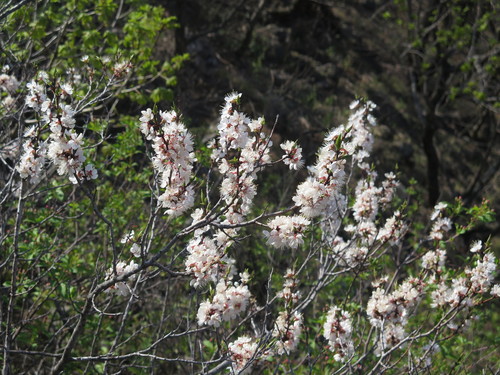
Rubus bellobatus
L. H. Bailey
Kittatinny blackberry
wikimedia· cc-by-sa
Wikimedia Commons - NiveisVulpes
Summary
Deciduous shrub reaching 2 m tall, hardy to UK zone 6. Hermaphrodite flowers pollinated by insects; self-fertile and apomictic. Tolerates light sandy, medium loamy, and heavy clay soils with good drainage. Grows in mildly acid to mildly alkaline pH, semi-shade to full sun, and prefers moist conditions.
Description
A rambling herb or shrub. It branches often and keeps growing from year to year. It can be a climber growing to 6 m high. It has a woody rootstock. The flowers are pink and white.
Edible Uses
The oblong fruit, around 30mm long, can be eaten raw or cooked.
Medicinal Uses
None known.
Distribution
It is a temperate plant. It grows on red lay loams and sandy soils It is often along creek banks.
Where It Grows
Australia, North America, USA,
Cultivation
Easily grown in a good well-drained loamy soil in sun or semi-shade. This species is a blackberry with biennial stems, it produces a number of new stems each year from the perennial rootstock, these stems fruit in their second year and then die. A parent of many cultivated forms of blackberry in N. America, the cultivar 'Kittatinny' has been available in Britain. The plant produces apomictic flowers, these produce fruit and viable seed without fertilization, each seedling is a genetic copy of the parent Plants in this genus are notably susceptible to honey fungus.
Propagation
Seed requires stratification and is best sown in early autumn in a cold frame. Stored seed needs one month of stratification at around 3°c and should be sown as early in the year as possible. Prick out seedlings once large enough to handle and grow on in a cold frame before planting out into permanent positions in late spring of the following year. Cuttings of half-ripe wood can be taken in July or August in a frame. Tip layering in July, planting out in autumn. Division in early spring or just before leaf-fall in autumn.
Other Uses
A purple to dull blue dye is obtained from the fruit.
Other Information
It is cultivated.
Notes
There are about 250 Rubus species.
Dangerous Lookalikes
This plant can be confused with the following toxic species. Always verify identification carefully before consuming any wild plant.
Red Baneberry
Actaea rubra
Walter Siegmund (talk)
Kittatinny blackberry
Rubus bellobatus
Wikimedia Commons - NiveisVulpes
Red Baneberry: Short herbaceous plant (no thorns), berries on thick red stems, each berry has a single seed, compound sharply-toothed leaves.
Kittatinny blackberry: Thorny woody canes (brambles), aggregate berry made of many drupelets, berries pull easily from receptacle.
References (4)
- Gentes Herb. 5:666. 1945
- Mansfield's Encyclopedia of Agricultural and Horticultural Crops p 430
- Paczkowska, G . & Chapman, A.R., 2000, The Western Australian Flora. A Descriptive Calatogue. Western Australian Herbarium. p 512
- Plants for a Future database, The Field, Penpol, Lostwithiel, Cornwall, PL22 0NG, UK. http://www.scs.leeds.ac.uk/pfaf/