Rhynchosia totta
(Thunb.) DC.
Yellow carpet bean
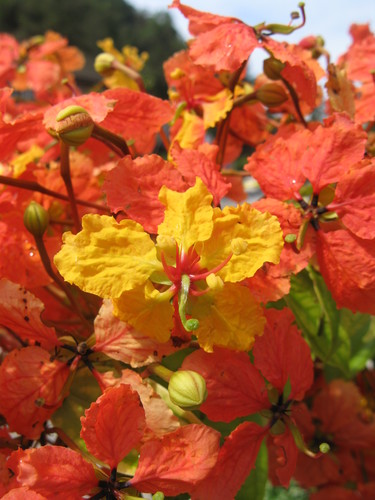
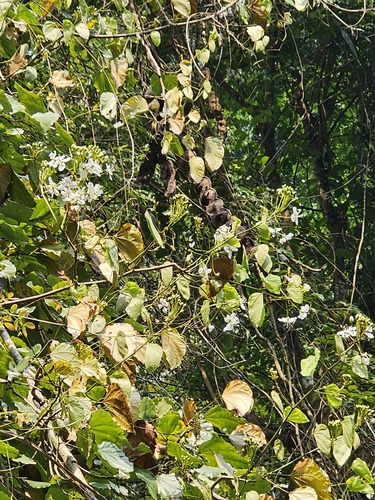
iNaturalist· cc-by-nc
(c) Chris Wahlberg, some rights reserved (CC BY-NC), uploaded by Chris Wahlberg
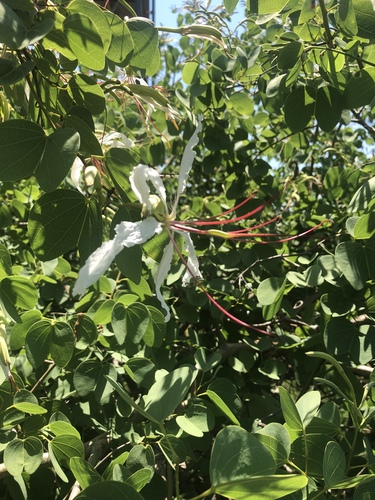
iNaturalist· cc-by-nc
(c) tjeerd, some rights reserved (CC BY-NC), uploaded by tjeerd
iNaturalist· cc-by-nc
(c) tjeerd, some rights reserved (CC BY-NC), uploaded by tjeerd
Description
A climbing herb. It has underground stems or rhizomes. It grows 1 m high. It has a tuberous rootstock and several thin stems. They can be covered with silvery or rusty hairs. The leaves have 3 leaflets. These can be 1-10 cm long by 3 cm wide. The flowers can occur singly or as a few in a group. They are yellow with red. The fruit are pods 2-4 cm long by 1 cm wide. The seeds are dark brown and kidney shaped. They are 3-5 mm long by 2-4 mm wide. There are several different varieties.
Edible Uses
The root tuber is chewed for its sweet flavor and can be eaten raw or roasted. It is eaten by both children and adults.
Traditional Uses
The root tuber is chewed for its sweet flavour. They can be eaten raw or roasted.
This uses section is brief — help expand it
Medicinal Uses
The plant is used in medicine.
Distribution
It is a tropical plant. It grows in sands. It grows between 10-2,090 m above sea level. It can grow in arid places.
Where It Grows
Africa, Angola, Botswana, Central Africa, Chad, East Africa, Eswatini, Ethiopia, Kenya, Lesotho, Mozambique, Namibia, Niger, Somalia, South Africa, Southern Africa, Sudan, Swaziland, Tanzania, Uganda, West Africa, Zambia, Zimbabwe,
Other Information
It is eaten especially by children but also by adults.
Notes
It is used in medicine.
Synonyms
Also Known As
Igugude, Kawab, Ligududze, Malintsoetla, Matsoelintsoetla, Mawungula, Nawayanaga, Samphiphi, Sebalibetloa, Seoeloloetla, Setloli, Tsoetsoetlela
References (14)
- Fox, F. W. & Young, M. E. N., 1982, Food from the Veld. Delta Books. p 214
- Grivetti, L. E., 1980, Agricultural development: present and potential role of edible wild plants. Part 2: Sub-Saharan Africa, Report to the Department of State Agency for International Development. p 65
- Guillarmod, J., 1971,
- Long, C., 2005, Swaziland's Flora - siSwati names and Uses http://www.sntc.org.sz/flora/
- Matlhare, T., et al, Vegetables in Botswana. p 21 Bioversity website.
Show all 14 references Hide references
- Peters, C. R., O'Brien, E. M., and Drummond, R.B., 1992, Edible Wild plants of Sub-saharan Africa. Kew. p 137
- Prodr. 2:388. 1825
- Royal Botanic Gardens, Kew (1999). Survey of Economic Plants for Arid and Semi-Arid Lands (SEPASAL) database. Published on the Internet; http://www.rbgkew.org.uk/ceb/sepasal/internet [Accessed 29th April 2011]
- Ruiters-Welcome, A. K., 2019, Food plants of southern Africa. Ph.D. thesis. Univ. of Johannesburg p 60
- Swaziland's Flora Database http://www.sntc.org.sz/flora
- USDA, ARS, National Genetic Resources Program. Germplasm Resources Information Network - (GRIN). [Online Database] National Germplasm Resources Laboratory, Beltsville, Maryland. Available: www.ars-grin.gov/cgi-bin/npgs/html/econ.pl (10 April 2000)
- van Wyk, Ben-Erik, 2019, The diversity and multiple uses of southern African legumes. Australian Systematic Botany, 2019, 32, 519–546
- Welcome, A. K. & Van Wyk, B.-E., 2019, An inventory and analysis of the food plants of southern Africa. South African Journal of Botany 122 (2019) 136–179
- World Checklist of Useful Plant Species 2020. Royal Botanic Gardens, Kew