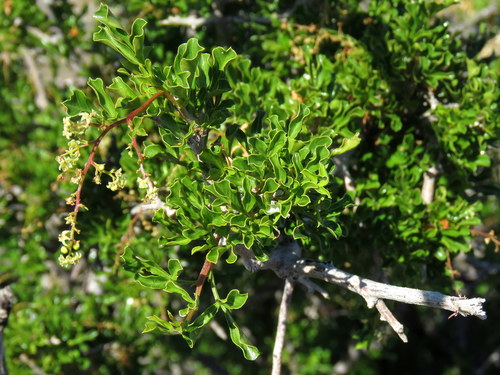
Searsia tenuinervis
(Engl.) Moffett
Kalahari taaibos, Commiphora rhus, Kalahari currant
iNaturalist· cc-by-nc
(c) Grant Reed, some rights reserved (CC BY-NC), uploaded by Grant Reed
iNaturalist· cc-by
(c) Robert Taylor, some rights reserved (CC BY)
Description
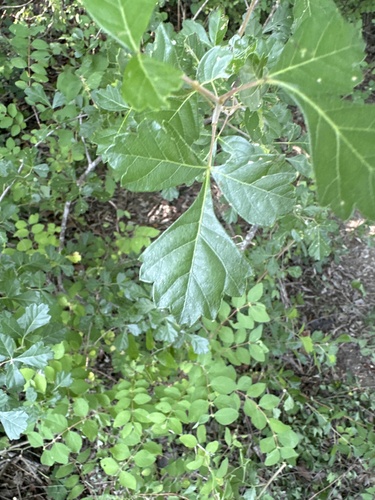
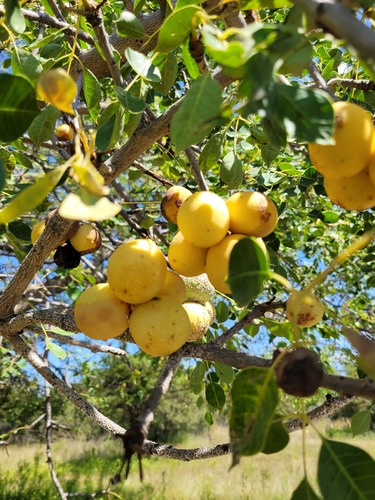
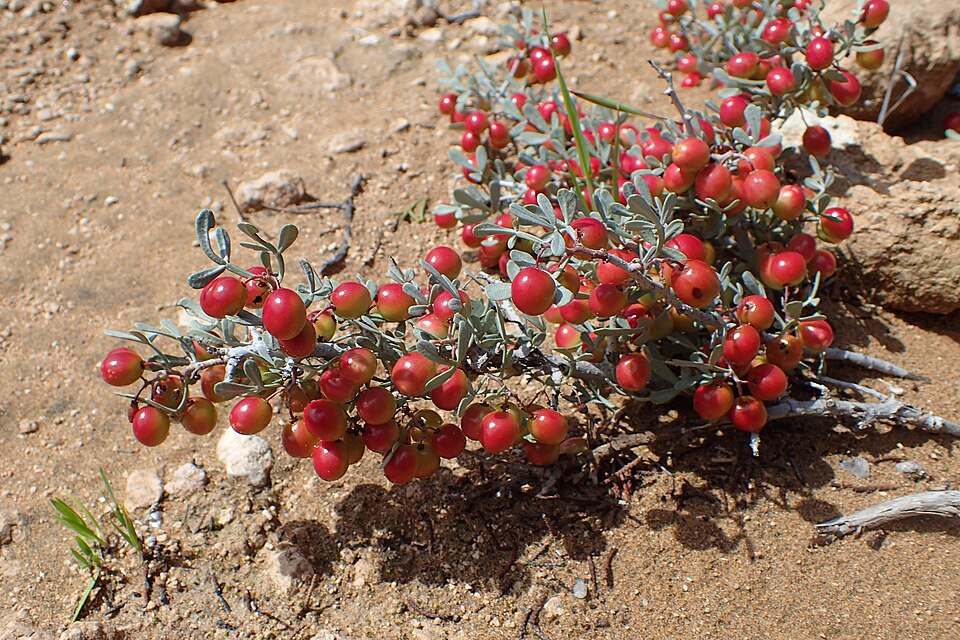
A low shrub. It can grow to 6 m tall. The crown is dense with many branches. The bark is dark. It loses its leaves during the year. The leaves have a scent. The young twigs and leaves are hairy. Sometimes the leaf branches are spiny. The leaves have 3 leaflets that are softly hairy. The leaflets are egg-shaped. The point is blunt and they narrow to the base. The edges of the leaves are normally coarsely scolloped. The leaflets are 1.3-10 cm long by 0.8-5 cm wide. The middle leaflet is the largest. The leaflets are dark green above and paler or yellowish below. They turn red in autumn. The flowers are star like. The flowers are greenish-white. They occur in loosely branched sprays. They are in the axils of leaves and near the ends of branches. The fruit are small, round and pea-sized. The fruit are 6 mm across. They can be white or purplish-brown when ripe. They are edible.
Edible Uses
The small round fruit are eaten raw and also used to make beer. The narrow leaves are used as flavouring in meat dishes and can be chewed; the stems are used to flavour water. The seeds are also edible.
Traditional Uses
The fruit are eaten raw. The leaves are used as flavouring. The leaves are eaten raw. They are chewed then spat out. They are also used to flavour meat dishes. The fruit are also used for beer. The stems are used to flavour water.
Medicinal Uses
A decoction of the root is used in the treatment of chest pains and severe coughing. The grated outer layer of the root is rubbed into skin incisions in the cheek to treat toothache. A decoction of the bark is taken in the treatment of chronic diarrhoea.
Distribution
It is a tropical plant. It grows in areas that are sometimes waterlogged. It is usually in areas with a rainfall between 300-800 mm. It grows between 300-1,850 m above sea level. It grows in open woodland and on termite mounds. It can grow in arid places. It grows in various types of woodland and on rocky hillsides. It grows on the banks of rivers. It can stand some frost.
Where It Grows
Africa, Botswana, East Africa, Ethiopia, Kenya, Namibia, South Africa, Southern Africa, Sudan, Zambia, Zimbabwe,
Cultivation
Plants can be grown from seeds. Seeds grown easily. Seedlings can be transplanted. It grows quickly.
Other Uses
The roots are very hard when dry and are used for carving arrowheads and arrow joints.
Other Information
The fruit are eaten especially by children.
Notes
There are about 200 Rhus species.
Synonyms
Also Known As
Kemo, Kimosh, Kitheu, Morupaphiri, Nana berry, Omupombo, Qadhadhiya, Rhus
References (30)
- A. L. P. P. de Candolle & A. C. de Candolle, Monogr. phan. 4:423. 1883 (As Rhus tenuinervis)
- Addis, G., et al, 2005, Ethnobotanical Study of Edible Wild Plants in Some Selected Districts of Ethiopia. Human Ecology, Vol. 33, No. 1, pp. 83-118 (As Rhus tenuinervis)
- Ashagre, M., et al, 2016, Ethnobotanical study of wild edible plants in Burji District, Segan Area Zone of Southern Nations, Nationalities and Peoples Region (SNNPR), Ethiopia. Journal of Ethnobiology and Ethnomedicine (2016) 12:32 (As Rhus tenuinervis)
- Cheikhyoussef, A & Embashu, W., 2013, Ethnobotanical knowledge on Indigenous fruits in Ohangwena and Oshito regions in Northern Namibia. Journal of Ethnobiology and Ethnomedicine 9:34
- Drummond, R. B., 1981, Common Trees of the Central Watershed Woodlands of Zimbabwe, National Herbarium Salisbury. p 122 (As Rhus tenuinervis)
Show all 30 references Hide references
- Fowler, D. G., 2007, Zambian Plants: Their Vernacular Names and Uses. Kew. p 8 (As Rhus tenuinervis)
- Fox, F. W. & Young, M. E. N., 1982, Food from the Veld. Delta Books. p 78 (As Rhus tenuinervis)
- Jardin, C., 1970, List of Foods Used In Africa, FAO Nutrition Information Document Series No 2.p 158 (As Rhus tenuinervis)
- Leger, S., 1997, A Description of Today's Use of Plants in West Bushmanland (Namibia). German Development Service. PO Box 220035, 14061 Berlin, Germany. http://www.sigridleger.de/book/ (As Rhus tenuinervis)
- Lulekal, E., et al, 2011, Wild edible plants in Ethiopia: a review on their potential to combat food insecurity. Afrika Focus - Vol. 24, No 2. pp 71-121 (As Rhus tenuinervis)
- Maguire, 1978, (As Rhus tenuinervis)
- Mannheimer, C. A. & Curtis. B.A. (eds), 2009, Le Roux and Muller's Field Guide to the Trees and Shrubs of Namibia. Windhoek: Macmillan Education Namibia. p 290
- Maroyi, A., 2011, The Gathering and Consumption of Wild Edible Plants in Nhema Communal Area, Midlands Province, Zimbabwe. Ecology of Food and Nutrition 50:6, 506-525 (As Rhus tenuinervis)
- Maroyi, A. & Cheikhyoussef, A., 2017, Traditional knowledge of wild edible fruit in southern Africa: A comparative use patterns in Namibia and Zimbabwe. Indian Journal of Traditional Knowledge. 16(3): 385-392
- Maundu, P. et al, 1999, Traditional Food Plants of Kenya. National Museum of Kenya. 288p (As Rhus tenuinervis)
- Moffett, R. O., 2007, Name changes in the Old World Rhus and recognition of Searsia (Anacardiaceae). Bothalia 37,2: 165-175 (2007)
- Mutie, F. G., 2020, Conservation of Wild Food Plants and Their Potential for Combatting Food Insecurity in Kenya as Exemplified by the Drylands of Kitui County. Plants 2020, 9, 1017
- Mutie, F. M., et al, 2023, Important Medicinal and Food Taxa (Orders and Families) in Kenya, Based on Three Quantitative Approaches. Plants 2023, 12, 1145
- Palgrave, K.C., 1996, Trees of Southern Africa. Struik Publishers. p 488 (As Rhus tenuinervis)
- Palmer, E and Pitman, N., 1972, Trees of Southern Africa. Vol. 2. A.A. Balkema, Cape Town p 1253 (As Rhus tenuinervis)
- Peters, C. R., O'Brien, E. M., and Drummond, R.B., 1992, Edible Wild plants of Sub-saharan Africa. Kew. p 52 (As Rhus tenuinervis)
- Roodt, V., 1998, Trees & Shrubs of the Okavango Delta. Medicinal Uses and Nutritional value. The Shell Field Guide Series: Part 1. Shell Botswana. p 129 (As Rhus tenuinervis)
- Royal Botanic Gardens, Kew (1999). Survey of Economic Plants for Arid and Semi-Arid Lands (SEPASAL) database. Published on the Internet; http://www.rbgkew.org.uk/ceb/sepasal/internet [Accessed 28th March 2011] (As Rhus tenuinervis)
- Ruiters-Welcome, A. K., 2019, Food plants of southern Africa. Ph.D. thesis. Univ. of Johannesburg p 16
- Seyoum, Y., et al, 2015, Edible Wild Fruit Trees and Shrubs and Their Socioeconomic Significance in Central Ethiopia. Ethnobotany Research & Applications. 14:183-197 (As Rhus tenuinervis)
- Story, 1958, (As Rhus tenuinervis)
- Tredgold, M.H., 1986, Food Plants of Zimbabwe. Mambo Press. p 117 (As Rhus tenuinervis)
- Welcome, A. K. & Van Wyk, B.-E., 2019, An inventory and analysis of the food plants of southern Africa. South African Journal of Botany 122 (2019) 136–179
- Wild, 1975, (As Rhus tenuinervis)
- World Checklist of Useful Plant Species 2020. Royal Botanic Gardens, Kew