Quercus semecarpifolia
Sm.
Kharshu oak
iNaturalist· cc-by-nc-sa
(c) Phuentsho, some rights reserved (CC BY-NC-SA), uploaded by Phuentsho
iNaturalist· cc-by-nc
(c) Ryan E. Gray, some rights reserved (CC BY-NC)
iNaturalist· cc-by-nc
(c) Phuntsho Wangdi, some rights reserved (CC BY-NC), uploaded by Phuntsho Wangdi
Summary
Source: WikipediaQuercus semecarpifolia is an Asian species of oak. It is native to the Himalayas and nearby mountains in Tibet, Afghanistan, India, Nepal, and Pakistan, where it is referred to as kharsu. It is classified in subgenus Cerris, section Ilex. Quercus semecarpifolia is an evergreen tree up to 30 metres (98 feet) tall. The leaves are up to 12 centimetres (4+3⁄4 inches) long, with a few teeth along the sides but rounded at the tip. It has been grown in middle Europe, Western Germany, winter-hardiness zone 7, withstanding -14 °C, without any damages. It gives a good, showy bush to small tree with lush green leaves. The epithet semecarpifolia refers to a resemblance between the leaves of this species and those of Semecarpus anacardium. In its native range, it serves as a keystone species, exhibiting up to 80% dominance at elevations between 2700 and 3300 meters. In areas where less degradation has occurred, Q. semecarpifolia reduces light at the forest floor, encouraging the growth of shade tolerant herbaceous species. Local people make use of kharsu more frequently than other native oaks for food, animal fodder, fuel, and timber. Its leaves are also known to support Antheraea proylei silk worms, goats, and prevent slug infestations.
Description
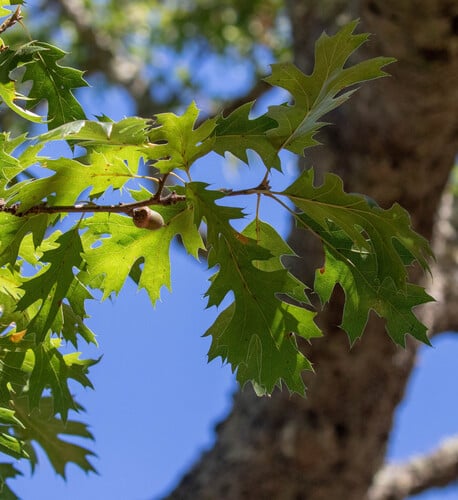
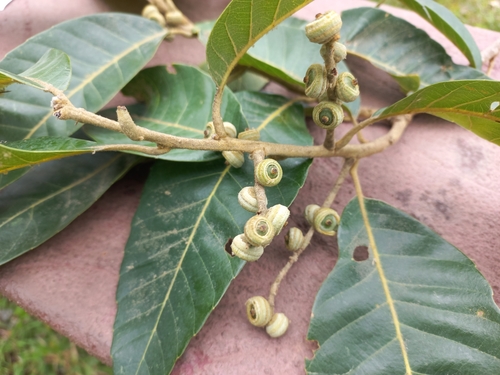
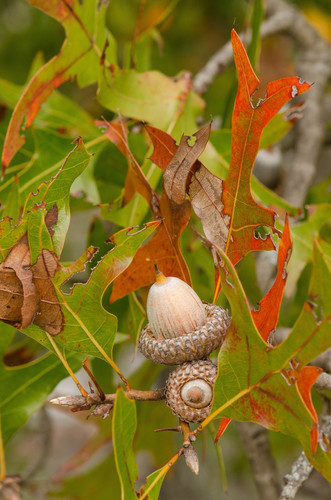
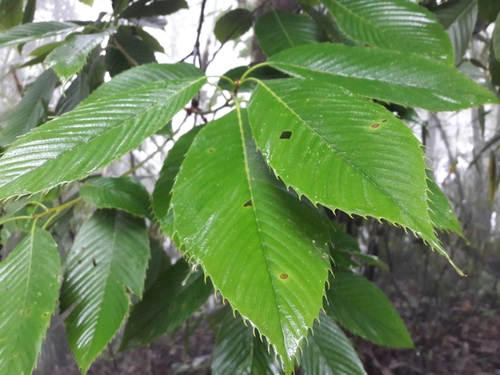
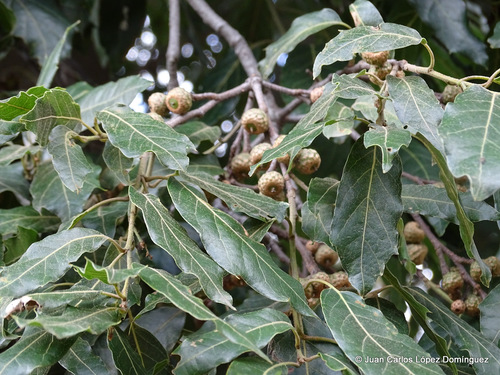
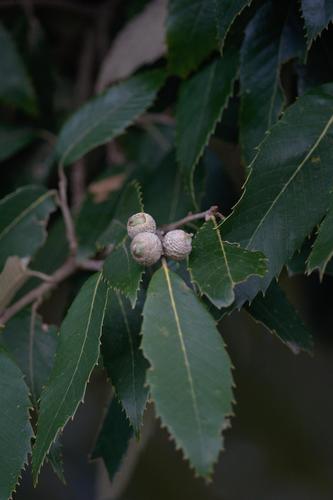
A tree. It grows about 20 m high. It keeps its leaves during the year. The young parts have a brown covering and hairs. The leaves have stalks. They are 2-6 mm long. Leaves are alternate. The leaves are oblong and densely hairy underneath when young. The leaf blade is 5-12 cm long by 3-6.5 cm wide. The male flower spikes are long and slender. They are densely hairy and droop. They are yellowish. The female fruit is an acorn. They occur singly or in pairs. The nut can be purple brown. It is 2-3 cm across.
Edible Uses
The seed, which can be up to 3cm long, must be cooked before eating. It can be dried and ground into a powder for use as a stew thickener or mixed with cereals to make bread. The seed contains bitter tannins that can be leached out by washing thoroughly in running water, though this process also removes many minerals. Either whole seeds or seed powder can be used — leaching whole seeds can take several days or even weeks, and wrapping them in a cloth bag placed in a stream is one effective method. Grinding first and then leaching the powder is considerably quicker. A simple taste test indicates when tannins have been sufficiently removed. The traditional preparation method was to bury seeds in boggy ground over winter; the germinating seed dug up in spring would have lost most of its astringency. The roasted seed serves as a coffee substitute. The plant's sap is drunk as a tea.
Traditional Uses
The sap of the plant is drunk as tea. The seeds can be dried and ground to a powder and used to thicken stews or mixed with cereals for bread. The seeds need to be leached in running water to remove bitterness.
Medicinal Uses
Galls produced on the tree are strongly astringent and are used in treating haemorrhages, chronic diarrhoea, and dysentery. The juice of the bark is applied externally to relieve muscular pain.
Distribution
It is a temperate plant. In Nepal they grow from 700-3800 m altitude. They occur on hillsides. In China they grow in mountain forests between 2600-4000 m altitude.
Where It Grows
Afghanistan, Asia, Bhutan, China, Europe, France, Himalayas, India, Indochina, Myanmar, Nepal, Northeastern India, Pakistan, SE Asia, Tibet,
Cultivation
Prefers a good deep fertile loam which can be on the stiff side. Young plants tolerate reasonable levels of side shade. Older trees dislike shade. Tolerates moderate exposure, surviving well but being somewhat stunted. This species is not hardy in the colder areas of the country, it tolerates temperatures down to between -5 and -10°c. Prefers warmer summers than are usually experienced in Britain, trees often grow poorly in this country and fail to properly ripen their wood resulting in frost damage overwinter. Trees respond well to coppicing. The seed ripens in its second year. Intolerant of root disturbance, trees should be planted in their permanent positions whilst young. Hybridizes freely with other members of the genus. Plants in this genus are notably resistant to honey fungus.
Propagation
Seed loses viability rapidly if allowed to dry out. It can be stored moist and cool over winter but is best sown as soon as it is ripe in an outdoor seed bed, with protection from mice and squirrels. Small quantities can be sown in deep pots in a cold frame. Because plants develop a deep taproot, they should be moved to their permanent positions as soon as possible — seed sown in situ produces the best trees. Trees left in a nursery bed for more than 2 growing seasons transplant very poorly.
Other Uses
A leaf mulch repels slugs and grubs, though fresh leaves should not be used as they can inhibit plant growth. Oak galls caused by insect larvae are a rich source of tannin once the insect has pupated and left; the tannin can also be used as a dyestuff. The bark is itself a source of tannins. The wood is very hard and close-grained but tends to split during seasoning; it is used in construction. The wood also makes an excellent fuel and yields good quality charcoal.
Notes
There are about 600 Quercus species.
Synonyms
Also Known As
Ban, Bani, Gao shan li, Kethcheng, Khalanza, Kharsu, Khasru, Terry
References (9)
- Amin, M., et al, 2023, Edible wild plant species used by different linguistic groups of Kohistan Upper Khyber Pakhtunkhwa (KP), Pakistan. Journal of Ethnobiology and Ethnomedicine 19:6 p 11
- Farooq, S., et al, 2012, Ethnobotanical Studies of the Flora of Tehsil Birmal in South Waziristan Agency, Pakistan. Pak. J. Weed Sci. Res. 18(3): 277-291
- Huang Chengjiu, Zhang Yongtian, Bartholomew, B., Fagaceae, Flora of China.
- Manandhar, N.P., 2002, Plants and People of Nepal. Timber Press. Portland, Oregon. p 388
- Plants for a Future database, The Field, Penpol, Lostwithiel, Cornwall, PL22 0NG, UK. http://www.scs.leeds.ac.uk/pfaf/
Show all 9 references Hide references
- A. Rees, Cycl. 29: Quercus no. 20. 1814
- Sahni, K.C., 2000, The Book of Indian Trees. Bombay Natural History Society. Oxford. p 173
- Tsering, J., et al, 2017, Ethnobotanical appraisal on wild edible plants used by the Monpa community of Arunchal Pradesh. Indian Journal of Traditional Knowledge. Vol 16(4), October 2017, pp 626-637
- www.worldagroforestrycentre.org/treedb/