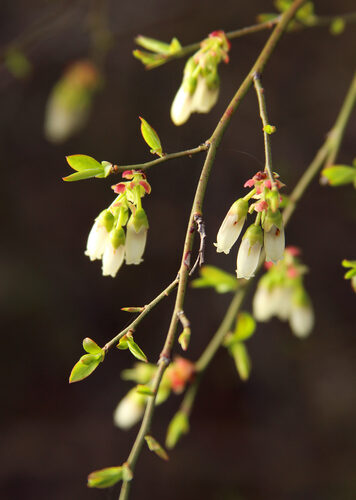
Pyrus ussuriensis
Maxim.
Chinese Asian pear, Manchurian Pear, Mongolian pear, Ussurian pear, Chinese white pear, Harbin pear
iNaturalist· cc-by
(c) Carrie Seltzer, some rights reserved (CC BY), uploaded by Carrie Seltzer
iNaturalist· cc-by-nc-sa
(c) Arthur Chapman, some rights reserved (CC BY-NC-SA)
iNaturalist· cc-by-nc
(c) onidiras-iNaturalist, some rights reserved (CC BY-NC), uploaded by onidiras-iNaturalist
Summary
Source: WikipediaPyrus ussuriensis, also known as the Ussurian pear, Harbin pear, and Manchurian pear, is a species of flowering plant in the family Rosaceae. It is native to Korea, Japan, China, and the Ussuri River area of far eastern Russia. It has flowers in spring that are slightly pink when budding and then turn white. Buds are dark brown and have an alternating arrangement. The tree grows to a height of about 15 meters (49 ft) and prefers well-drained loam-type soils. It is considered the hardiest of all pears. When planted in milder climates, the trees have been known to be killed by freezes after they begin budding. Many species of birds and mammals feed upon the fruit of this species. Deer, mice, and rabbits are known to damage the trees. Leaves are dark green in spring and summer and turn dark red and gold in autumn. Products made from the fruits may prove more effective than commercial insecticides in killing ticks and mites. The fruits are not the tastiest of pears to humans, but the taste is better after a freeze and the juice tastes better. Crosses of this species with other pears produces tasty pears that grow in climates too cold for most pears. Cultivars include the 'Reli', 'Jinxiang', 'Hongbalixiang', 'Baibalixiang', 'Fuwuxiang', 'Qiuxiang', 'Fuanjianba', 'Longxiang', 'Guanhongxiao', 'Shanli24', 'Wuxiangli', 'Shatangli', 'Manyuanxiang', 'McDermand', and the Prairie Gem® Flowering Pear (cultivar ‘MorDak’). There are at least 108 compounds in the fruits that affect plant breeding and these show that P. ussuriensis cultivars fall into 4 groups.
Description
A tree. It grows 15 m high and spreads 6 m wide. The leaves are oval or rounded. They are yellowish-green. They have bristly teeth. The leaves turn red or bronze in autumn. The flowers are white. The fruit are greenish-brown.
Edible Uses
The fruit can be eaten raw or cooked, though size and quality vary considerably from tree to tree. Good forms produce somewhat dry but pleasantly flavoured fruits up to 4cm in diameter, while other forms tend to be smaller and less enjoyable.
Traditional Uses
The fruit are eaten raw. The leaves are used for a tea drink.
This uses section is brief — help expand it
Medicinal Uses
None known
Distribution
It is a temperate plant. It grows in north China. It suits hardiness zones 4-9.
Where It Grows
Asia, Australia, Asia, Central Asia, China, India, Indochina, Japan, Korea, Manchuria, Mexico, Mongolia, North America, Russia, SE Asia, Tajikistan,USA, Vietnam,
Cultivation
Prefers a good well-drained loam in full sun. Grows well in heavy clay soils. Tolerates light shade but does not fruit so well in such a position. Tolerates atmospheric pollution, excessive moisture and a range of soil types if they are moderately fertile. Established plants are drought tolerant. A very frost resistant tree, tolerating temperatures down to below -15°, it is a possible rootstock for northern areas. It is used as a rootstock for P. pyrifolia culta in Korea. This species is a parent of the cultivated Asian pears.
Propagation
Seed is best sown in a cold frame as soon as it is ripe in autumn, when it will typically germinate in mid to late winter. Stored seed requires 8–10 weeks of cold stratification at 1°c and should be sown as early in the year as possible. Temperatures above 15–20°c can induce secondary dormancy. Prick out seedlings into individual pots when large enough to handle and grow on in light shade in a cold frame or greenhouse for their first year. Plant out in late spring or early summer the following year.
Other Uses
The tree is used as a rootstock for Pyrus pyrifolia culta in Korea and is notably frost resistant.
Other Information
It is a cultivated food plant.
Synonyms
Also Known As
Alima, Heger-e inilam-a, Le, Pera china, Peral hoja de sauce, Qiu zi li, Shan li
References (23)
- Bodkin, F., 1991, Encyclopedia Botanica. Cornstalk publishing, p 859
- Brickell, C. (Ed.), 1999, The Royal Horticultural Society A-Z Encyclopedia of Garden Plants. Convent Garden Books. p 852
- Burkill, I.H., 1966, A Dictionary of the Economic Products of the Malay Peninsula. Ministry of Agriculture and Cooperatives, Kuala Lumpur, Malaysia. Vol 2 (I-Z) p 1879 (As Pyrus lindleyi)
- Bull. Cl. Phys.-Math. Acad. Imp. Sci. Saint-Petersbourg 15:132. 1857 ("1856")
- Cundall, P., (ed.), 2004, Gardening Australia: flora: the gardener's bible. ABC Books. p 1119
Show all 23 references Hide references
- Facciola, S., 1998, Cornucopia 2: a Source Book of Edible Plants. Kampong Publications, p 206
- Flora of China. Vol. 9, p 174
- Glowinski, L., 1999, The Complete Book of Fruit Growing in Australia. Lothian. p 29
- Hedrick, U.P., 1919, (Ed.), Sturtevant's edible plants of the world. p 543 (As Pyrus sinensis)
- Hibbert, M., 2002, The Aussie Plant Finder 2002, Florilegium. p 244
- Hu, Shiu-ying, 2005, Food Plants of China. The Chinese University Press. p 451
- INFOODS:FAO/INFOODS Databases
- Khasbagan, Hu-Yin Huai, and Sheng-Ji pei, 2000, Wild Plants in the Diet of Athorchin Mongol Herdsmen in Inner Mongolia. Economic Botany 54(4): 528-536
- Kiple, K.F. & Ornelas, K.C., (eds), 2000, The Cambridge World History of Food. CUP p 1723
- Pham-Hoang Ho, 1999, An Illustrated Flora of Vietnam. Nha Xuat Ban Tre. p 782
- Plants for a Future database, The Field, Penpol, Lostwithiel, Cornwall, PL22 0NG, UK. http://www.scs.leeds.ac.uk/pfaf/
- Sachula, et al, 2020, Wild edible plants collected and consumed by the locals in Daqinggou, Inner Mongolia, China. Journal of Ethnobiology and Ethnomedicine (2020) 16:60
- Segura, S., et al, 2018, The edible fruit species in Mexico. Genet Resour Crop Evol (2018) 65:1767–1793
- Tanaka,
- USDA, ARS, National Genetic Resources Program. Germplasm Resources Information Network - (GRIN). [Online Database] National Germplasm Resources Laboratory, Beltsville, Maryland. Available: www.ars-grin.gov/cgi-bin/npgs/html/econ.pl (10 April 2000)
- Wiersema, J. H. & Leon, B., 2013, World Economic Plants. A Standard Reference CRC Press. 2nd Ed. p 575
- www.efloras.org Flora of China Volume 9
- Zeven, A. C. & de West, J. M. J., 1982, Dictionary of cultivated plants and their regions of diversity. Wageningen. p 41