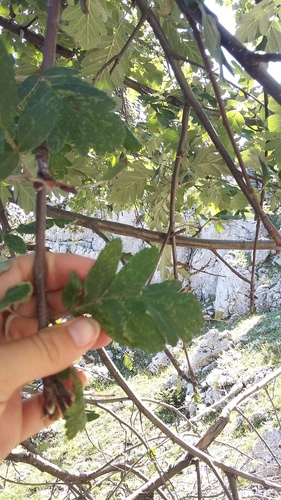
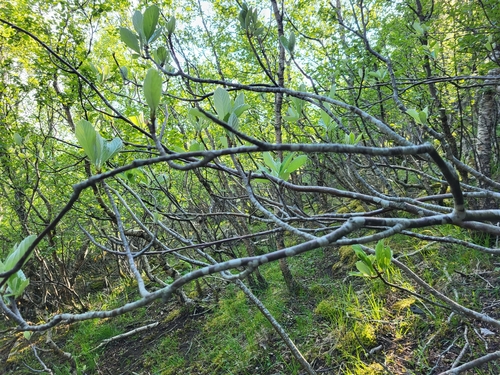
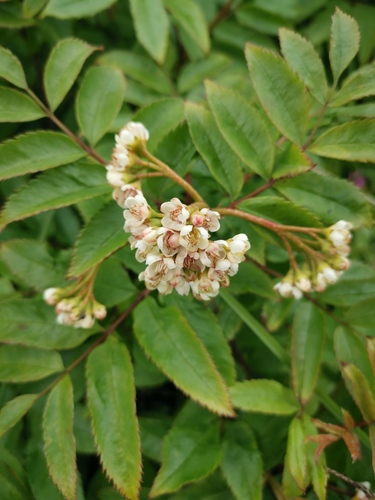
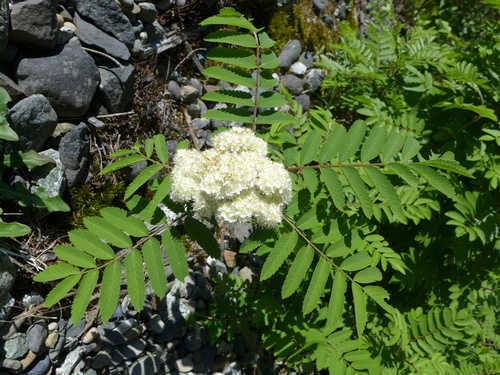
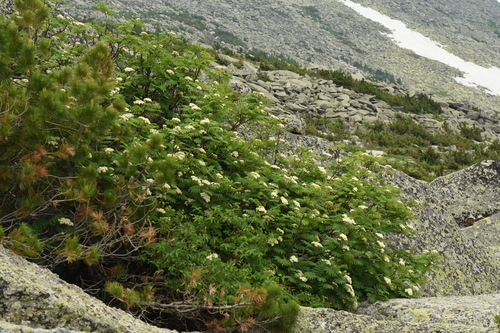
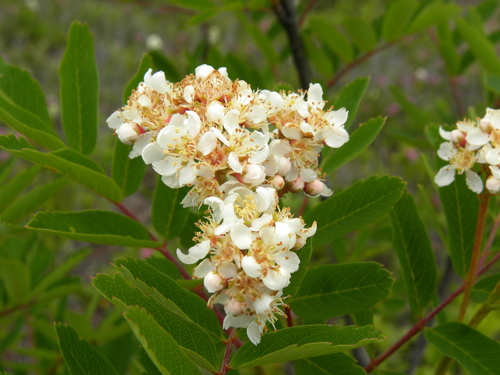
Pyrus elaeagnifolia
Pallas
Ahlat
iNaturalist· cc-by-nc
(c) Jaakko J. Ilvonen, some rights reserved (CC BY-NC)
iNaturalist· cc-by-nc
(c) Jaakko J. Ilvonen, some rights reserved (CC BY-NC)
iNaturalist· cc-by-nc
(c) Jaakko J. Ilvonen, some rights reserved (CC BY-NC)
Summary
A deciduous tree reaching 10 meters tall with a similar spread. Flowers appear in April and are pollinated by insects. Tolerant of sandy, loamy, and heavy clay soils with good drainage. Adapts to mildly acidic through mildly alkaline soil pH. Grows in partial shade or full sun, handles drought and atmospheric pollution well.
Description
A deciduous tree reaching 10 meters tall with a similar spread. Flowers appear in April and are pollinated by insects. Tolerant of sandy, loamy, and heavy clay soils with good drainage. Adapts to mildly acidic through mildly alkaline soil pH. Grows in partial shade or full sun, handles drought and atmospheric pollution well.
Edible Uses
The fruit, up to 2cm long, can be eaten raw or cooked. The flesh is rather tough and gritty but develops a reasonable flavour when fully ripe.
Traditional Uses
The ripe fruit are eaten and also used for pickles.
This uses section is brief — help expand it
Medicinal Uses
None known
Known Hazards
None known
Distribution
A temperate plant.
Where It Grows
Armenia, Asia, Balkans, Bulgaria, Caucasus, Europe, Romania, Turkey, Türkiye,
Cultivation
Prefers a good well-drained loam in full sun. Grows well in heavy clay soils. Tolerates light shade but does not fruit so well in such a position. Tolerates atmospheric pollution, excessive moisture and a range of soil types if they are moderately fertile. Established plants are drought tolerant. Plants are hardy to at least -15°c. The branches are thorny. This species is closely related to P. nivalis.
Propagation
Seed is best sown in a cold frame as soon as it is ripe in autumn, when it will typically germinate in mid to late winter. Stored seed requires 8–10 weeks of cold stratification at 1°c and should be sown as early in the year as possible. Temperatures above 15–20°c can induce secondary dormancy. Prick out seedlings into individual pots once large enough to handle, and grow on in light shade in a cold frame or greenhouse for their first year. Plant out in late spring or early summer the following year.
Other Uses
None known
Synonyms
Also Known As
Ahlat, Aflat, Alfat, Çakal armudu, Geyik elması, Kruska, Maslena krusha, Tasarmutu, Üvez, Yabani armut
References (12)
- Dogan, Y., et al, 2004, The Use of Wild Edible Plants in Western and Central Anatolia (Turkey). Economic Botany 58(4) pp. 684-690
- Ertug, F., 2000, An Ethnobotanical Study in Central Anatolia (Turkey). Economic Botany Vol. 54. No. 2. pp. 155-182
- Ertug, F, Yenen Bitkiler. Resimli Türkiye Florası -I- Flora of Turkey - Ethnobotany supplement
- Gunes, S. et al, 2018, Survey of wild food plants for human consumption in Karaisali (Adana-Turkey). Indian Journal of Traditional Knowledge. Vol. 17(2), April 2018, pp 290-298
- Hancer, C. K., et al, 2020, Traditional Knowledge of Wild Edible Plants of Biga (Çanakkale), Turkey. Acta Societatis Botanicorum Poloniae / 2020 / Volume 89 / Issue 1 / Article 8914
Show all 12 references Hide references
- Kargioglu, M., et al, 2008, An Ethnobotanical Survey of Inner-West Anatolia, Turkey. Human Ecology 36:763-777
- Kargioglu, M. et al, 2010, Traditional Uses of Wild Plants in the Middle Aegean Region. Human Ecology 38:429-450
- Nedelcheva A., 2013, An ethnobotanical study of wild edible plants in Bulgaria. EurAsian Journal of BioSciences 7, 77-94
- Nova Acta Acad. Sci. Imp. Petrop. Hist. Acad. 7:355, t. 10. 1793
- Özdemir, E. and Kültür, S., 2017, Wild Edible Plants of Savaştepe District (Balıkesir, Turkey), Marmara Pharm J 21/3: 578-589
- Plants for a Future database, The Field, Penpol, Lostwithiel, Cornwall, PL22 0NG, UK. http://www.scs.leeds.ac.uk/pfaf/
- Postman, J. D., et al, 2012, Recent NPGS Coordinated Expeditions in the Trans-Caucasus Region to Collect Wild Relatives of Temperate Fruit and Nut Crops. In Acta Horticulturae Number 948 p 191-198