Annona purpurea
Sesse & Mocino ex Dunal
Soncoya
iNaturalist· cc-by-nc-sa
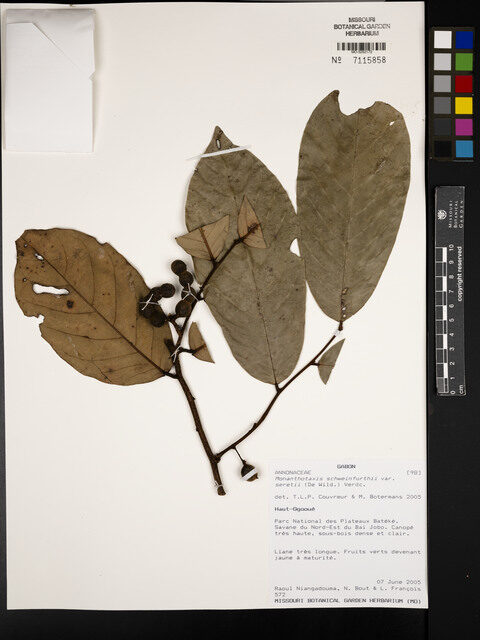
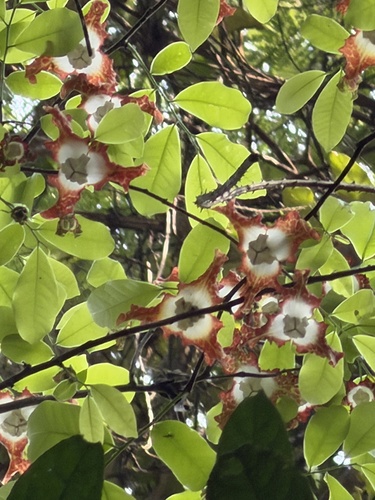
(c) Reinaldo Aguilar, some rights reserved (CC BY-NC-SA)
iNaturalist· cc-by-nc
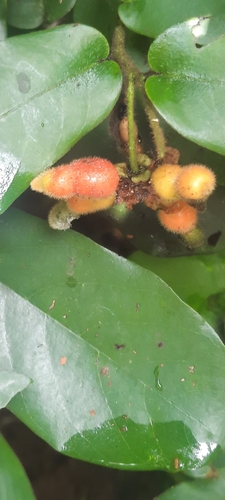
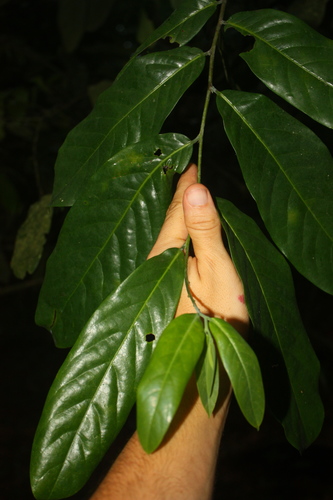
(c) Luis Humberto Vicente-Rivera, some rights reserved (CC BY-NC)
iNaturalist· cc-by-nc
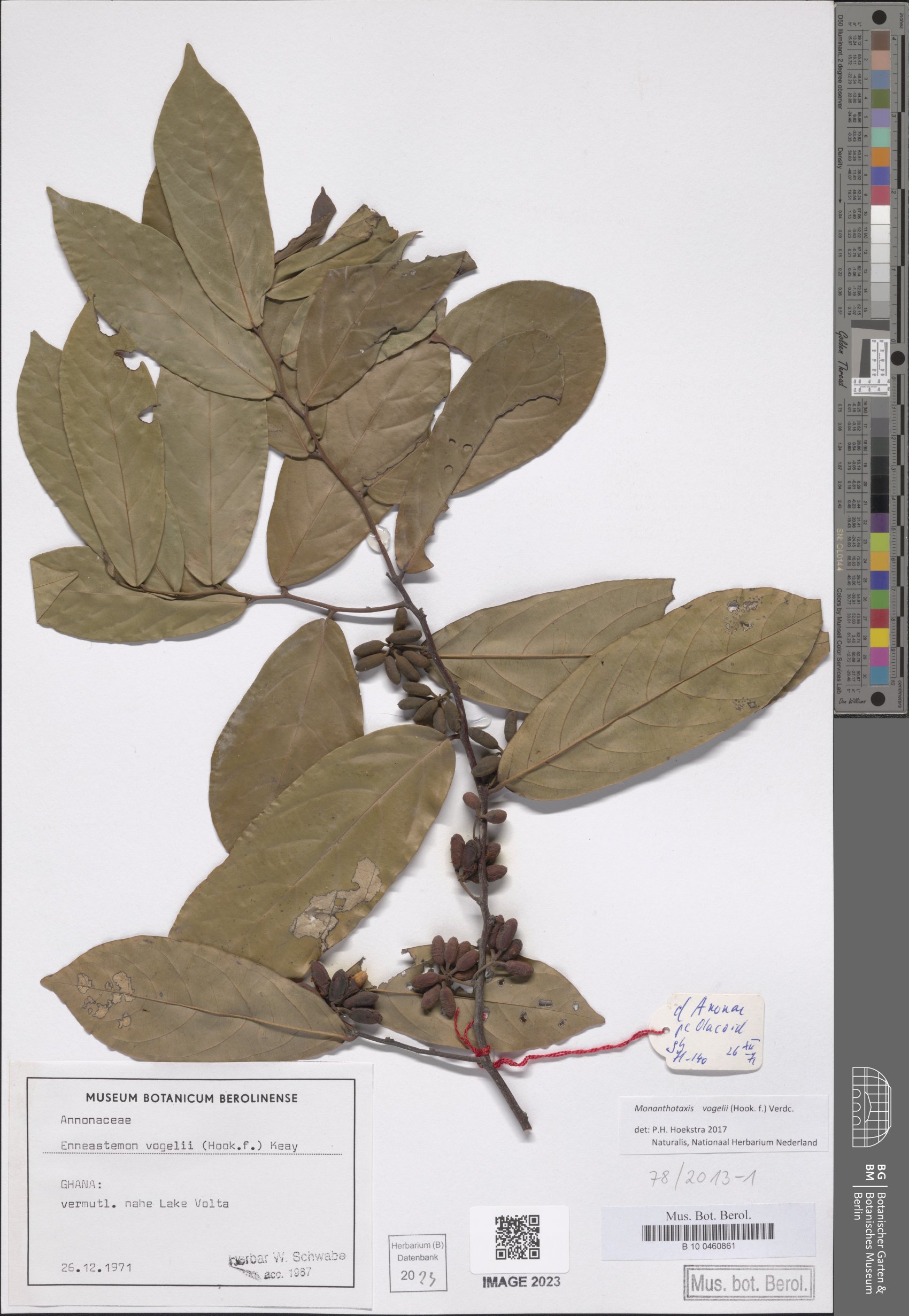
(c) Luis Humberto Vicente-Rivera, some rights reserved (CC BY-NC)
Summary
Source: WikipediaAnnona purpurea is an edible fruit and medicinal plant in the Annonaceae family. It is native to Mexico, Central America, and parts of South America. Its common names include soncoya, sincuya, and cabeza de negro.
Description
A small tree. It can grow 6-7 m high. It has a short trunk 45 cm across. The branches are spreading and have a rusty woolly covering when young. It loses its leaves during the year. The leaves are wavy and narrowly oval. They are 20-30 cm long by 10-14 cm wide. The flowers have a strong scent. The flowers occur singly and are fleshy. They are large and cone shaped. The fruit are large and brown. They are 15-20 cm across. They have sweet aromatic pulp. The flesh is bright orange and soft. There are soft spines on the skin.
Edible Uses
Fruit - raw and also made into juice. The abundant pulp has an agreeable, aromatic flavour. A mango-like flavour. The broadly ovoid fruit turns brown to gray when ripe and is about 15 - 20cm in diameter.
Traditional Uses
The fruit are eaten fresh. They are also used to produce a drink by straining the juice. The flowers and leaves are used in soups.
This uses section is brief — help expand it
Medicinal Uses
The unripe, green fruits are used as a treatment against diarrhoea and dysentery; The juice of the fruit is regarded as a remedy for fever, chills and jaundice. Its use in the treatment of jaundice is most likely to be based on its colour rather than its efficacy. An infusion of the leaves is used as a treatment for pulmonary infections. A decoction of the bark is effective against dysentery and oedema. The inner bark is used. The rootbark is used to treat snakebite.)
Distribution
A tropical and subtropical plant. It can tolerate drought, but does best with lots of moisture. It cannot stand waterlogging. It suits the tropical lowlands.
Where It Grows
Amazon, Asia, Australia, Belize, Central America*, Colombia, Costa Rica, Cuba, Ecuador, El Salvador, Guatemala, Honduras, India, Mexico, Nicaragua, North America, Pacific, Panama, Philippines, North America, Puerto Rico, SE Asia, South America, Trinidad and Tobago, USA, Venezuela, West Indies,
Cultivation
Plants can be grown from seeds.
Propagation
The seed of many species in this genus has a hard seedcoat and may benefit from scarification before sowing in order to speed up germination. This can usually be done by pouring a small amount of nearly boiling water on the seeds (being careful not to cook them!) and then soaking them for 12 - 24 hours in warm water. By this time they should have imbibed moisture and swollen - if they have not, then carefully make a nick in the seedcoat (being careful not to damage the embryo) and soak for a further 12 hours before sowing.
Other Uses
Seed extracts destroy fleas. Extracts of the seeds are poisonous and can be used as an insecticide. Brown and yellow dye;s can be obtained from the bark and roots. An ink can be made from the green fruits. A fibre is obtained from the bark. The plant (it is not clear if this refers to the bark or the unripe fruit) is a source of tannin. The wood is used locally in construction and to make agricultural implements, boxes, cases, fences, posts etc. It can be pulped for making paper.
Other Information
It is also cultivated.
Notes
There are about 100-150 Annona species.
Nutrition
| Part | Moisture | kJ | kcal | Protein | Vit A | Vit C | Iron | Zinc |
|---|---|---|---|---|---|---|---|---|
| Fruit | 85 | 423 | 101 | 0.7 | 360 | 28 | 1 | — |
Synonyms
Also Known As
Chincua, Chincuya, Gallina, Gorda, Ilama, Matimba, Sincuya, Toreta
References (33)
- References Annona purpurea Sesse & Mocino ex Dunal Soncoya
- Ambasta S.P. (Ed.), 2000, The Useful Plants of India. CSIR India. p 43
- Bircher, A. G. & Bircher, W. H., 2000, Encyclopedia of Fruit Trees and Edible Flowering Plants in Egypt and the Subtropics. AUC Press. p 31
- Casas, A., et al, 1996, Plant Management Among the Nahua and the Mixtec in the Balsas River Basin, Mexico: An Ethnobotanical Approach to the Study of Plant Domestication. Human Ecology, Vol. 24, No. 4 pp. 455-478
- Chizmar Fernandez, C., et al, 2009, Plantas comestibles de Centroamerica. Instituto de Biodiversidad, Costa Rica. p 35
Show all 33 references Hide references
- Condit, R., et al, 2011, Trees of Panama and Costa Rica. PrincetonField Guides. p 42
- Coronel, R.E., 1982, Fruit Collections in the Philippines. IBPGR Newsletter p 8
- Darley, J.J., 1993, Know and Enjoy Tropical Fruit. P & S Publishers. p 3
- Etkin, N.L. (Ed.), 1994, Eating on the Wild Side, Univ. of Arizona. p 136
- Facciola, S., 1998, Cornucopia 2: a Source Book of Edible Plants. Kampong Publications, p 12
- Garner, R. J., and Chaudhri, S.A., (Ed.) 1976, The Propagation of Tropical fruit Trees. FAO/CAB. p 223
- Grandtner, M. M. & Chevrette, J., 2013, Dictionary of Trees, Volume 2: South America: Nomenclature, Taxonomy and Ecology. Academic Press p 39
- Hermandez Bermejo, J.E., and Leon, J. (Eds.), 1994, Neglected Crops. 1492 from a different perspective. FAO Plant Production and Protection Series No 26. FAO, Rome. p14
- Hibbert, M., 2002, The Aussie Plant Finder 2002, Florilegium. p 29
- Kiple, K.F. & Ornelas, K.C., (eds), 2000, The Cambridge World History of Food. CUP p 1853
- Kunkel, G. Plants for human consumption
- Lopez-Diago, D. & Garcia, N., 2021, Wild edible fruits of Colombia. Biota ColomBiana 22 (2) p 28
- Martin, F. W., et al, 1987, Perennial Edible Fruits of the Tropics. USDA Handbook 642 p 17 (Also as Annona involucrata)
- Miguel, E., et al, 1989, A checklist of the cultivated plants of Cuba. Kulturpflanze 37. 1989, 211-357
- Monogr. Anonac. 64. 1817
- Morton, J. F., 1987, Fruits of Warm Climates. Wipf & Stock Publishers p 85
- Mutchnick, P. A. and McCarthy, B. C., 1997, An Ethnobotanical Analysis of the Tree Species Common to the Subtropical Moist Forests of the Peten, Guatemala. Economic Botany, Vol. 51, No. 2, pp. 158-183
- Piedra-Malagón, E. M. et al, 2022, Edible native plants of the Gulf of Mexico Province. Biodiversity Data Journal 10: e80565 p 9
- Rivero, J. A., y Brunner, B. R., 2007, Arborels frutales exoticas y poco conocidos en Puerto Rico. Universidad de Puerto Rico. p 31
- Roa, J. A. G. & Boada, D. S. G., 2018, Fundación para el Fortalecimiento de la Fruticultura y Plantas Alimenticias no Convencionales en Colombia.
- Segura, S. et al, 2018, The edible fruit species in Mexico. Genet Resour Crop Evol (2018) 65:1767–1793
- Standley & Steyerm. 1946-1976. Flora of Guatemala.
- Terrell et al. 1986. Agric. Handb. no. 505.
- Torre, de la L., et al, 2008, Enciclopedia de las Plantas Útiles del Ecuador. Herbario QCA. Pontificia Universidad Católica del Ecuador. p 164
- Vazquez-Garcia. V., 2008, Gender, ethnicity, and economic status in plant management: Uncultivated edible plants among the Nahuas and Popolucas of veracruz, Mexico. Agriculture and Human Values 25: 65-77
- Wiersema, J. H. & Leon, B., 2013, World Economic Plants. A Standard Reference CRC Press. 2nd Ed. p 56
- Woodson & Schery, eds. 1943-1980. Flora of Panama.
- World Checklist of Useful Plant Species 2020. Royal Botanic Gardens, Kew