Psidium cattleianum
Sabine
Cherry guava
iNaturalist· cc-by-nc
(c) seeds_of_change_project, some rights reserved (CC BY-NC)
iNaturalist· cc-by-nc
(c) Matt Guilliams, some rights reserved (CC BY-NC)
iNaturalist· cc-by-nc
(c) Matt Guilliams, some rights reserved (CC BY-NC)
Summary
Source: WikipediaAn evergreen shrub reaching 6 m tall. Hardy to UK zone 10, frost tender. Year-round foliage with May flowers. Hermaphrodite. Prefers light sandy and medium loamy soils with good drainage; grows in poor soil. Tolerates mildly acidic, neutral, basic, and very acidic soil pH. Requires full sun; adapts to dry or moist conditions.
Description
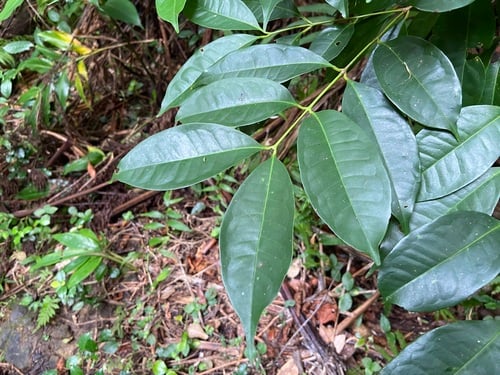
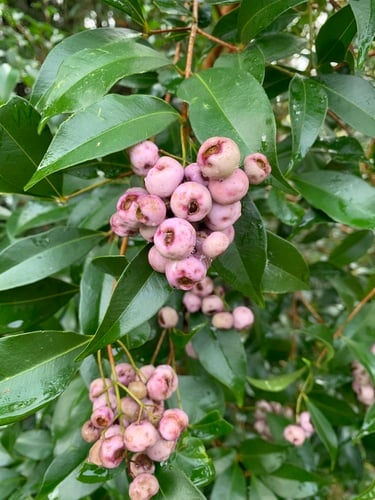
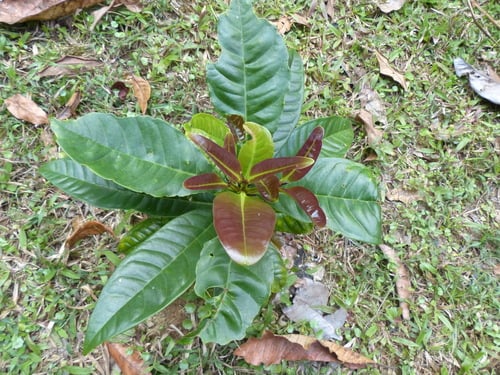
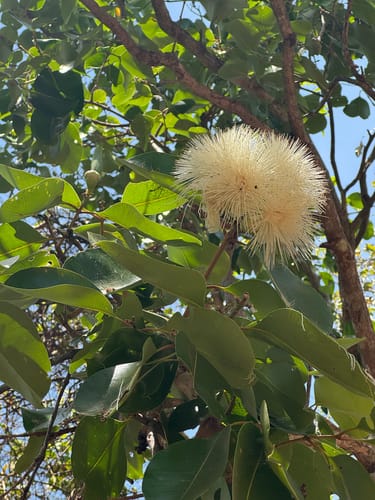
An evergreen shrub. It grows 3-6 m high. The young shoots are rounded. They can be hairy or smooth. The leaf stalk is 4-15 mm long. Leaves are dark green and shiny above and 4-6 cm x 2-3 cm. The edges of the leaves curl backwards. The leaves are wedge shaped at the base. There are several glands under the leaf. Flowers are white and singly in the axils of leaves. The flower stalk is 3-7 mm long. It has small round red or purplish fruit. The flesh is white. There are several hard seeds inside. The seeds are 3 mm long by 2.5 mm wide. The fruit are edible.
Edible Uses
The fruit can be eaten raw or cooked and works well in jellies, jams, custards, and drinks. It has a sweet, aromatic, agreeably acid-sweet flavour — more pronounced than that of yellow strawberry guava, though without the muskiness of common guava. The fruit is about 4cm in diameter. Fruit and processed products are traded locally across the tropics and subtropics, and cultivation can be commercially significant, as demonstrated on Réunion. Trials have also been conducted in Spain. Unlike Psidium guajava, the fruit is not rich in vitamin C, containing only 11–50mg per 100g.
Traditional Uses
Fruit are eaten raw or used in jams and jellies.
This uses section is brief — help expand it
Medicinal Uses
Leaves contain compounds active against antibiotic-resistant strains of Gram-positive bacteria that are significant human pathogens. They contain flavonoids, saponins, tannins, and essential oils, primarily b-caryophyllene. Fruit and leaves are used in traditional medicine to treat haemorrhage, diarrhoea, and colic. The leaves are also a source of essential oils obtained by distillation.
Distribution
A tropical plant. It is native to Brazil. It does quite well in highland areas in the tropics. It grows from sea level to 1,900 m. It is more frost resistant than common guava. It can be grown on a range of soils. It is fairly drought resistant. It suits hardiness zones 8-12. In Hobart Botanical gardens. Melbourne Botanical gardens. In Yunnan.
Where It Grows
Africa, Asia, Australia, Bahamas, Bangladesh, Bermuda, Brazil*, Cameroon, Cape Verde, Central Africa, Central America, China, Colombia, Cook Islands, Costa Rica, Cuba, East Africa, Fiji, Ghana, Guyana, Hawaii, India, Indonesia, Jamaica, Madagascar, Malawi, Malaysia, Marquesas, Mexico, Mozambique, New Caledonia, Norfolk Island, North America, Pacific, Papua New Guinea, PNG, Philippines, Reunion, Samoa, Sao Tome and Principe, SE Asia, Slovenia, South Africa, Southern Africa, South America, Sri Lanka, St Helena, Taiwan, Tanzania, Tasmania, Uruguay, USA, Vanuatu, West Africa, West Indies, Zambia, Zimbabwe,
Cultivation
Plants are grown by seed, suckers or cuttings. It can also be grown by layering. Pruning helps fruit production. It can be pruned to form a hedge. The ripe fruit are harvested and the seed removed and washed in running water then dried in the shade. Seed will remain viable for 4 months. Fresh seed should be planted and they germinate in 20-40 days.
Propagation
Sow seed in spring in a warm greenhouse. Prick out seedlings into individual pots when large enough to handle and grow on in the greenhouse for at least the first winter. If trialling plants outdoors, plant out in summer and provide protection from winter cold for at least the first two winters. Cuttings of half-ripe wood can be taken in July/August in a frame.
Other Uses
Can be grown as a fruiting hedge in warm temperate climates. Cultivated as an ornamental garden or hedge tree throughout the tropics and subtropics, valued for its slow growth, attractive dark glossy foliage, and tasty fruit. Also used as a fuel source, a source of essential oil, and as poultry forage. Suitable as a windbreak.
Production
Plants grow slowly. Fruit are produced after 2 years. Fruit production is seasonal. There are probably two crops per year. Fruit matures in 60-90 days.
Other Information
A cultivated fruit tree. At present not widely grown in Papua New Guinea, but fruit are liked and it will probably get wider acceptance.
Notes
It can become a weed in some places eg Hawaii. There are about 150 Psidium species. It can be invasive.
Nutrition
| Part | Moisture | kJ | kcal | Protein | Vit A | Vit C | Iron | Zinc |
|---|---|---|---|---|---|---|---|---|
| Fruit | 80.7 | 289 | 69 | 0.6 | 9 | 37 | 0.2 | — |
Synonyms
Also Known As
Araca, Araca-amarelo, Araca-vermelho, Bella seebai, Cattley guava, Cheena pera, Goavitsinahy, Guayabita fresa, Jambu stroberi, Konda jamipandu, Malam perakka, Mpera-ngombe, Mpera, Pahadi pijuli, Pahari payara, Pohon jambu stroberi, Porpay, Purple guava, Purple strawberry guava, Quwawa ni vavalagi, Red Strawberry guava, Seemai koyya
References (74)
- Abbiw, D.K., 1990, Useful Plants of Ghana. West African uses of wild and cultivated plants. Intermediate Technology Publications and the Royal Botanic Gardens, Kew. p 42
- Ambasta S.P. (Ed.), 2000, The Useful Plants of India. CSIR India. p 498
- Arora, R. K., 2014, Diversity in Underutilized Plant Species - An Asia-Pacific Perspective. Bioversity International. p 83
- Ashton, M. S., et al 1997, A Field Guide to the Common Trees and Shrubs of Sri Lanka. WHT Publications Ltd. pdf p 295 (As Psidium littorale)
- Barwick, M., 2004, Tropical and Subtropical Trees. A Worldwide Encyclopedic Guide. Thames and Hudson p 348
Show all 74 references Hide references
- Bodkin, F., 1991, Encyclopedia Botanica. Cornstalk publishing, p 845
- Bodkin, F., 1991, Encyclopedia Botanica. Cornstalk publishing, p 845 (As Psidium littorale)
- Bourke, R. M., Altitudinal limits of 230 economic crop species in Papua New Guinea. Terra australis 32.
- Bourret, D., 1981, Bonnes-Plantes de Nouvelle-Caledonie et des Loyaute. ORSTOM. p 40
- Brack, P., et al, 2020, Frutas nativas do Rio Grande do Sul, Brasil: riqueza e potencial alimentício. Native fruits of Rio Grande do Sul, Brazil: richness and potential as food. Rodriguésia 71: e03102018.
- Brazil: Biodiversity for Food and Nutrition. http://www.b4fn.org/countries/brazil/
- Burkill, H. M., 1985, The useful plants of west tropical Africa, Vol. 4. Kew.
- Burkill, I.H., 1966, A Dictionary of the Economic Products of the Malay Peninsula. Ministry of Agriculture and Cooperatives, Kuala Lumpur, Malaysia. Vol 2 (I-Z) p 1846
- Cheifetz, A., (ed), 1999, 500 popular vegetables, herbs, fruits and nuts for Australian Gardeners. Random House p 231
- Cooper W & Cooper W T, 1994, Fruits of the Rain Forest. RD Press p 238
- Cooper, W. and Cooper, W., 2004, Fruits of the Australian Tropical Rainforest. Nokomis Editions, Victoria, Australia. p 351
- Coronel, R.E., 1982, Fruit Collections in the Philippines. IBPGR Newsletter p 8
- Cundall, P., (ed.), 2004, Gardening Australia: flora: the gardener's bible. ABC Books. p 1104
- Duarte, M. C., et al, 2022, Diversity of Useful Plants in Cabo Verde Islands: A Biogeographic and Conservation Perspective. Plants 2022, 11, 1313 p 14
- Facciola, S., 1998, Cornucopia 2: a Source Book of Edible Plants. Kampong Publications, p 159 (As Psidium littorale)
- Fl. Hawaiiensis 273. 1939 (As Psidium cattleianum f. lucidum)
- Flowerdew, B., 2000, Complete Fruit Book. Kyle Cathie Ltd., London. p 154
- French, B.R., 1986, Food Plants of Papua New Guinea, A Compendium. Asia Pacific Science Foundation p 217 (As Psidium littorale)
- Garner, R.J., and Chaudhri, S.A., (Ed.) 1976, The Propagation of Tropical fruit Trees. FAO/CAB. p 531
- Grandtner, M. M. & Chevrette, J., 2013, Dictionary of Trees, Volume 2: South America: Nomenclature, Taxonomy and Ecology. Academic Press p 545
- Hedrick, U.P., 1919, (Ed.), Sturtevant's edible plants of the world. p 531
- Hermandez Bermejo, J.E., and Leon, J. (Eds.), 1994, Neglected Crops. 1492 from a different perspective. FAO Plant Production and Protection Series No 26. FAO, Rome. p16
- Hibbert, M., 2002, The Aussie Plant Finder 2002, Florilegium. p 242
- http://www.botanic-gardens-ljubljana.com/en/plants
- Hu, Shiu-ying, 2005, Food Plants of China. The Chinese University Press. p 578 (As Psidium littorale)
- Hunter, D., et al, 2019, The potential of neglected and underutilized species for improving diets and nutrition. Planta (2019) 250:709-729
- Jardin, C., 1970, List of Foods Used In Africa, FAO Nutrition Information Document Series No 2.p 156
- John, L., & Stevenson, V., 1979, The Complete Book of Fruit. Angus & Robertson p 151
- Kermath, B. M., et al, 2014, Food Plants in the Americas: A survey of the domesticated, cultivated and wild plants used for Human food in North, Central and South America and the Caribbean. On line draft. p 722 (As Psidium humile)
- Kinupp, V. F., 2007, Plantas alimenticias nao-convencionais da regiao metropolitana de Porto Alegre, RS, Brazil p 87
- Kinupp, V. F. & Bergman, I., 2008, Protein and minerals of native species, potential vegetables and fruits. Cienc.Tecnol. Aliment. Vol. 28 No. 4 Campinas Oct/Dec.
- Kiple, K.F. & Ornelas, K.C., (eds), 2000, The Cambridge World History of Food. CUP p 1859
- Lazarides, M. & Hince, B., 1993, Handbook of Economic Plants of Australia, CSIRO. p 200
- Leal, M. L. et al, 2018, Knowledge, use, and disuse of unconventional food plants. Journal of Ethnobiology and Ethnomedicine (2018) 14:6
- Lord, E.E., & Willis, J.H., 1999, Shrubs and Trees for Australian gardens. Lothian. p 254 (As Psidium littorale)
- Llamas, K.A., 2003, Tropical Flowering Plants. Timber Press. p 289
- Lorenzi, H., 2002, Brazilian Trees. A Guide to the Identification and Cultivation of Brazilian Native Trees. Vol. 01 Nova Odessa, SP, Instituto Plantarum p 284
- Lorenzi, H., Bacher, L., Lacerda, M. & Sartori, S., 2006, Brazilian Fruits & Cultivated Exotics. Sao Paulo, Instituto Plantarum de Estuados da Flora Ltda. p 236
- Marinelli, J. (Ed), 2004, Plant. DK. p 466
- Martin, F. W., et al, 1987, Perennial Edible Fruits of the Tropics. USDA Handbook 642 p 42
- Martin, F.W., C.W. Campbell and R.M. Ruberté, 1987, Perennial edible fruits of the tropics - An inventory. United States Department of Agriculture, Agricultural Research Service, Agriculture Handbook No. 642. Washington, D.C., USA. (As Psidium humile)
- Miguel, E., et al, 1989, A checklist of the cultivated plants of Cuba. Kulturpflanze 37. 1989, 211-357 (As Psidium littorale)
- Morton, Julia F., 1987, Fruits of Warm Climates. Creative Resources Systems, Inc. . p. 363
- NYBG Herbarium "edible"
- Palgrave, K.C., 1996, Trees of Southern Africa. Struik Publishers. p 688
- Parham, B. E. V., 1972, Plants of Samoa. New Zealand Department of Scientific and Industrial Research. Information Series. No. 85 p 46 (As Psidium littorale)
- Pasha, M. K. & Uddin, S. B., 2019, Minor Edible Fruits of Bangladesh. Bangladesh J. Plant Taxon. 26(2): 299–313 (As Psidium chinense)
- Peekel, P.G., 1984, (Translation E.E.Henty), Flora of the Bismarck Archipelago for Naturalists, Division of Botany, Lae, PNG. p 408, 406 (As Psidium littorale)
- Plants for a Future database, The Field, Penpol, Lostwithiel, Cornwall, PL22 0NG, UK. http://www.scs.leeds.ac.uk/pfaf/
- PROSEA No. 2
- Purseglove, J.W., 1968, Tropical Crops Dicotyledons, Longmans. p 414
- Recher, P, 2001, Fruit Spirit Botanical Gardens Plant Index. www.nrg.com.au/~recher/ seedlist.html p 3
- Reis, S. V. and Lipp, F. L., 1982, New Plant Sources for Drugs and Foods from the New York Botanical Garden herbarium. Harvard. p 207 (As Psidium littorale)
- Roa, J. A. G. & Boada, D. S. G., 2018, Fundación para el Fortalecimiento de la Fruticultura y Plantas Alimenticias no Convencionales en Colombia.
- Schatz, G.E., 2001, Generic Tree Flora of Madagascar. Royal Botanical Gardens, Kew and Missouri Botanical Garden. p 289
- Staples, G.W. and Herbst, D.R., 2005, A tropical Garden Flora. Bishop Museum Press, Honolulu, Hawaii. p 428
- Styger, E., et al, 1999, Indigenous fruit trees of Madagascar: potential components of agroforestry systems to improve human nutrition and restore biological diversity. Agroforestry Systems 46: 289-310
- Sukarya, D. G., (Ed.) 2013, 3,500 Plant Species of the Botanic Gardens of Indonesia. LIPI p 476, 692
- Trans. Hort. Soc. London 4:317, t. 11. 1821 May-Jun
- USDA, ARS, National Genetic Resources Program. Germplasm Resources Information Network - (GRIN). [Online Database] National Germplasm Resources Laboratory, Beltsville, Maryland. Available: www.ars-grin.gov/cgi-bin/npgs/html/econ.pl (10 April 2000)
- van Wyk, B., 2005, Food Plants of the World. An illustrated guide. Timber press. p 313 (As Psidium littorale) and (As Psidium cattleianum f. lucidum)
- van Wyk, Be., & Gericke, N., 2007, People's plants. A Guide to Useful Plants of Southern Africa. Briza. p 58
- Vignale, B., et al, 2016, Selección de frutales nativos en Uruguay. 19 Horticultura Argentina 35 (87): May.-Ago. 2016
- Vivien, J., & Faure, J.J., 1996, Fruitiers Sauvages d'Afrique. Especes du Cameroun. CTA p 237
- Walter, A. & Lebot, V., 2007, Gardens of Oceania. ACIAR Monograph No. 122. p 175
- White, F., Dowsett-Lemaire, F. and Chapman, J. D., 2001, Evergreen Forest Flora of Malawi. Kew. p 410
- Wiersema, J. H. & Leon, B., 2013, World Economic Plants. A Standard Reference CRC Press. 2nd Ed. p 568
- World Checklist of Useful Plant Species 2020. Royal Botanic Gardens, Kew
- www.colecionandofrutas.org