Aniseia martinicensis
(Jacq.) Choisy
Ulan puteh
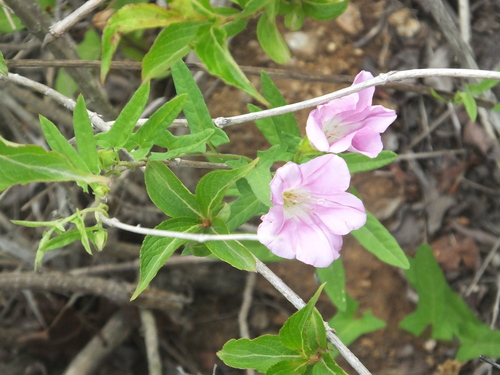
iNaturalist· cc-by-nc
(c) JaguarGozandoSelva, some rights reserved (CC BY-NC), uploaded by JaguarGozandoSelva
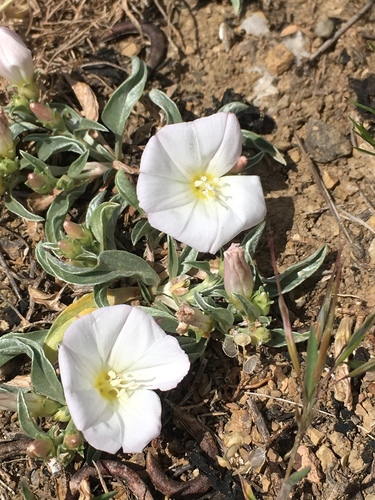
iNaturalist· cc-by-nc
(c) JaguarGozandoSelva, some rights reserved (CC BY-NC), uploaded by JaguarGozandoSelva
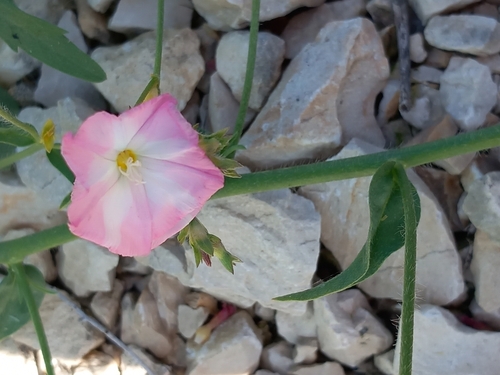
iNaturalist· cc-by-nc
(c) Hervé GALLIFFET, some rights reserved (CC BY-NC), uploaded by Hervé GALLIFFET
Summary
Source: WikipediaAniseia martinicensis is a species of herb climber in the Convolvulaceae family. Native to subtropical and tropical America, it has been introduced to the tropics and sub-tropics of the Pacific Islands, Australia, Asia, and Africa. It is usually eaten as a supplementary vegetable. Even though it grows around the world, in a variety of habitats, it is a rare plant.
Description
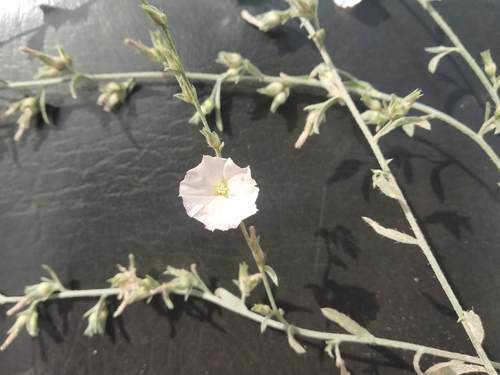
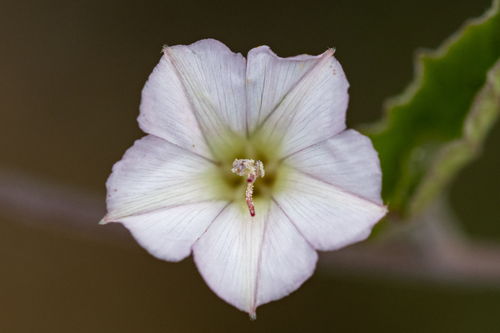
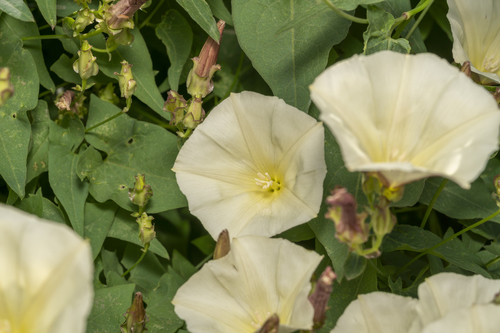
A small climber which is woody at the base. It is slender. It grows 1.5 m tall. It can grow from seed each year or keep growing from year to year. The leaf blades are narrowly sword shaped. They are 4-8 cm long by 2 cm wide. The flowers are white and bell shaped. The fruit is oval and 1.5-2 cm long. It has a large calyx around it. The seeds are 4-6 mm across.
Edible Uses
The leaves are used as a vegetable. The whole plant is eaten during times of food shortage.
Traditional Uses
The whole plant is eaten in times of food shortage. The leaves are used as a vegetable.
This uses section is brief — help expand it
Medicinal Uses
The leaves of the species are sometimes gathered as a vegetable, particularly in Indonesia and Malaysia. The seeds are used in a traditional medicine system. In Cambodia, during the famine years of the Khmer Rouge, the whole plant, stem included, was cooked and eaten. It is still used as supplementary vegetable (when diversity of food is desired) in the 'flooded village' (of Stilt houses) of Peam Ta Our, in the Tonle Sap floodplain, Puok District, Siem Reap province, it is eaten raw or cooked in soups.
Distribution
A tropical plant. It can be in swamps or open forests. It grows near sea level. It is mostly near the coast.
Where It Grows
Africa, Asia, Australia, Cambodia, Central Africa, Central African Republic, CAR, Central America*, Congo DR, Dominican Republic, East Africa, Fiji, Gabon, Guiana, Guianas, Guinea, Guinée, Guinea-Bissau, Guyana, Haiti, India, Indochina, Indonesia, Laos, Malaysia, Martinique, Mexico, Mozambique, Myanmar, North America, Pacific, Puerto Rico, SE Asia, Sierra Leone, South America, Suriname, Tonga, Venezuela, West Africa, West Indies*,
Other Information
It is a famine food.
Notes
There are 5 Aniseia species.
Synonyms
Also Known As
Anndat trakuet, Lidah patong, Lotombo, Venthiruthali, Vor andatt trokourt
References (16)
- Ambasta S.P. (Ed.), 2000, The Useful Plants of India. CSIR India. p 42
- Austin, D. F., 1999, The genus Aniseia (Convolvulaceae). Syst. Bot.23:411-420
- Bircher, A. G. & Bircher, W. H., 2000, Encyclopedia of Fruit Trees and Edible Flowering Plants in Egypt and the Subtropics. AUC Press. p 28
- Burkill, I.H., 1966, A Dictionary of the Economic Products of the Malay Peninsula. Ministry of Agriculture and Cooperatives, Kuala Lumpur, Malaysia. Vol 1 (A-H) p 161
- Cengel, D. J. & Dany, C., (Eds), 2016, Integrating Forest Biodiversity Resource Management and Sustainable Community Livelihood Development in the Preah Vihear Protected Forest. International Tropical Timber Organization p 123
Show all 16 references Hide references
- Liengola, I. B., 2001, A contribution to the study of native edible plants by the Turumbu and Lokele of the Tshopo District, Province Orientale, D. R. Congo. Syst. Geogr. Pl. 71:687-698
- Martin, F.W. & Ruberte, R.M., 1979, Edible Leaves of the Tropics. Antillian College Press, Mayaguez, Puerto Rico. p 186
- Martin, F.W. & Ruberte, R.M., 1979, Edible Leaves of the Tropics. Antillian College Press, Mayaguez, Puerto Rico. p 187 (As Ipomoea uniflora)
- Mem. Soc. Phys. Geneve 8:144. 1837 (Convolv. diss. sec.)
- Plants of Haiti Smithsonian Institute http://botany.si.edu/antilles/West Indies (As var. ambigua)
- Romanowski, N., 2007, Edible Water Gardens. Hyland House. p 103
- Singh, H.B., Arora R.K.,1978, Wild edible Plants of India. Indian Council of Agricultural Research, New Delhi. p 27 (As Ipomoea uniflora)
- Smith, A.C., 1991, Flora Vitiensis Nova, Lawaii, Kuai, Hawaii, Volume 5 p 43
- Swapna, M. M. et al, 2011, A review on the medicinal and edible aspects of aquatic and wetland plants of India. J. Med. Plants Res. 5 (33) pp. 7163-7176
- Terra, G.J.A., 1973, Tropical Vegetables. Communication 54e Royal Tropical Institute, Amsterdam, p 54 (As Ipomoea uniflora)
- World Checklist of Useful Plant Species 2020. Royal Botanic Gardens, Kew