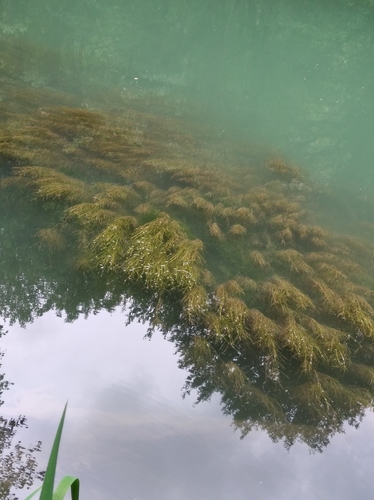
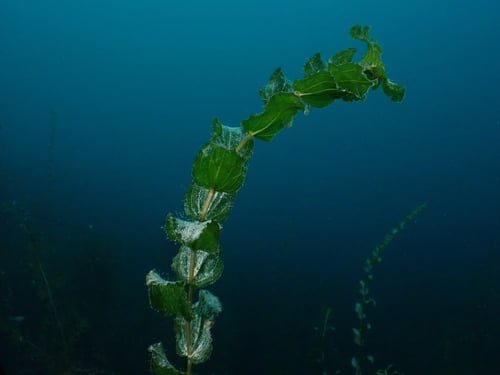
Potamogeton crispus
L.
Curly Pondweed
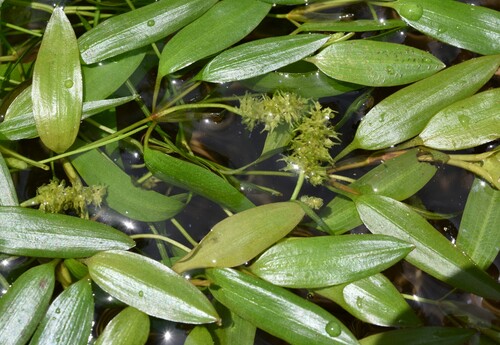
iNaturalist· cc-by
(c) gwynmwilliams, some rights reserved (CC BY), uploaded by gwynmwilliams
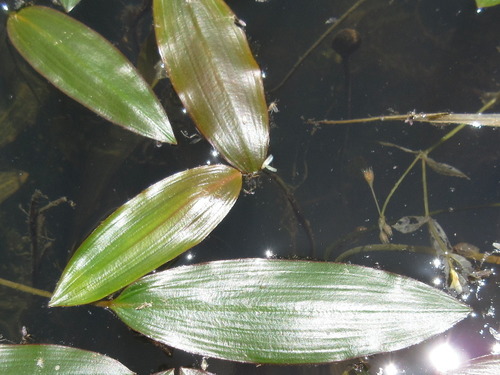
iNaturalist· cc-by-nc
(c) Susan Elliott, some rights reserved (CC BY-NC), uploaded by Susan Elliott
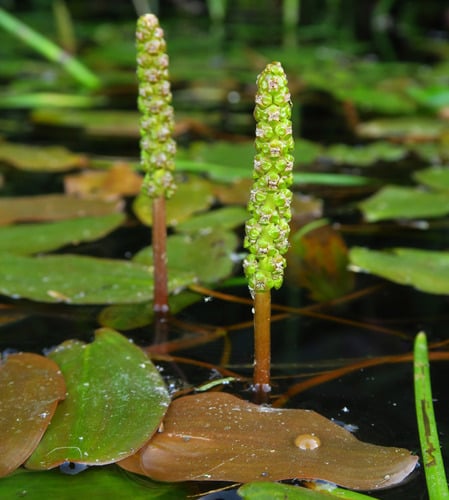
iNaturalist· cc-by-nc
(c) Chuangzao, some rights reserved (CC BY-NC), uploaded by Chuangzao
Summary
Source: WikipediaPotamogeton crispus, the crisp-leaved pondweed, curly pondweed, curly-leaf pondweed or curled pondweed, is a species of aquatic plant (hydrophyte) native to Eurasia but an introduced species and often a noxious weed in North America.
Description
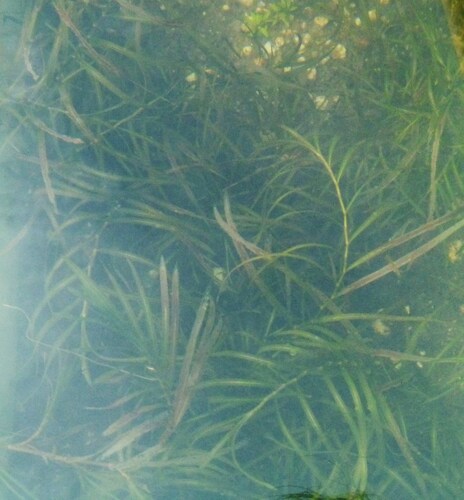
A herb which grows under water. It extends about 2-8 m across. It has underground stems or rhizomes. There are also trailing stems which are flattened and 4 m long. The leaves are alternate. The leaves are 2.5-10 cm long by 0.5-1.5 cm wide. They are narrowly oblong. They do not have a stalk. They are thin and deep green. The edges have fine teeth and are wavy. The flower spikes are 0.8-2 cm long.
Edible Uses
Young leaves are edible when cooked. The root is also edible, though no further preparation details are recorded.
Traditional Uses
The leaves and roots are cooked and eaten.
This uses section is brief — help expand it
Medicinal Uses
None known.
Distribution
It grows in tropical and warm temperate regions. It grows in ponds and dams and slow flowing waterways. It grows in wetlands. It can tolerate very low salinity. It grows best in water more than 50 cm deep. It tolerates cold water. It grows best when water temperatures are above 15°C. In Sichuan and Yunnan.
Where It Grows
Afghanistan, Africa, America, Asia, Australia, Bangladesh, Bhutan, Botswana, Britain, Cambodia, Central Asia, China, Eswatini, Europe, Fiji, Georgia, Himalayas, India, Indochina, Indonesia, Japan, Kazakhstan, Korea, Kyrgyzstan, Laos, Luxembourg, Mexico, Mongolia, Myanmar, Nepal, New Zealand, North America, Pacific, Pakistan, Russia, SE Asia, South Africa, South America, Southern Africa, Swaziland, Taiwan, Tajikistan, Tasmania, Thailand, Tibet, Turkmenistan, USA, Uzbekistan, Vietnam,
Cultivation
A submerged aquatic plant that can be used as an oxygenator of ponds. It is best given a loam based medium in full sun. It prefers alkaline water. Prefers cool water. A fast growing plant in need of constant checking to make sure it does not overrun the pond. Hybridizes freely with other members of this genus, the resulting progeny is usually sterile.
Propagation
No specific information is available for this species, but the recommended approach is to sow seed in a pot standing in its own depth of water in a greenhouse as soon as ripe, since stored seed is likely to lose viability quickly. Prick out seedlings when large enough to handle and gradually increase the water depth around the pot until plants are covered by a few centimetres. Grow on in a sunny greenhouse position through the first winter, continuing to increase water depth as plants develop. Plant out into permanent positions in early summer. Alternatively, divide plants in spring or take cuttings of erect shoots during the growing season.
Other Uses
None known.
Notes
There are about 100 Potamogeton species.
Synonyms
References (23)
- Altschul, S.V.R., 1973, Drugs and Foods from Little-known Plants. Notes in Harvard University Herbaria. Harvard Univ. Press. Massachusetts. no. 5
- Ambasta, S.P. (Ed.), 2000, The Useful Plants of India. CSIR India. p 486
- Bodkin, F., 1991, Encyclopedia Botanica. Cornstalk publishing, p 825
- Brickell, C. (Ed.), 1999, The Royal Horticultural Society A-Z Encyclopedia of Garden Plants. Convent Garden Books. p 823
- Elliot, W.R., & Jones, D.L., 1997, Encyclopedia of Australian Plants suitable for cultivation. Vol 7. Lothian. p 446 (Drawing)
Show all 23 references Hide references
- Flora of Pakistan. www.eFloras.org
- Hussey, B.M.J., Keighery, G.J., Cousens, R.D., Dodd, J., Lloyd, S.G., 1997, Western Weeds. A guide to the weeds of Western Australia. Plant Protection Society of Western Australia. p 74
- Lazarides, M. & Hince, B., 1993, Handbook of Economic Plants of Australia, CSIRO. p 197
- Lim, T. K., 2015, Edible Medicinal and Non Medicinal Plants. Volume 9, Modified Stems, Roots, Bulbs. Springer p 68
- Paczkowska, G. & Chapman, A.R., 2000, The Western Australian Flora. A Descriptive Catalogue. Western Australian Herbarium. p 123
- Plants for a Future database, The Field, Penpol, Lostwithiel, Cornwall, PL22 0NG, UK. http://www.scs.leeds.ac.uk/pfaf/
- READ,
- Romanowski, N., 2007, Edible Water Gardens. Hyland House. p 113
- Sainty, G.R. & Jacobs, S.W.L., 1981, Waterplants of New South Wales. Water Resources Commission. NSW p 369
- Slocum, P.D. & Robinson, P., 1999, Water Gardening. Water Lilies and Lotuses. Timber Press. p 85
- Smith, A.C., 1979, Flora Vitiensis Nova, Lawaii, Kuai, Hawaii, Volume 1 p 130
- Sp. pl. 1:126. 1753
- Stephens, K.M., & Dowling, R.M., 2002, Wetland Plants of Queensland. A field guide. CSIRO p 79
- Swaziland's Flora Database http://www.sntc.org.sz/flora
- Tasmanian Herbarium Vascular Plants list p 91
- Urgamal, M., et al, 2014, Conspectus of the Vascular Plants of Mongolia. Mongolia Academy of Sciences Institute of Botany and National University of Mongolia Department of Biology. p 39
- Wheeler, J.R.(ed.), 1992, Flora of the Kimberley Region. CALM, Western Australian Herbarium, p 974
- Zhang, Y., et al, 2014, Diversity of wetland plants used traditionally in China: a literature review. Journal of Ethnobiology and Ethnomedicine. 10:72